Saffron Supplements: What Human Studies Actually Show
Studies of saffron for mood, hot flashes, and cognition offer some promising findings, but the preparation and people studied matter.
Human trials have tested saffron supplementation, saffron extract capsules, saffron stigma, and the saffron component crocin for different conditions. The strongest group of studies here concerns depressive symptoms; one small trial also found less hot-flash interference in postmenopausal women. None shows that saffron in food has the same effects, and these studies don’t establish supplement safety during pregnancy or breastfeeding. 2 4 5 6
Start with the form, not the word “saffron”
Saffron is the dried stigma of Crocus sativus. But a bottle labeled “saffron” might contain an extract or an isolated component such as crocin. Human studies have tested these as distinct preparations: one Alzheimer’s trial used saffron extract capsules, a postmenopausal trial studied saffron stigma, and an obsessive-compulsive disorder trial used crocin capsules. Their results can’t simply be transferred from one preparation to another. Nor do these trials tell us what, if anything, a pinch of saffron in a meal would do. 2 4 6
If you’re considering a product for a particular concern, read its ingredient description before looking at a benefit claim. The useful comparison is not just “saffron versus no saffron.” It’s this preparation, studied for this outcome, in people like me.
Mood: encouraging findings with limits
Depressive symptoms have the most developed evidence among these uses. A 2013 meta-analysis brought together five randomized trials in adults with major depressive disorder. Across two placebo-controlled trials, saffron supplementation reduced depressive symptoms more than placebo. Across three trials comparing it with antidepressants, the review found no statistically significant difference between groups. The authors still called for larger studies and longer follow-up before firm conclusions about effectiveness and safety. A finding of “no significant difference” does not, by itself, prove that saffron and an antidepressant are interchangeable. 5
One additional six-week trial enrolled 40 people with mild to moderate depression after a coronary artery procedure. Depression scores improved without a statistically significant difference between the saffron-capsule and fluoxetine groups. That describes a small, specific group over a short period, not a reason to replace an effective prescribed treatment. 3
What the postmenopausal study measured
In one six-week placebo-controlled trial, 60 postmenopausal women with hot flashes were assigned saffron stigma or placebo; 56 completed the study. The researchers reported improvements in both depression scores and hot-flash interference, a measure of how much hot flashes disrupt daily life. This is a relevant finding if you’re asking about hot flashes alongside depressive symptoms, but one short trial doesn’t establish saffron as a treatment for hot flashes on their own. It also says nothing about menstrual symptoms or symptoms during pregnancy or postpartum. 4
The depression meta-analysis reports results for adults, not a women-specific effect. The trial after a coronary procedure likewise does not report a women-specific result in its abstract. The postmenopausal trial offers a direct finding in women, but its participants and outcomes are more specific than a general claim that saffron “helps women’s hormones.” 3 4 5
Cognition: two different conditions, two limited answers
A one-year trial in mild cognitive impairment compared 17 people taking saffron with 18 on a waiting list. Cognitive screening scores improved in the saffron group and worsened in the waiting-list group. The small size and waiting-list comparison make this an early finding, not proof that a supplement prevents dementia. 1
A different one-year trial assigned 68 people with moderate to severe Alzheimer’s disease to saffron extract capsules or memantine. It found no statistically significant difference between groups on the reported cognitive and functional measures. Without a placebo group, that result cannot establish how much benefit saffron provided, and it does not show that the treatments can be substituted for each other. 2
There are also studies of other outcomes, but the ingredient matters. For example, an eight-week trial in 50 adults with obsessive-compulsive disorder compared crocin capsules, not saffron stigma or saffron extract, with fluoxetine. It found no significant difference in symptom-score changes between groups. That finding is too narrow to support a broad claim about saffron supplements for mental health. 6
Safety questions worth settling before you buy
In the postmenopausal trial, the frequency of reported adverse events did not differ significantly from placebo over six weeks. The Alzheimer’s trial likewise found no significant difference in adverse-event frequency between saffron extract and memantine over a year. These observations are useful, but neither establishes safety for every product or every person. 2 4
In particular, these studies don’t establish whether concentrated saffron supplements are safe during pregnancy or breastfeeding, or whether a specific product interacts with your medicines. That’s a gap in what these findings answer, not proof of harm or reassurance of safety. If either situation applies to you, bring the actual product label to a pharmacist or clinician so the question is about what you’d take, rather than saffron in general.
The most practical takeaway: match a product’s stated preparation to the preparation studied, then check whether that study measured the outcome you care about. A result for depression, hot-flash interference, or a cognitive condition doesn’t automatically carry over to another use.
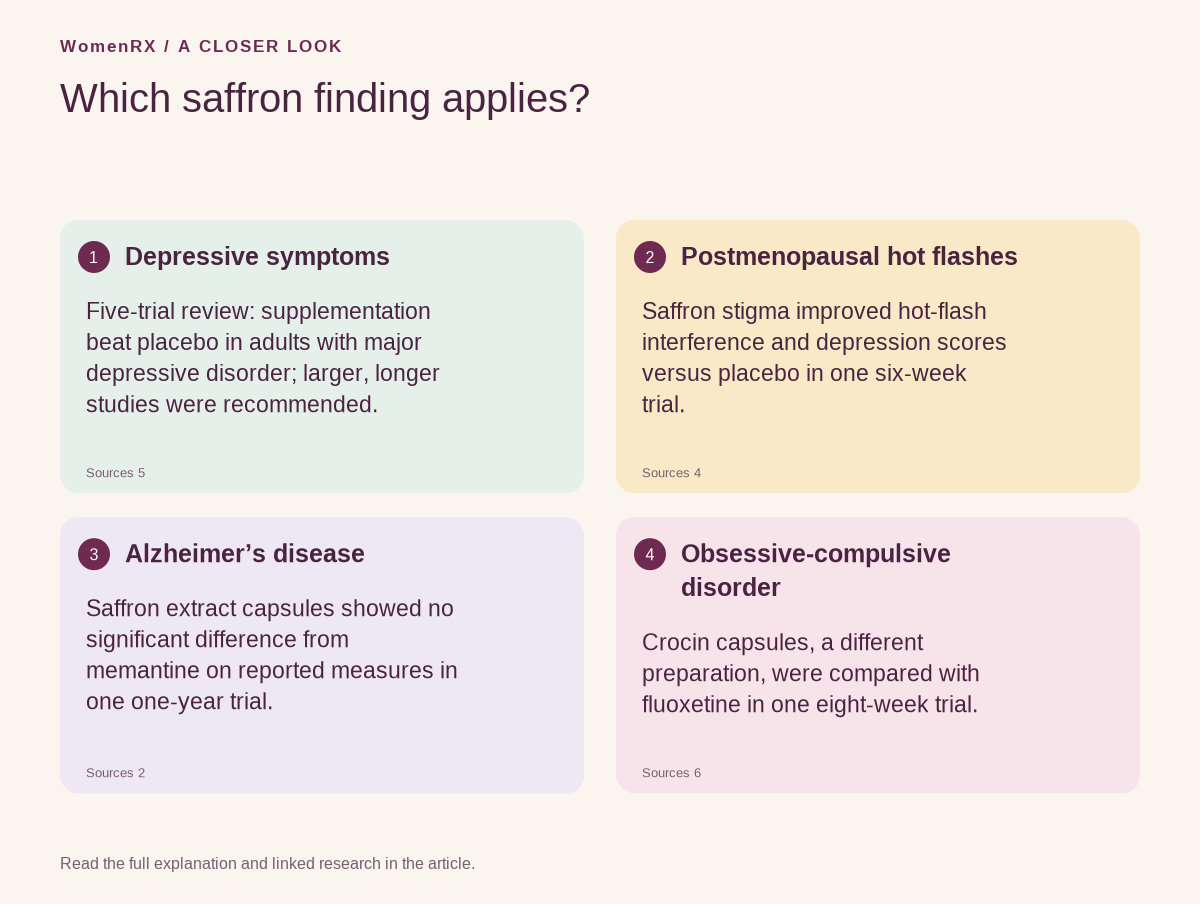
Which saffron finding applies?
Depressive symptoms: Five-trial review: supplementation beat placebo in adults with major depressive disorder; larger, longer studies were recommended.5
Postmenopausal hot flashes: Saffron stigma improved hot-flash interference and depression scores versus placebo in one six-week trial.4
Alzheimer’s disease: Saffron extract capsules showed no significant difference from memantine on reported measures in one one-year trial.2
Obsessive-compulsive disorder: Crocin capsules, a different preparation, were compared with fluoxetine in one eight-week trial.6
Read the figure as text
Read each result alongside the preparation, condition, and study group it came from.- Depressive symptoms: Five-trial review: supplementation beat placebo in adults with major depressive disorder; larger, longer studies were recommended.5
- Postmenopausal hot flashes: Saffron stigma improved hot-flash interference and depression scores versus placebo in one six-week trial.4
- Alzheimer’s disease: Saffron extract capsules showed no significant difference from memantine on reported measures in one one-year trial.2
- Obsessive-compulsive disorder: Crocin capsules, a different preparation, were compared with fluoxetine in one eight-week trial.6
Sources you can check
- Efficacy and Safety of Crocus sativus L. in Patients with Mild Cognitive Impairment: One Year Single-Blind Randomized, with Parallel Groups, Clinical Trial.Tsolaki M, Karathanasi E, Lazarou I, Dovas K, Verykouki E, Karacostas A, Georgiadis K, Tsolaki A, Adam K, Kompatsiaris I, Sinakos Z. · Journal of Alzheimer's disease : JAD · 2016Return to first citation
- Comparing the efficacy and safety of Crocus sativus L. with memantine in patients with moderate to severe Alzheimer's disease: a double-blind randomized clinical trial.Farokhnia M, Shafiee Sabet M, Iranpour N, Gougol A, Yekehtaz H, Alimardani R, Farsad F, Kamalipour M, Akhondzadeh S. · Human psychopharmacology · 2014Return to first citation
- A randomized, double-blind, clinical trial comparing the efficacy and safety of Crocus sativus L. with fluoxetine for improving mild to moderate depression in post percutaneous coronary intervention patients.Shahmansouri N, Farokhnia M, Abbasi SH, Kassaian SE, Noorbala Tafti AA, Gougol A, Yekehtaz H, Forghani S, Mahmoodian M, Saroukhani S, Arjmandi-Beglar A, Akhondzadeh S. · Journal of affective disorders · 2014Return to first citation
- Efficacy of Crocus sativus (saffron) in treatment of major depressive disorder associated with post-menopausal hot flashes: a double-blind, randomized, placebo-controlled trial.Kashani L, Esalatmanesh S, Eftekhari F, Salimi S, Foroughifar T, Etesam F, Safiaghdam H, Moazen-Zadeh E, Akhondzadeh S. · Archives of gynecology and obstetrics · 2018Return to first citation
- Saffron (Crocus sativus L.) and major depressive disorder: a meta-analysis of randomized clinical trials.Hausenblas HA, Saha D, Dubyak PJ, Anton SD. · Journal of integrative medicine · 2013Return to first citation
- Effect of crocin versus fluoxetine in treatment of mild to moderate obsessive-compulsive disorder: A double blind randomized clinical trial.Kazemi F, Vosough I, Sepahi S, Mohajeri SA. · Human psychopharmacology · 2021Return to first citation