Prebiotics: How to Choose a Food-First Approach
Some fibers can act as prebiotics, but a fiber label alone doesn’t promise a specific microbiome or health benefit.
If you want more everyday dietary fiber, foods such as whole grains, fruits, and vegetables are a straightforward start. A prebiotic is more specific: it’s an ingredient used selectively by gut microbes in a way linked to a health benefit. Probiotics are a distinct approach, discussed in research in terms of strains rather than prebiotic ingredients. Inulin, FOS, and GOS are prebiotic terms you may see on labels, but no label guarantees how you’ll respond. 12
Fiber, prebiotics, and probiotics aren’t interchangeable
Dietary fiber is a broad category of plant carbohydrate. It’s found in foods such as whole grains, fruits, and vegetables, and it can support digestion and help prevent constipation. Prebiotic describes a function, not a category contained entirely within dietary fiber: the scientific definition describes an ingredient that is selectively fermented and causes specific changes in gut microbes that benefit the person. Some fibers are prebiotics, but a product listing “fiber” doesn’t automatically show that its fiber has a demonstrated prebiotic effect. 12
Probiotics are a different approach, discussed in research in terms of strains. Inulin on a label identifies a prebiotic ingredient, not a probiotic strain. Neither label establishes that the product will help with your particular goal, or that a product combining both is right for everyone. 2
What to look for on a label
Inulin, fructooligosaccharides (FOS), and galactooligosaccharides (GOS) are names associated with prebiotic ingredients. Seeing one of these names can help you understand what a product contains. It doesn’t, by itself, tell you whether the product will help with a particular goal or how you’ll tolerate it. Research findings vary with factors such as a person’s health, usual diet, and the specific ingredient or intervention. 2
If your goal is simply to eat more fiber, a food-first approach can mean adding fiber-containing plant foods such as whole grains, fruits, and vegetables. Those are useful fiber sources, but that doesn’t make every fiber-rich food a proven treatment or establish that it has a prebiotic effect. 12
Set expectations for benefits
Gut microbes can ferment some ingredients, and that process can affect microbial activity and the production of short-chain fatty acids. That mechanism is a reason for research interest, not proof that a prebiotic product will deliver a broad health benefit. A narrative review describes effects as context-dependent and calls for better-controlled studies to clarify which ingredients help which populations and outcomes. 2
Women aren’t one uniform group when it comes to this decision. Health status and usual diet may influence responses, and the general evidence described here doesn’t report outcomes separately for women. 2 A review focused on pregnancies affected by maternal obesity reports inconsistent results for prebiotics and probiotics; it doesn’t establish the benefit or safety of a particular prebiotic supplement during pregnancy. 3
If you’re pregnant or breastfeeding and considering a product, the distinction is between eating familiar fiber-containing foods and choosing a supplement with its own ingredients and amounts. Check the full ingredient list rather than assuming a “prebiotic” label establishes suitability. Independent quality testing can help verify what’s on a supplement label, but it doesn’t establish that the product is safe for you or your baby. The pregnancy findings above don’t answer the breastfeeding question, so ask your pregnancy or postpartum care team or a pharmacist about the specific product before using it. 34
Make a change your gut can handle
If you’re increasing dietary fiber, go gradually. Increasing dietary fiber too quickly can lead to gas, bloating, and cramps. 1 If you already live with a digestive condition or troublesome bloating, that tolerability issue matters more than a general promise of “gut health.” Research on prebiotics doesn’t establish that a particular product is suitable for your condition; get advice about the specific ingredient before trying to address symptoms with it. 12
A practical way to choose is to ask: Am I looking for more general dietary fiber, or am I specifically interested in a named prebiotic ingredient? For the first goal, fiber-containing foods are a simple starting point. For the second, check which ingredient is actually listed and keep expectations focused: the label identifies an ingredient, not a guaranteed result. 12
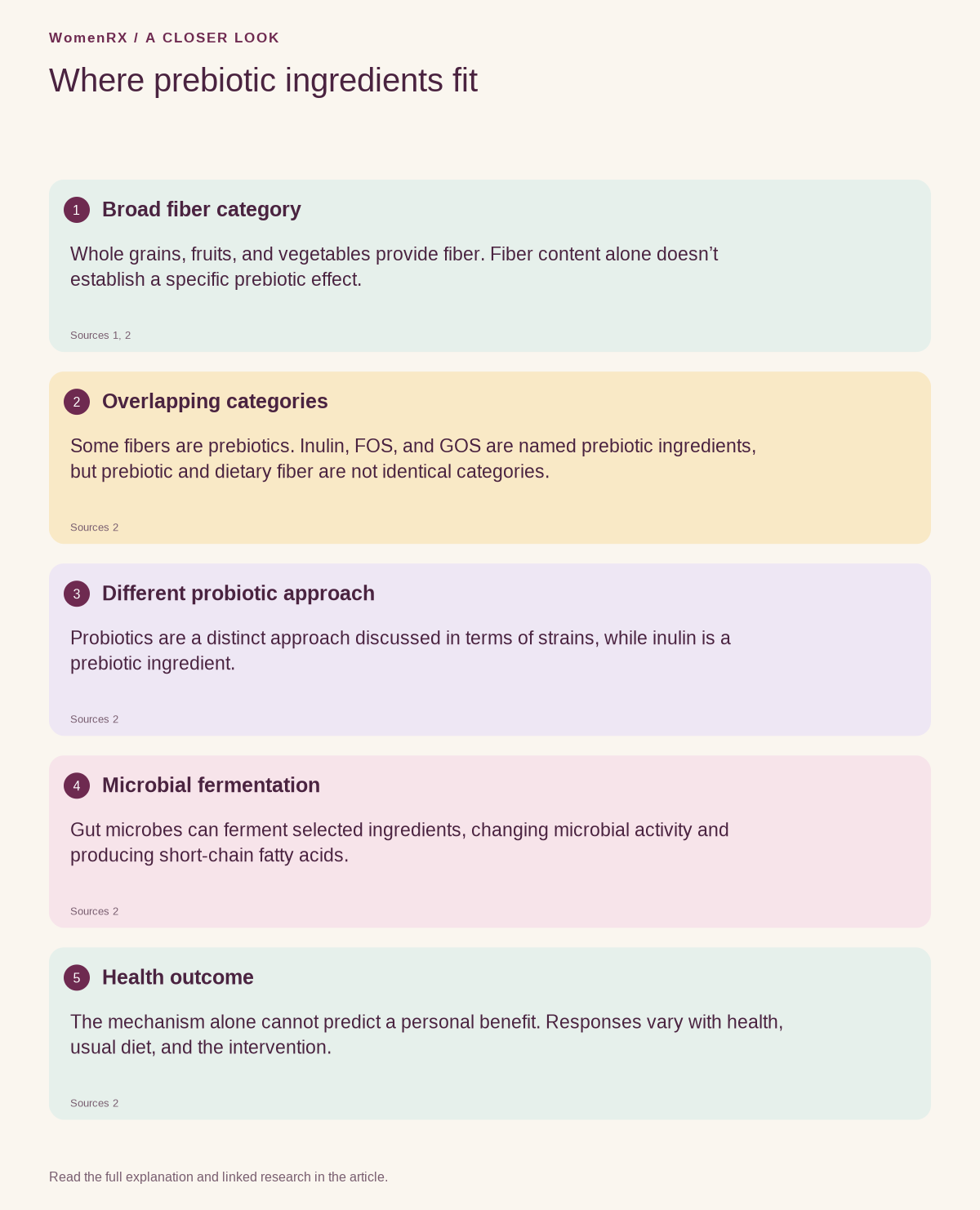
Where prebiotic ingredients fit
Broad fiber category: Whole grains, fruits, and vegetables provide fiber. Fiber content alone doesn’t establish a specific prebiotic effect.12
Overlapping categories: Some fibers are prebiotics. Inulin, FOS, and GOS are named prebiotic ingredients, but prebiotic and dietary fiber are not identical categories.2
Different probiotic approach: Probiotics are a distinct approach discussed in terms of strains, while inulin is a prebiotic ingredient.2
Microbial fermentation: Gut microbes can ferment selected ingredients, changing microbial activity and producing short-chain fatty acids.2
Health outcome: The mechanism alone cannot predict a personal benefit. Responses vary with health, usual diet, and the intervention.2
Read the figure as text
Fiber, prebiotic ingredients, and probiotic products aren’t the same thing. Fermentation explains a possible pathway, not a guaranteed health outcome.- Broad fiber category: Whole grains, fruits, and vegetables provide fiber. Fiber content alone doesn’t establish a specific prebiotic effect.12
- Overlapping categories: Some fibers are prebiotics. Inulin, FOS, and GOS are named prebiotic ingredients, but prebiotic and dietary fiber are not identical categories.2
- Different probiotic approach: Probiotics are a distinct approach discussed in terms of strains, while inulin is a prebiotic ingredient.2
- Microbial fermentation: Gut microbes can ferment selected ingredients, changing microbial activity and producing short-chain fatty acids.2
- Health outcome: The mechanism alone cannot predict a personal benefit. Responses vary with health, usual diet, and the intervention.2
More questions, answered
Does “prebiotic” on a label guarantee a benefit?
No. A prebiotic is defined by selective fermentation and a health benefit, but the presence of a prebiotic-related ingredient name doesn’t establish that a particular product will help with your goal. Effects can depend on the ingredient and the person. 2
Does the evidence show whether prebiotic supplements are suitable during pregnancy or breastfeeding?
Not for every product. A review focused on pregnancies affected by maternal obesity reports inconsistent prebiotic and probiotic results; it doesn’t establish the safety of an individual prebiotic supplement during pregnancy or address breastfeeding. If you’re considering one, check its full ingredient list and amounts with your pregnancy or postpartum care team or a pharmacist. Quality testing can help verify label contents, but it isn’t proof of safety in either situation. 34
Sources you can check
- Dietary Fiber: MedlinePlusAccessed 2026-09-25Return to first citation
- Dietary and Supplementation Strategies for Modulating Gut Microbiota: A Narrative Review.Ekstedt-Biskot N, Jamioł-Milc D, Melkis K, Pieczyńska J. · Foods (Basel, Switzerland) · 2026Return to first citation
- Dietary Interventions Targeting Maternal Obesity: Intergenerational Effects, Mechanisms, and Translational Insights.Li X, Liu M, Liao A, Pan L, Liu J, Zhou J, Huang J. · Current nutrition reports · 2026Return to first citation
- Dietary Supplements and Life Stages: Pregnancy - Health Professional Fact SheetAccessed 2026-09-25Return to first citation