Prebiotics, Bloating, and When to Get Advice
A new prebiotic could explain extra gas or bloating, but symptoms that persist or come with other changes deserve a closer look.
Gas or bloating after starting a prebiotic may be related to the product: some prebiotic fibers are fermented by gut bacteria, which can produce gas, and bloating was more common with one inulin-based preparation in studies of people with inflammatory bowel disease. 56 Check what changed, including the ingredient and amount you took. Don’t assume severe or persistent symptoms are just an adjustment to fiber. 3
Why a prebiotic might leave you feeling gassy
A prebiotic gives certain gut microbes something to use. That activity can produce gas, which may feel like fullness, pressure, or more frequent passing of gas. Laboratory studies show that different fibers can ferment differently, but a fermentation result cannot predict how a particular supplement will feel in your gut. 45
That’s why the ingredient matters. In a systematic review of studies involving people with inflammatory bowel disease (IBD), flatulence and bloating were more common with oligofructose-enriched inulin than with control treatments. Other prebiotics in the review did not show the same pattern of reported adverse events, though the authors rated the overall evidence as very low certainty. The finding is a reason to look at the label, not a reason to assume every prebiotic will cause the same symptoms. 6
Is it the supplement or something else?
Think back to what changed around the time the symptoms began. For example, did you start a powder containing inulin, add a fortified snack, or begin using more than one product with added fiber? Note the ingredient and amount on each label, when you started, and whether symptoms followed its use. Those details make the connection easier to assess than “prebiotics upset my stomach.” They don’t prove the product is the cause.
Amount and individual tolerance are worth considering, but there’s no reliable amount in this evidence that predicts whether you’ll feel bloated. Laboratory experiments found differences in fermentation between fibers and between donors’ gut microbes; they did not test how much of a supplement people can comfortably take. 45 If you changed the amount or added a second product, include that detail when you assess what happened rather than assuming one ingredient tells the whole story.
Bloating has other possible explanations, including constipation, food intolerance, and gas from foods or fizzy drinks. Some people also notice bloating around their period. 3 If your main change is loose, watery stools, remember that diarrhea can have causes unrelated to a supplement, including infection or irritable bowel syndrome. 1 New constipation is worth distinguishing from gas, too: it can involve stools that are hard, dry, or painful to pass. 2
If the discomfort is mild but bothersome, you don’t have to keep taking a nonessential supplement just to see whether you’ll “get used to it.” Pausing it and noticing whether you feel different is one practical way to test a possible connection. If symptoms continue without it, the supplement may not be the whole explanation. This is a way to observe a pattern, not a diagnosis.
When not to wait it out
Get medical advice if bloating keeps returning, doesn’t go away, or comes with blood in your stool. Bloating alongside vomiting, diarrhea, constipation, or stomach pain also warrants prompt assessment rather than being written off as a normal prebiotic effect. 3 Diarrhea that lasts more than a few days deserves attention, and replacing lost fluids matters because diarrhea can cause dehydration. 1
A digestive condition changes the conversation, but it isn’t an automatic ban on prebiotics. If you have IBD, the evidence does not support treating all prebiotic ingredients as interchangeable: the review found more bloating and flatulence with one inulin-based preparation, while its conclusions about benefits and harms overall remained uncertain. 6 If you’re already managing recurring bowel symptoms, it’s useful to identify the exact product when discussing a new change in symptoms.
If you’re pregnant or breastfeeding, check the specific supplement with the clinician involved in your care before using it. Research on prebiotic supplements during these periods is limited and cannot establish how a particular product will affect you or your baby. 8 That uncertainty is different from evidence that every prebiotic is harmful or safe.
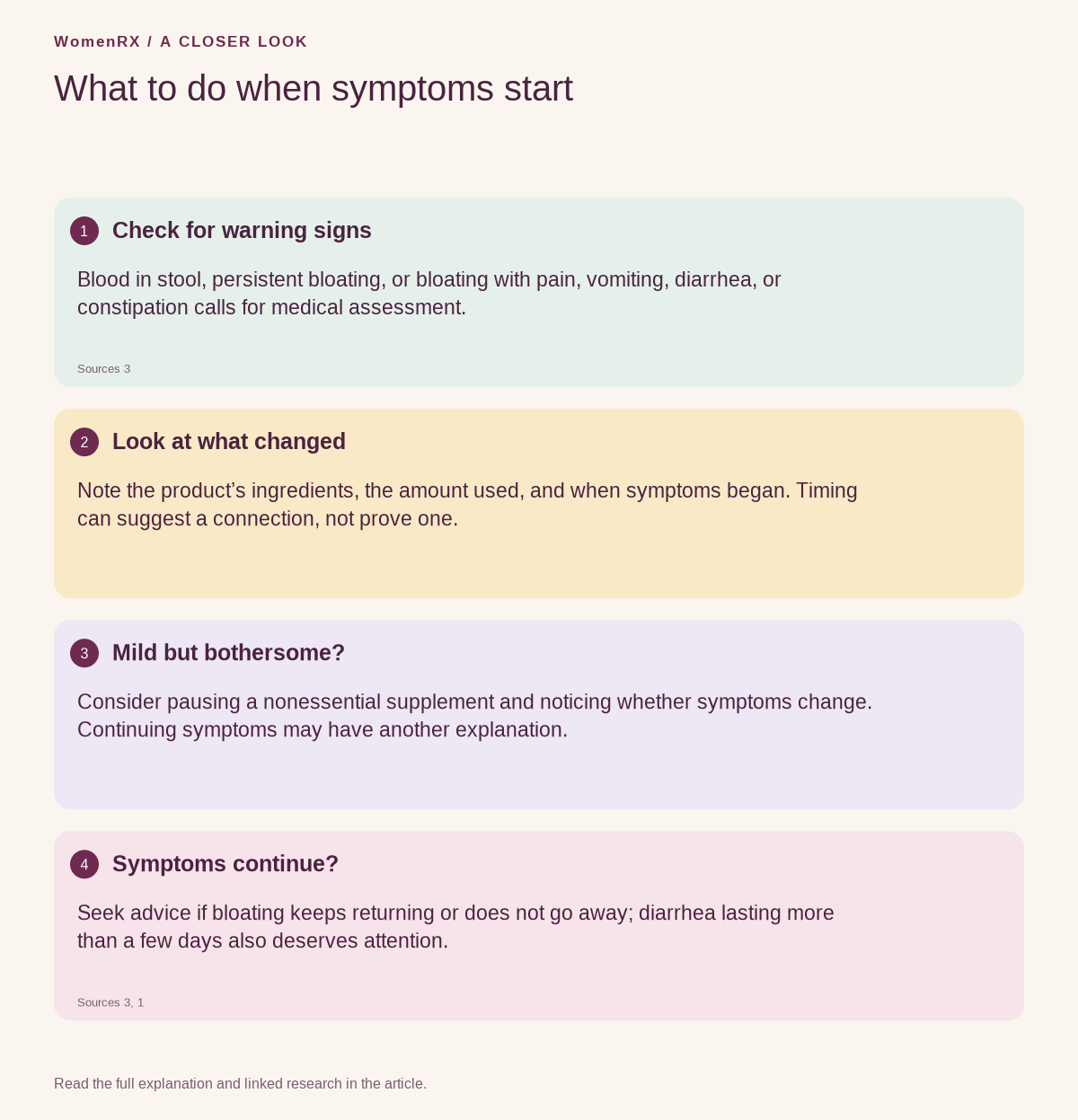
What to do when symptoms start
Check for warning signs: Blood in stool, persistent bloating, or bloating with pain, vomiting, diarrhea, or constipation calls for medical assessment.3
Look at what changed: Note the product’s ingredients, the amount used, and when symptoms began. Timing can suggest a connection, not prove one.
Mild but bothersome?: Consider pausing a nonessential supplement and noticing whether symptoms change. Continuing symptoms may have another explanation.
Symptoms continue?: Seek advice if bloating keeps returning or does not go away; diarrhea lasting more than a few days also deserves attention.31
Read the figure as text
A way to sort a possible supplement effect from symptoms that need more attention.- Check for warning signs: Blood in stool, persistent bloating, or bloating with pain, vomiting, diarrhea, or constipation calls for medical assessment.3
- Look at what changed: Note the product’s ingredients, the amount used, and when symptoms began. Timing can suggest a connection, not prove one.
- Mild but bothersome?: Consider pausing a nonessential supplement and noticing whether symptoms change. Continuing symptoms may have another explanation.
- Symptoms continue?: Seek advice if bloating keeps returning or does not go away; diarrhea lasting more than a few days also deserves attention.31
More questions, answered
Are prebiotics and probiotics the same thing?
No. Prebiotics are substances used by gut microorganisms; probiotics are live microorganisms. A product containing both may make it harder to tell which component coincided with a symptom change. 7
Does bloating mean the prebiotic is working?
No. Fermentation can produce gas, but discomfort is not a measure of benefit. Laboratory fermentation findings cannot establish whether an individual person will benefit from, or tolerate, a product. 45
Sources you can check
- Diarrhea | MedlinePlusAccessed 2026-09-25Return to first citation
- Constipation | MedlinePlusAccessed 2026-09-25Return to first citation
- Bloating - NHSAccessed 2026-09-25Return to first citation
- Starch-entrapped microspheres selectively promote propionate or butyrate production through individual-specific modulation of the human fecal microbiome.Wang S, De Paepe K, Onyango SO, Zhang B, Huang Q, Wang S, Van de Wiele T. · Carbohydrate polymers · 2026Return to first citation
- Effects of NatureKnit™ organic, a blend of organic fruit and vegetable fibers rich in naturally occurring bound polyphenols, on the metabolic activity and community composition of the human gut microbiome using the M-SHIME® gastrointestinal model.Govaert M, Duysburgh C, Kesler B, Marzorati M. · Frontiers in nutrition · 2025Return to first citation
- Prebiotics for Induction and Maintenance of Remission in Inflammatory Bowel Disease: Systematic Review and Meta-Analysis.Limketkai BN, Godoy-Brewer G, Shah ND, Maas L, White J, Parian AM, Mullin GE. · Inflammatory bowel diseases · 2025Return to first citation
- The Use of Prebiotic and Probiotic Interventions for Treating Gastrointestinal and Psychosocial Health Symptoms in Cancer Patients and Survivors: A Systematic Review.Deleemans JM, Gajtani Z, Baydoun M, Reimer RA, Piedalue KA, Carlson LE. · Integrative cancer therapies · 2021Return to first citation
- Gut Health for Two: the Critical Role of Probiotics and Prebiotics in Pregnancy and Lactation.Açar Kuru Y, Aksu S, Gökler AF, Somuncu Eİ, Yassıbaş E, Ayyıldız F. · Current nutrition reports · 2025Return to first citation