Prebiotics After 40: Does Age Change the Case?
Studies in older adults show changes in gut bacteria, but they don’t identify age 40 as a reason to start a prebiotic.
The older-adult studies don’t identify age 40 as a threshold for taking a prebiotic. Trials in people 60 and older found an increase in Bifidobacterium with prebiotics, but that bacterial change doesn’t tell you whether a supplement will meet a digestive or other health goal. The more useful question is what you want it to do, and whether studies measured that outcome. 1
What age-specific studies actually show
Prebiotics are fibers that gut microbes can use. Research in older adults offers one useful clue, but it doesn’t answer every question about taking a supplement in midlife.
A 2025 meta-analysis included 29 randomized trials with 1,633 adults aged 60 and older. The trials studied probiotics, prebiotics, or synbiotics, which combine the two. In its prebiotic findings, the review reported an increase in Bifidobacterium. That is a microbiome outcome: it tells us about the abundance of a type of bacteria, not whether participants felt better, avoided illness, or gained a lasting health benefit. 1
A separate review of interventions in older adults also reported increased Bifidobacterium with prebiotics, probiotics, and synbiotics. Because those are different interventions and the outcome is a bacterial change, this finding doesn’t show that a prebiotic supplement is helpful for everyone over a certain age. 2
How adult evidence compares
A review of studies in adults with type 2 diabetes offers a different kind of evidence. It included people aged 18 and older and considered dietary changes, probiotics, and other approaches. It reported improvements in some blood-sugar measures with probiotic supplementation and dietary fiber intake, while concluding that the evidence did not support routine clinical use of microbiome interventions for diabetes. Those findings concern a specific condition and do not isolate the effect of an inulin or FOS supplement in women over 40. 5
That distinction matters when you see a broad claim about “adult” results. An adult study may measure an outcome you care about, but its participants and intervention still need to match the choice in front of you. The older-adult prebiotic findings are more directly about prebiotics, yet chiefly answer a narrower question about gut bacteria. 1 5
Why a birthday isn’t the decision point
The older-adult trials don’t establish what happens specifically at 40, during perimenopause, or after menopause. They also don’t compare women at those stages with one another. So it would be a stretch to take findings from older adults and promise a hormone-related or menopause-specific benefit. 1
Age-related gut changes are an area of research, but age is only one possible influence. A review of older adults describes substantial variation between people and notes that factors such as diet, medication use, lifestyle, and frailty can shape gut microbiota. That makes a birthday an imprecise reason to start a supplement. 4
Match the evidence to your goal
Start with the reason you’re considering a prebiotic. If your goal is to change the mix of gut bacteria, the older-adult trials offer evidence for an increase in Bifidobacterium with prebiotics. If your goal is relief from a digestive symptom, that bacterial result alone can’t tell you whether you’ll feel better. 1
If you’re interested in a claim about memory or healthy aging, check whether the study reports results or only describes a plan. Inulin, for example, is one of the fibers in a planned trial involving adults ages 60 to 79 with suspected cognitive decline. The publication describes what researchers intend to measure; it does not show that inulin improves cognition. 3
Finally, check the ingredient as well as the outcome. Evidence about dietary fiber as a broad category, a combination of probiotics and prebiotics, or several fibers tested together cannot establish what one inulin or FOS supplement will do for you. 1 3 5
If you’re considering a prebiotic simply because you’ve turned 40, the older-adult findings don’t provide a reason tied to that birthday. If you have a particular goal, the useful test is whether research on that ingredient, in a relevant group, measured the result you want.
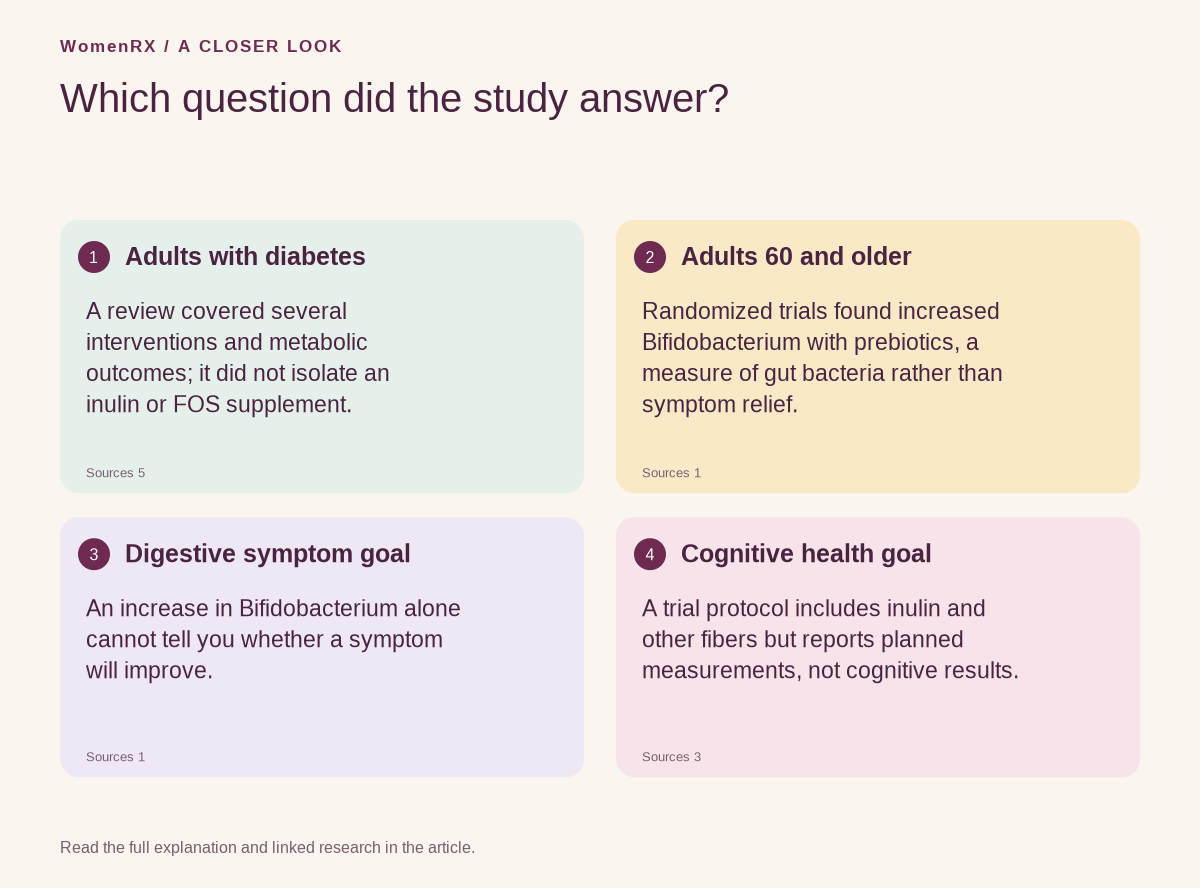
Which question did the study answer?
Adults with diabetes: A review covered several interventions and metabolic outcomes; it did not isolate an inulin or FOS supplement.5
Adults 60 and older: Randomized trials found increased Bifidobacterium with prebiotics, a measure of gut bacteria rather than symptom relief.1
Digestive symptom goal: An increase in Bifidobacterium alone cannot tell you whether a symptom will improve.1
Cognitive health goal: A trial protocol includes inulin and other fibers but reports planned measurements, not cognitive results.3
Read the figure as text
Population, ingredient, and outcome determine how closely a finding fits your reason for considering a prebiotic.- Adults with diabetes: A review covered several interventions and metabolic outcomes; it did not isolate an inulin or FOS supplement.5
- Adults 60 and older: Randomized trials found increased Bifidobacterium with prebiotics, a measure of gut bacteria rather than symptom relief.1
- Digestive symptom goal: An increase in Bifidobacterium alone cannot tell you whether a symptom will improve.1
- Cognitive health goal: A trial protocol includes inulin and other fibers but reports planned measurements, not cognitive results.3
Sources you can check
- Effects of probiotics, prebiotics, and synbiotics on gut microbiota in older adults: a systematic review and meta-analysis of randomized controlled trials.Zhuang K, Luo H, Zeng M, Chan SCL, Gong M, Wang Y. · Nutrition journal · 2025Return to first citation
- Effects of non-pharmacological interventions on gut microbiota and intestinal permeability in older adults: A systematic review: Non-pharmacological interventions on gut microbiota/barrier.Hairul Hisham HI, Lim SM, Neoh CF, Abdul Majeed AB, Shahar S, Ramasamy K. · Archives of gerontology and geriatrics · 2025Return to first citation
- Gut-brain health effects of PREbiotics in older adults with suspected COgnitive DEcline: design of the PRECODE randomised placebo-controlled trial.Kruger K, van der Veen H, Beigy M, O'Donovan SD, van Riel N, Remie LB, Aarts E, Steegenga W, Smeets PAM, van Trijp MPH, de Groot LCPGM, Vermeiren Y. · Frontiers in nutrition · 2026Return to first citation
- Gut Microbiota and Ageing: Mechanisms, Age-Related Diseases, and Therapeutic Perspectives.Alves Ferreira JM, Tukaiev S, Giannouli V. · Healthcare (Basel, Switzerland) · 2026Return to first citation
- Microbiome-Driven Therapeutic Strategies for Type 2 Diabetes: A Systematic Review of Microbiota Modulation, Glycaemic Outcomes, and Transplantation.Haneesh M, Amalraj S, Anusha G, Karthick V, Poongavanam SS, Thamarai R. · Applied biochemistry and biotechnology · 2026Return to first citation