Betaine HCl After 40: Does Age Change the Case?
Midlife digestive changes can be real, but age alone doesn’t show that your stomach acid is low or that betaine HCl will help.
Turning 40 or entering menopause isn’t, by itself, a reason to take betaine HCl. Specific conditions such as autoimmune gastritis can reduce stomach acid, but digestive symptoms alone don’t identify low acid. Human betaine HCl studies have measured absorption of particular medicines during drug-induced low acid, not relief of everyday digestive symptoms. 1 3 4 5
The age claim skips a step
If indigestion has become more noticeable in midlife, it’s reasonable to wonder what changed. But a new symptom doesn’t tell you that your stomach is making less acid. The betaine HCl research discussed below doesn’t establish that age 40 or menopause creates a need for extra stomach acid. 3 4 5
The distinction matters because “low stomach acid” describes something happening in the stomach. Indigestion describes what you feel. One doesn’t automatically prove the other.
When low stomach acid has a specific cause
Autoimmune gastritis is one condition that can reduce acid production. It damages the stomach’s acid-producing parietal cells and can eventually leave the stomach making very little acid. H. pylori-related atrophic gastritis can also be associated with reduced acid secretion. These are stomach conditions, not expected consequences of reaching a particular birthday. 2 5
Symptoms can be misleading. Autoimmune atrophic gastritis may be associated with long-standing indigestion or anemia, but neither finding confirms the diagnosis on its own. Heartburn doesn’t settle the acid question either: a review describes reflux symptoms in people with autoimmune gastritis despite their reduced stomach acid. 1 5
That’s why persistent or recurring symptoms deserve a look at the cause rather than an assumption that more acid is the answer. If you’ve been told you have anemia, or you have a known stomach condition, include that information when you discuss the symptoms with your clinician. 1
What betaine HCl has actually been shown to do
Betaine HCl can temporarily make the stomach more acidic. The human studies most directly relevant to that effect involved healthy volunteers whose stomach acid had been suppressed with rabeprazole. Researchers measured whether betaine HCl changed the absorption of specific prescription medicines. They did not test whether it eased routine indigestion in women over 40. 3 4 5
The two medicine studies illustrate why the outcome matters. In one randomized crossover study, betaine HCl restored exposure to dasatinib after rabeprazole had reduced it. In a separate randomized crossover study involving atazanavir taken with a light meal, betaine HCl restored only a small portion of the drug exposure lost after rabeprazole. A finding about one medicine’s absorption, under one set of conditions, isn’t evidence that a supplement will relieve bloating or heartburn. 3 4
A review proposes acid replacement, including betaine HCl, as a possible approach for people with autoimmune gastritis. That is a research question worth distinguishing from a demonstrated benefit: the review does not establish that betaine HCl improves digestive symptoms in people with that condition. 5
For a midlife symptom, the more useful next question is what’s causing it? Age doesn’t answer that, and a supplement trial can’t confirm low acid. If symptoms keep returning, describing what you feel and mentioning any anemia, stomach diagnosis, or acid-reducing medicine use gives a clinician a better starting point than assuming your stomach needs betaine HCl. 1 3 4
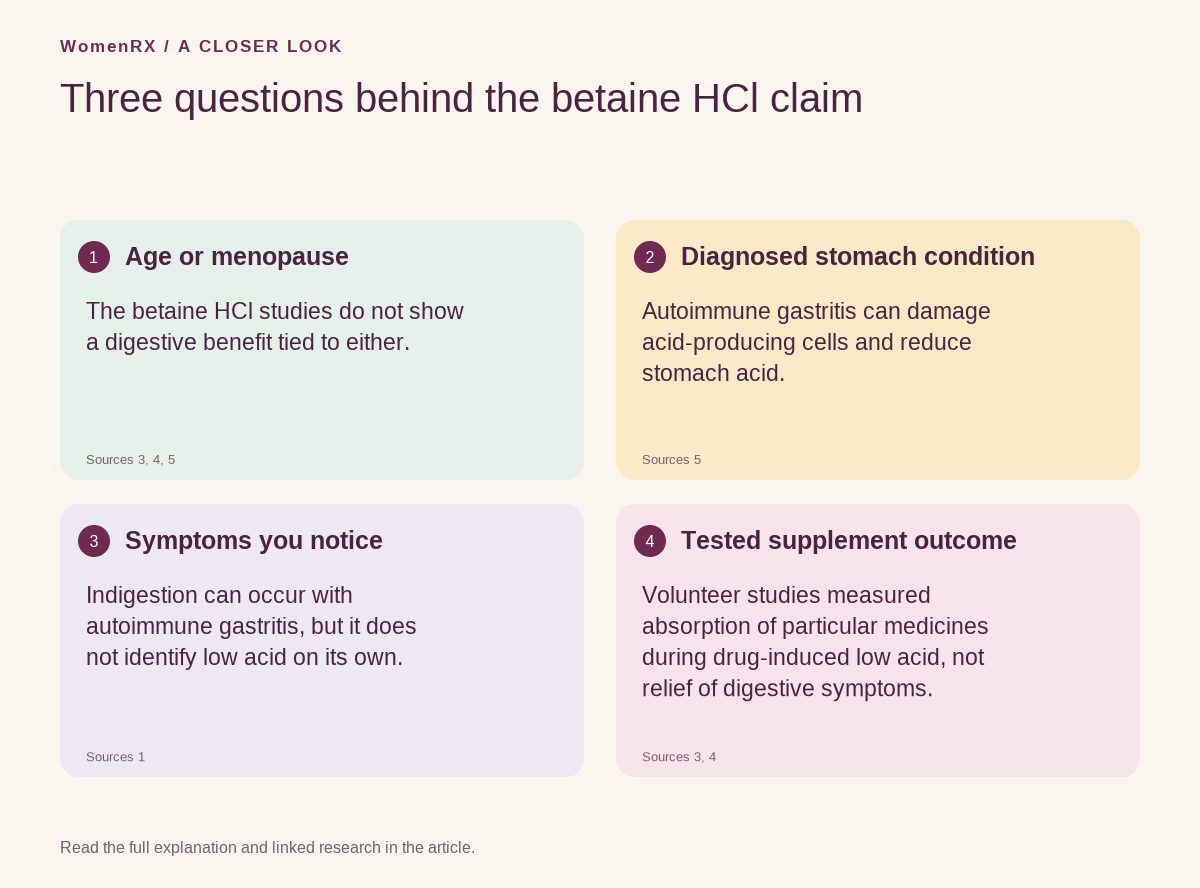
Three questions behind the betaine HCl claim
Age or menopause: The betaine HCl studies do not show a digestive benefit tied to either.345
Diagnosed stomach condition: Autoimmune gastritis can damage acid-producing cells and reduce stomach acid.5
Symptoms you notice: Indigestion can occur with autoimmune gastritis, but it does not identify low acid on its own.1
Tested supplement outcome: Volunteer studies measured absorption of particular medicines during drug-induced low acid, not relief of digestive symptoms.34
Read the figure as text
A midlife symptom, a cause of low acid, and a tested supplement outcome are different kinds of evidence.- Age or menopause: The betaine HCl studies do not show a digestive benefit tied to either.345
- Diagnosed stomach condition: Autoimmune gastritis can damage acid-producing cells and reduce stomach acid.5
- Symptoms you notice: Indigestion can occur with autoimmune gastritis, but it does not identify low acid on its own.1
- Tested supplement outcome: Volunteer studies measured absorption of particular medicines during drug-induced low acid, not relief of digestive symptoms.34
More questions, answered
Is betaine HCl the same as betaine anhydrous?
No. Betaine HCl is an acidifying form used in supplements. Betaine anhydrous is a different form used for a different medical purpose; findings about one shouldn’t be applied to the other. 5
Sources you can check
- The Impact of Proton Pump Inhibitors on the Development of Gastric Neoplastic Lesions in Patients With Autoimmune Atrophic Gastritis.Dilaghi E, Bellisario M, Esposito G, Carabotti M, Annibale B, Lahner E. · Frontiers in immunology · 2022Return to first citation
- Infection of Helicobacter pylori and Atrophic Gastritis Influence Lactobacillus in Gut Microbiota in a Japanese Population.Iino C, Shimoyama T, Chinda D, Arai T, Chiba D, Nakaji S, Fukuda S. · Frontiers in immunology · 2018Return to first citation
- The use of betaine HCl to enhance dasatinib absorption in healthy volunteers with rabeprazole-induced hypochlorhydria.Yago MR, Frymoyer A, Benet LZ, Smelick GS, Frassetto LA, Ding X, Dean B, Salphati L, Budha N, Jin JY, Dresser MJ, Ware JA. · The AAPS journal · 2014Return to first citation
- Meal Effects Confound Attempts to Counteract Rabeprazole-Induced Hypochlorhydria Decreases in Atazanavir Absorption.Faber KP, Wu HF, Yago MR, Xu X, Kadiyala P, Frassetto LA, Benet LZ. · Pharmaceutical research · 2017Return to first citation
- Creating a Framework for Treating Autoimmune Gastritis-The Case for Replacing Lost Acid.Taylor L, McCaddon A, Wolffenbuttel BHR. · Nutrients · 2024Return to first citation