Betaine HCl for Digestion: What the Evidence Actually Shows
Betaine HCl can temporarily lower stomach pH in small human studies, but that isn’t proof it relieves bloating or treats a confirmed cause of digestive symptoms.
Human studies show that betaine HCl can temporarily make stomach contents more acidic in certain settings. They do not establish that it relieves bloating or other digestive symptoms caused by “low stomach acid.” Symptoms such as bloating have many possible causes, and these studies don’t report whether women with confirmed low stomach acid benefited. 1 2 5
Changing stomach pH is not the same as treating symptoms
Betaine hydrochloride (HCl) is an acidifying supplement. A small randomized crossover study in nine people measured stomach pH after a meal. The researchers found that betaine HCl could bring pH back toward its pre-meal level more quickly in that study. But the outcome was a stomach-pH measurement, not whether participants felt less bloated, had less indigestion, or improved over time. 2
That distinction matters. A change in a measurement can show that a substance affects the stomach environment. It doesn’t show that the change solves the symptom that led you to consider the supplement.
Bloating alone can’t tell you your stomach acid is low
Bloating is a sensation, not a diagnosis. It can have several causes, including constipation, food intolerance, certain foods and drinks, or swallowing air while eating. So having bloating, fullness, or discomfort doesn’t by itself establish that you make too little stomach acid. 1
The betaine HCl research also doesn’t validate a symptom-based way to identify people with low stomach acid. One review describes a study in people with functional dyspepsia who took a product combining an amino-acid hydrochloride with bovine protease. That study had no placebo group, used a range of doses, and couldn’t show whether any reported symptom changes were due to the product, to betaine HCl specifically, or to other factors. 5
What human studies have, and haven’t, tested
Some small studies tested betaine HCl for a different purpose: to change absorption of medicines affected by stomach acidity. In healthy volunteers whose acid levels had been lowered with a prescription medicine, one study found betaine HCl increased absorption of dasatinib. Another found that, with a meal, it did not sufficiently restore absorption of atazanavir. These studies show that effects can depend on the medicine and study conditions. They are not evidence that betaine HCl treats digestive symptoms, and they don’t establish a safe way to adjust medication absorption yourself. 3 4
The studies summarized here don’t report whether women with the specific condition of confirmed low stomach acid experienced symptom relief. They also don’t establish that common digestive symptoms in women are caused by sex hormones.
A more useful next step than guessing
If bloating is occasional, consider whether it follows a particular food or drink, constipation, or eating quickly. General measures such as addressing constipation, avoiding a food you know you don’t tolerate, and chewing with your mouth closed may help in some situations. 1
If the problem keeps returning, doesn’t go away, or comes with unintentional weight loss or blood in your stool, arrange medical evaluation rather than using symptoms to diagnose low acid. 1 The useful question is what may be causing your symptoms and whether there’s evidence of a specific condition, not whether a supplement can make stomach contents more acidic.
If you take a medicine whose absorption can be affected by stomach acidity, don’t add betaine HCl or change an acid-suppressing medicine to try to alter absorption on your own. The human studies found different results for different medicines and meal conditions. 3 4
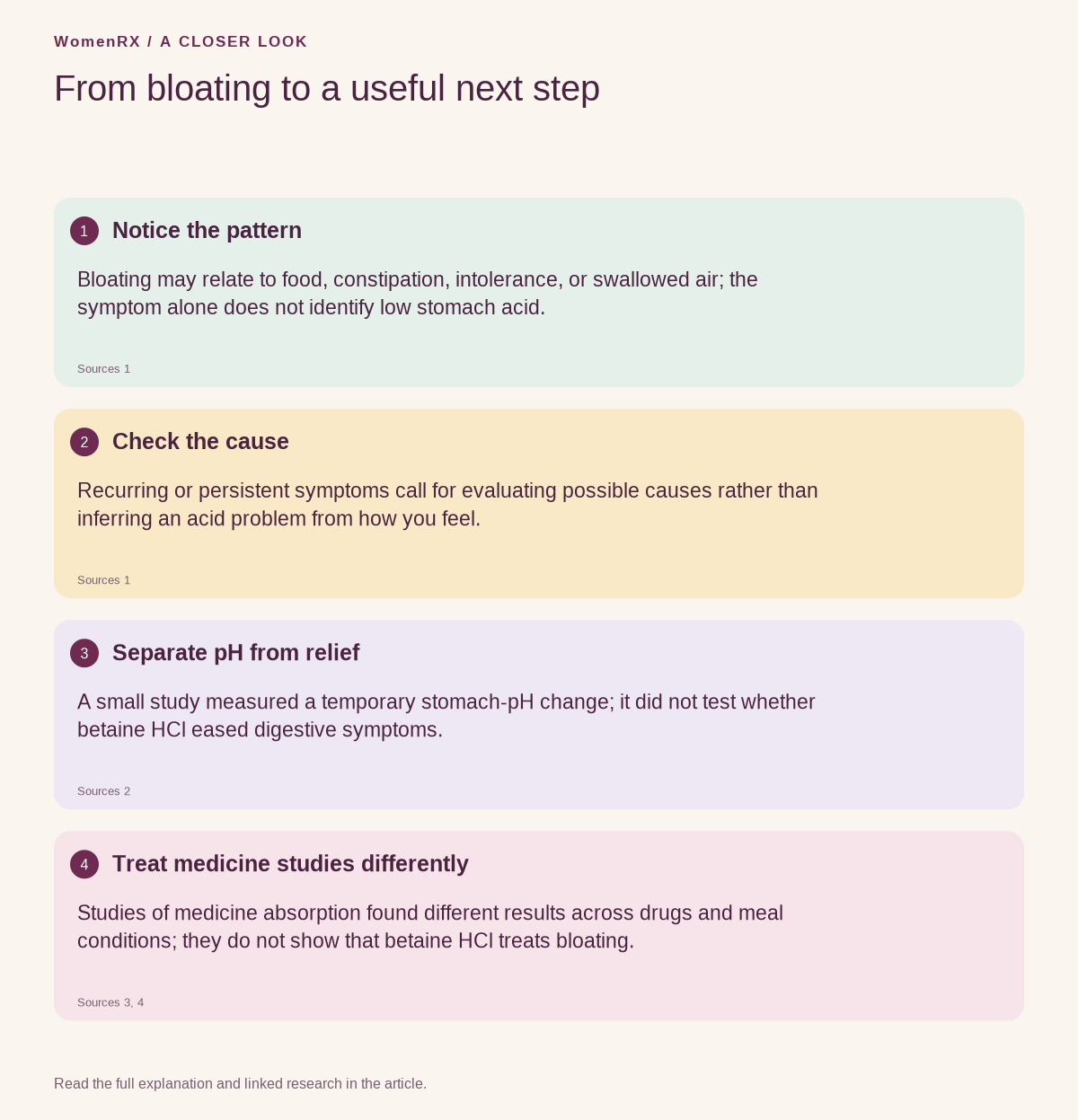
From bloating to a useful next step
Notice the pattern: Bloating may relate to food, constipation, intolerance, or swallowed air; the symptom alone does not identify low stomach acid.1
Check the cause: Recurring or persistent symptoms call for evaluating possible causes rather than inferring an acid problem from how you feel.1
Separate pH from relief: A small study measured a temporary stomach-pH change; it did not test whether betaine HCl eased digestive symptoms.2
Treat medicine studies differently: Studies of medicine absorption found different results across drugs and meal conditions; they do not show that betaine HCl treats bloating.34
Read the figure as text
Bloating does not identify its cause. This flow separates symptom observation from a diagnosis and from evidence about what betaine HCl has actually been tested to do.- Notice the pattern: Bloating may relate to food, constipation, intolerance, or swallowed air; the symptom alone does not identify low stomach acid.1
- Check the cause: Recurring or persistent symptoms call for evaluating possible causes rather than inferring an acid problem from how you feel.1
- Separate pH from relief: A small study measured a temporary stomach-pH change; it did not test whether betaine HCl eased digestive symptoms.2
- Treat medicine studies differently: Studies of medicine absorption found different results across drugs and meal conditions; they do not show that betaine HCl treats bloating.34
More questions, answered
Is betaine HCl the same as betaine anhydrous?
No. Betaine HCl is the hydrochloride form used as an acidifying supplement. Betaine anhydrous is a different form; the review distinguishes it from betaine HCl and discusses its use for a separate condition. Evidence or dosing for one form shouldn’t be assumed to apply to the other. 5
Does a study showing lower stomach pH prove betaine HCl helps digestion?
No. A pH change shows an effect on stomach acidity under the conditions studied. It doesn’t establish that the supplement relieves symptoms or treats their cause. 2
Sources you can check
- Bloating - NHSAccessed 2026-09-25Return to first citation
- Food, Acid Supplementation and Drug Absorption - a Complicated Gastric Mix: a Randomized Control Trial.Surofchy DD, Frassetto LA, Benet LZ. · Pharmaceutical research · 2019Return to first citation
- The use of betaine HCl to enhance dasatinib absorption in healthy volunteers with rabeprazole-induced hypochlorhydria.Yago MR, Frymoyer A, Benet LZ, Smelick GS, Frassetto LA, Ding X, Dean B, Salphati L, Budha N, Jin JY, Dresser MJ, Ware JA. · The AAPS journal · 2014Return to first citation
- Meal Effects Confound Attempts to Counteract Rabeprazole-Induced Hypochlorhydria Decreases in Atazanavir Absorption.Faber KP, Wu HF, Yago MR, Xu X, Kadiyala P, Frassetto LA, Benet LZ. · Pharmaceutical research · 2017Return to first citation
- Creating a Framework for Treating Autoimmune Gastritis-The Case for Replacing Lost Acid.Taylor L, McCaddon A, Wolffenbuttel BHR. · Nutrients · 2024Return to first citation