Betaine HCl: What It Can Do and What’s Unproven
Betaine HCl can briefly change stomach acidity, but that alone doesn’t show it improves digestion or treats a digestive condition.
Betaine hydrochloride releases acid in the stomach, and small human studies show it can change stomach pH and affect absorption of certain medicines under specific conditions. Those are measurable effects, not proof of digestive symptom relief. A review describes only weak, indirect symptom evidence, and the studies summarized here don’t report results by sex or establish a distinct benefit for women. 1 2 3 4
Betaine HCl has a plausible-sounding pitch: add acid to the stomach, and digestion should improve. But a change in stomach acidity is a different outcome from feeling better or treating a diagnosed condition. Human studies show the first can happen in particular circumstances; they don’t establish the second.
What changing stomach acidity tells us
Betaine HCl is a form of betaine that releases hydrochloric acid in the stomach. Stomach acid helps create an acidic environment that supports protein digestion and releases some nutrients from their food compounds. That makes an acidity effect biologically plausible, but it doesn’t prove that taking an acid supplement improves digestion in daily life. 4
A small crossover study measured stomach pH in nine people after a meal and different amounts of betaine HCl. Without the supplement, pH returned to its pre-meal level in about 50 minutes on average. After the largest amount tested, it returned in about 17 minutes. The study’s outcome was pH, not relief from indigestion; its overall measure of pH over time was similar across treatments and not statistically different. 2
So this study suggests that betaine HCl can affect a stomach-acidity measurement under specific conditions. It does not show that the supplement resolves symptoms or establish an amount for self-treatment.
Medicine absorption is a separate question
The clearest randomized human studies in this research tested whether betaine HCl could alter absorption of particular medicines after healthy volunteers took rabeprazole, an acid-reducing medicine. They were drug-absorption studies, not trials of digestive symptoms.
Results differed. In one study, betaine HCl brought measured exposure to dasatinib, a cancer medicine, back toward the level seen without rabeprazole. In another, participants took atazanavir with a light meal. Betaine HCl restored only a small part of the drug exposure lost after rabeprazole, and the researchers concluded it did not sufficiently counteract the reduction. 1 3
That difference is a useful reminder: results for one medicine don’t automatically apply to another. The medicine and meal conditions mattered in these studies. Don’t use betaine HCl to try to offset an acid-reducing medicine or change how a prescription works. If you’re concerned about a medicine’s absorption, ask the prescriber or pharmacist about that specific medicine. 1 3
Symptom claims have weaker support
A review describes an observational study involving people with functional dyspepsia who took an amino-acid hydrochloride supplement together with bovine protease. The study had no placebo group, used varying amounts, and didn’t test betaine HCl alone. It can’t tell whether reported symptom changes came from the acid, the protease, other factors, or symptoms changing over time. 4
The same review discusses acid replacement as a possible approach for autoimmune gastritis, a condition in which acid-producing stomach cells are damaged. That is a proposed rationale, not demonstrated treatment benefit. The review says how well betaine HCl is tolerated in people with autoimmune gastritis is unknown. 4
The practical distinction is simple: evidence that a supplement changes stomach pH or a medicine’s absorption is not evidence that it reliably relieves digestive discomfort or treats low stomach acid.
What the research says about women
The study descriptions and review summarized here don’t report sex-specific results or findings for pregnancy or other reproductive life stages. That means these sources don’t establish a distinct benefit for women; it doesn’t settle whether effects differ by sex or life stage.
And digestive discomfort by itself doesn’t establish that someone has low stomach acid. The medicine studies deliberately changed acidity in healthy volunteers, while the symptom study used a combination supplement and lacked a comparison group. Those are different situations from self-diagnosing a cause of ongoing symptoms. 1 3 4
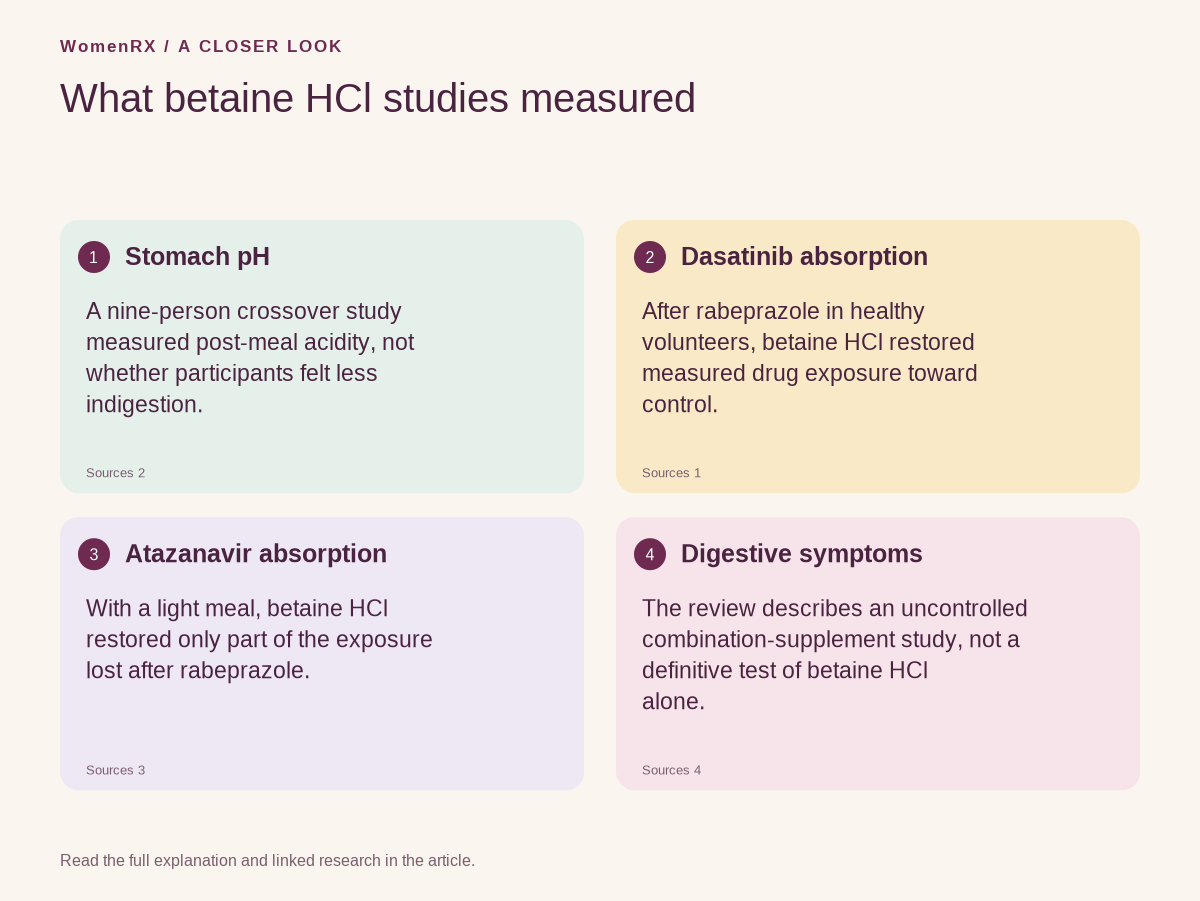
What betaine HCl studies measured
Stomach pH: A nine-person crossover study measured post-meal acidity, not whether participants felt less indigestion.2
Dasatinib absorption: After rabeprazole in healthy volunteers, betaine HCl restored measured drug exposure toward control.1
Atazanavir absorption: With a light meal, betaine HCl restored only part of the exposure lost after rabeprazole.3
Digestive symptoms: The review describes an uncontrolled combination-supplement study, not a definitive test of betaine HCl alone.4
Read the figure as text
The outcomes differ: changing stomach pH or a medicine’s absorption doesn’t by itself demonstrate digestive symptom relief.- Stomach pH: A nine-person crossover study measured post-meal acidity, not whether participants felt less indigestion.2
- Dasatinib absorption: After rabeprazole in healthy volunteers, betaine HCl restored measured drug exposure toward control.1
- Atazanavir absorption: With a light meal, betaine HCl restored only part of the exposure lost after rabeprazole.3
- Digestive symptoms: The review describes an uncontrolled combination-supplement study, not a definitive test of betaine HCl alone.4
More questions, answered
Is betaine HCl the same as betaine anhydrous?
No. Betaine HCl is an acidifying form. The review distinguishes it from betaine anhydrous, which is used for homocystinuria. Evidence about one form shouldn’t be assumed to apply to the other. 4
Sources you can check
- The use of betaine HCl to enhance dasatinib absorption in healthy volunteers with rabeprazole-induced hypochlorhydria.Yago MR, Frymoyer A, Benet LZ, Smelick GS, Frassetto LA, Ding X, Dean B, Salphati L, Budha N, Jin JY, Dresser MJ, Ware JA. · The AAPS journal · 2014Return to first citation
- Food, Acid Supplementation and Drug Absorption - a Complicated Gastric Mix: a Randomized Control Trial.Surofchy DD, Frassetto LA, Benet LZ. · Pharmaceutical research · 2019Return to first citation
- Meal Effects Confound Attempts to Counteract Rabeprazole-Induced Hypochlorhydria Decreases in Atazanavir Absorption.Faber KP, Wu HF, Yago MR, Xu X, Kadiyala P, Frassetto LA, Benet LZ. · Pharmaceutical research · 2017Return to first citation
- Creating a Framework for Treating Autoimmune Gastritis-The Case for Replacing Lost Acid.Taylor L, McCaddon A, Wolffenbuttel BHR. · Nutrients · 2024Return to first citation