Betaine HCl: What to Know Before Trying It
A dose tested in a small stomach-pH study is not the same as a dose shown to treat symptoms or known to be safe for you.
A human study tested betaine HCl doses of 1,500, 3,000 and 4,500 mg, but it included only nine people and measured stomach pH after a meal, not symptom relief or a recommended dose. The 4,500 mg result is a study finding, not an established amount to take. The study also doesn’t settle medication interactions or pregnancy and breastfeeding safety. 2

What the dose study actually tells us
A small, open-label crossover study tested 1,500, 3,000 and 4,500 mg of betaine hydrochloride (HCl) in nine people. Researchers looked at stomach acidity after eating. Without betaine HCl, stomach pH returned to its pre-meal level in an average of about 50 minutes. After 4,500 mg, it took about 17 minutes. Those results describe a change in stomach pH under the study conditions, not relief from indigestion, reflux or another symptom. 2
That difference matters when you read a product label. A serving size or suggested use tells you how the manufacturer directs people to use that product. It does not establish that amount as an effective or safe treatment dose. The study’s 4,500 mg finding should not be treated as a recommendation: the study was very small, and it did not establish a dose for symptom relief or ongoing use. 2
What the study doesn’t answer about safety
The study abstract doesn’t establish how often side effects occur, whether repeated use is safe, or which amount would suit a particular person. It also doesn’t report results by women’s health stage or answer whether betaine HCl is safe during pregnancy or breastfeeding. Those questions need individualized advice rather than a dose borrowed from a stomach-pH experiment. 2
The study also doesn’t establish specific interactions between betaine HCl and medicines. Before trying it, show a pharmacist or clinician the exact product label and your full list of medicines and supplements. Ask them to check the particular combination, rather than assuming that a product sold as a supplement has no interaction concerns.
If you take medicine to reduce stomach acid, mention that specifically. The study examined how betaine HCl changed stomach pH after a meal; it was not a clinical interaction study and doesn’t establish how to combine betaine HCl with acid-reducing medicine. 2
Think about your symptoms, too
Heartburn happens when stomach acid moves up toward the throat. Since betaine HCl was studied for its ability to make stomach contents more acidic, recurring heartburn is a useful reason to ask for advice before trying it. That mechanism alone doesn’t prove betaine HCl will worsen your symptoms, but the study didn’t test whether it improves or aggravates heartburn. 12
Don’t use a supplement response to diagnose “low stomach acid.” The study measured stomach pH after a meal; it did not assess a home test for low acid or show that taking betaine HCl identifies the cause of digestive symptoms. 2
If heartburn happens most days, or you have trouble swallowing, vomit frequently or lose weight without explanation, get medical advice instead of trying to manage the problem by adding acid. 1
A quick check before you try it
- Read the whole label: Note the amount per capsule and per serving, plus the suggested use. A label direction isn’t a clinically established dose.
- Review medicines and supplements: Ask a pharmacist to check your specific product against your full list. Make sure they know if you use acid-reducing medicine.
- Mention pregnancy or breastfeeding: The small pH study doesn’t answer safety in either situation, so ask for advice tailored to you before use. 2
- Consider why you want to take it: If you’re trying to treat frequent heartburn or ongoing digestive symptoms, address the symptoms rather than using betaine HCl to guess at their cause. 12
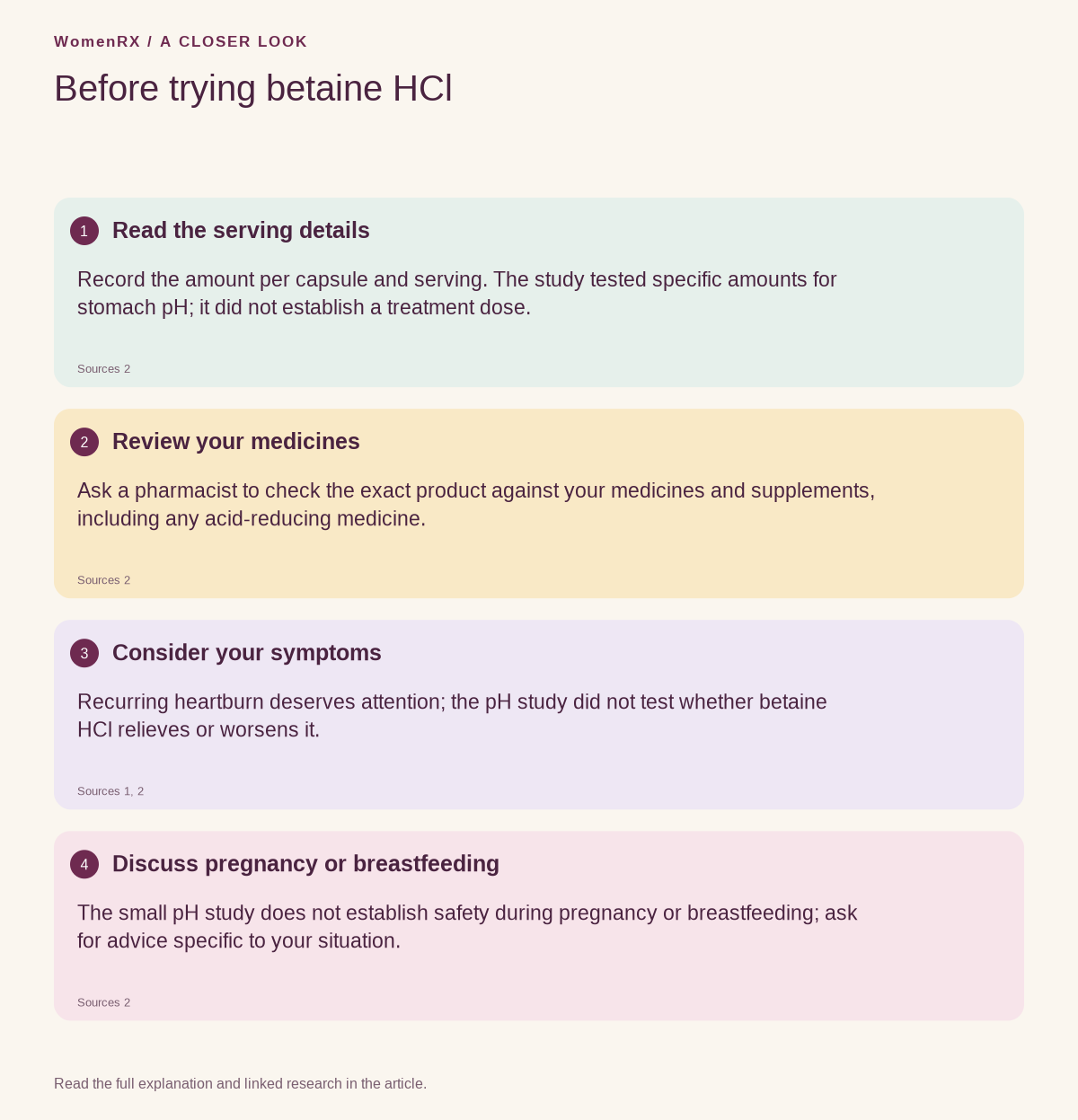
Before trying betaine HCl
Read the serving details: Record the amount per capsule and serving. The study tested specific amounts for stomach pH; it did not establish a treatment dose.2
Review your medicines: Ask a pharmacist to check the exact product against your medicines and supplements, including any acid-reducing medicine.2
Consider your symptoms: Recurring heartburn deserves attention; the pH study did not test whether betaine HCl relieves or worsens it.12
Discuss pregnancy or breastfeeding: The small pH study does not establish safety during pregnancy or breastfeeding; ask for advice specific to your situation.2
Read the figure as text
Use these checks to separate a product’s directions from what the small human study established and to identify questions worth raising before use.- Read the serving details: Record the amount per capsule and serving. The study tested specific amounts for stomach pH; it did not establish a treatment dose.2
- Review your medicines: Ask a pharmacist to check the exact product against your medicines and supplements, including any acid-reducing medicine.2
- Consider your symptoms: Recurring heartburn deserves attention; the pH study did not test whether betaine HCl relieves or worsens it.12
- Discuss pregnancy or breastfeeding: The small pH study does not establish safety during pregnancy or breastfeeding; ask for advice specific to your situation.2
Sources you can check
- Heartburn and acid reflux - NHSAccessed 2026-09-25Return to first citation
- Food, Acid Supplementation and Drug Absorption - a Complicated Gastric Mix: a Randomized Control Trial.Surofchy DD, Frassetto LA, Benet LZ. · Pharmaceutical research · 2019Return to first citation