Betaine HCl and Food: What Meal Timing Evidence Shows
A small study found betaine HCl brought stomach acidity back toward its pre-meal level faster after food, but the result doesn’t establish digestive relief or whether to take it on an empty stomach.
In a study of nine people, food raised stomach pH, and a 4,500 mg experimental dose of betaine HCl brought it back to baseline in about 17 minutes, compared with about 50 minutes without supplementation. That measures acidity, not symptom relief or whether taking betaine HCl without food is safe or better. It isn’t a general timing recommendation. 1
What happened after a meal
Betaine hydrochloride, often called betaine HCl, has been studied for its ability to change stomach acidity. In a small open-label crossover study, nine people ate food that raised their stomach pH, meaning their stomach contents became less acidic. Without betaine HCl, pH returned to baseline in an average of 49.7 minutes. After an experimental 4,500 mg dose, it returned to baseline in about 17.3 minutes. 1
That result helps explain why meal context matters in research on betaine HCl. But the study measured stomach pH, not whether people felt less discomfort, digested food more comfortably, or tolerated the supplement better with or without food. The experimental dose and result are not a general-use schedule. 1
Here, baseline means the stomach pH measured before the meal. Returning to that reading sooner doesn’t tell you whether someone needed more acid in the first place. 1
What that means for taking it without food
The reported pH result concerns betaine HCl after food, not empty-stomach use. It therefore can’t tell you whether taking it without food is safe, harmful, or easier to tolerate. 1
For example, taking a capsule before breakfast or between meals would be a different situation from the one studied. Comparing those situations would require evidence about use with and without food, not just a measurement of how quickly stomach pH returned to baseline after eating. 1
Another human study looked at a different question: whether betaine HCl could affect absorption of the HIV medicine atazanavir when stomach acidity had been reduced by rabeprazole. Participants took atazanavir with a light meal. Betaine HCl restored 13% of the lost peak concentration and 12% of the lost overall exposure, but the researchers concluded it did not sufficiently offset the reduction associated with rabeprazole. This specific drug-absorption experiment is not a general meal-timing rule or a reason to adjust a medicine yourself. 2
If digestive symptoms are the reason you’re considering betaine HCl, ask what may be causing them before assuming more acid is the answer. If you take a medicine whose absorption may depend on stomach acidity, ask your prescriber or pharmacist about that specific medicine before adding betaine HCl. The atazanavir result shows why a supplement shouldn’t be assumed to correct an acid-related absorption issue. 1 2
The meal-related studies also don’t establish betaine HCl safety or timing during pregnancy or breastfeeding. They offer no separate meal-timing rule for women. 1 2
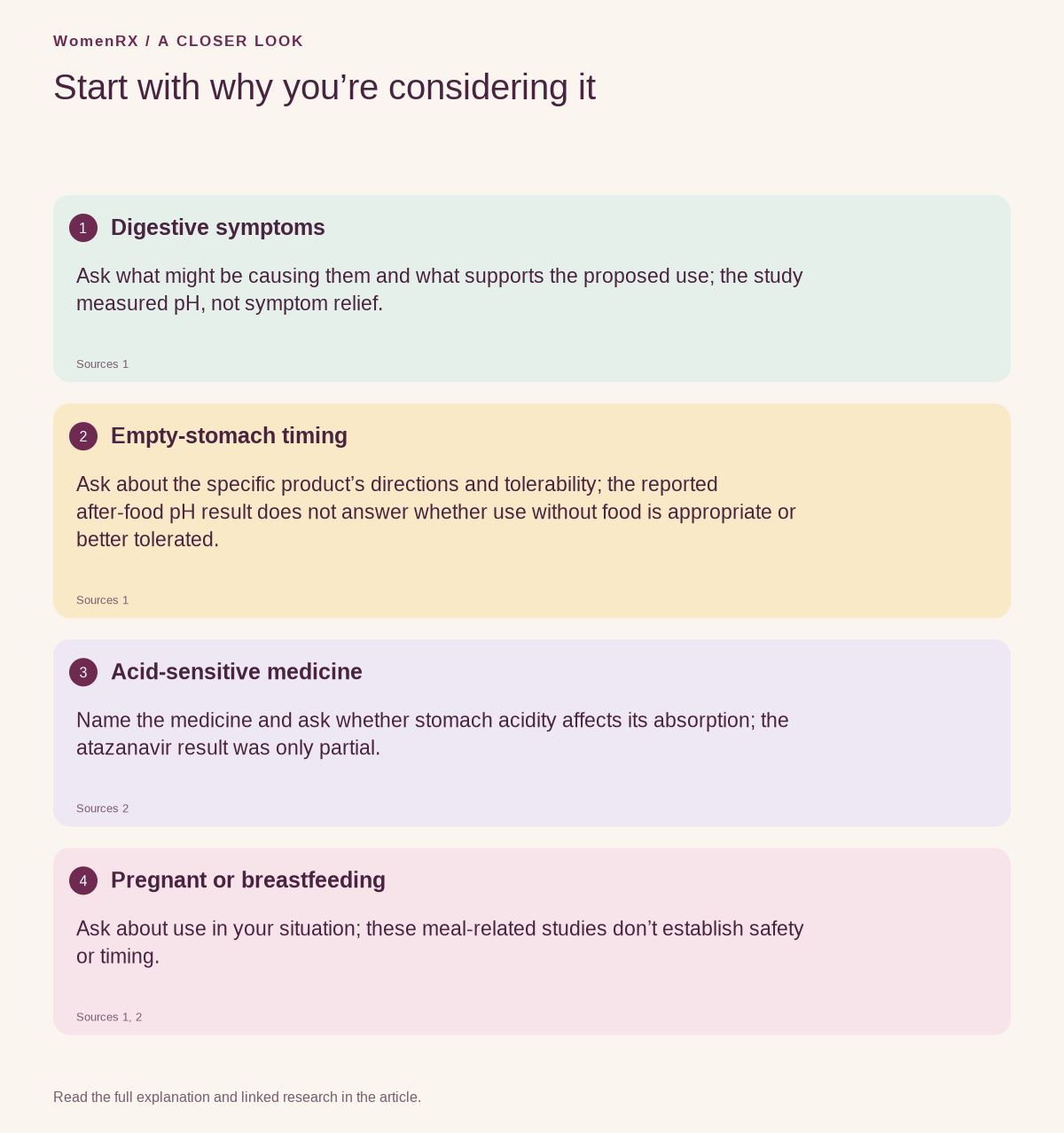
Start with why you’re considering it
Digestive symptoms: Ask what might be causing them and what supports the proposed use; the study measured pH, not symptom relief.1
Empty-stomach timing: Ask about the specific product’s directions and tolerability; the reported after-food pH result does not answer whether use without food is appropriate or better tolerated.1
Acid-sensitive medicine: Name the medicine and ask whether stomach acidity affects its absorption; the atazanavir result was only partial.2
Pregnant or breastfeeding: Ask about use in your situation; these meal-related studies don’t establish safety or timing.12
Read the figure as text
Your reason for considering betaine HCl points to a more useful next question than a one-size-fits-all meal schedule.- Digestive symptoms: Ask what might be causing them and what supports the proposed use; the study measured pH, not symptom relief.1
- Empty-stomach timing: Ask about the specific product’s directions and tolerability; the reported after-food pH result does not answer whether use without food is appropriate or better tolerated.1
- Acid-sensitive medicine: Name the medicine and ask whether stomach acidity affects its absorption; the atazanavir result was only partial.2
- Pregnant or breastfeeding: Ask about use in your situation; these meal-related studies don’t establish safety or timing.12
Sources you can check
- Food, Acid Supplementation and Drug Absorption - a Complicated Gastric Mix: a Randomized Control Trial.Surofchy DD, Frassetto LA, Benet LZ. · Pharmaceutical research · 2019Return to first citation
- Meal Effects Confound Attempts to Counteract Rabeprazole-Induced Hypochlorhydria Decreases in Atazanavir Absorption.Faber KP, Wu HF, Yago MR, Xu X, Kadiyala P, Frassetto LA, Benet LZ. · Pharmaceutical research · 2017Return to first citation