Betaine HCl: What the Safety Evidence Can Tell You
Betaine HCl can temporarily make the stomach more acidic, but that doesn’t show that it treats everyday indigestion or is safe for everyone.
Betaine HCl is an acidifying supplement, not a proven fix for digestive symptoms or a way to diagnose “low stomach acid.” A very small human study found no significant side effects during a short test, but it can’t establish general safety. If you have reflux or an ulcer concern, take acid-reducing medicine, or are pregnant or breastfeeding, the evidence doesn’t settle whether it’s right for you. 2
What betaine HCl does, and what it doesn’t prove
Betaine hydrochloride (Betaine HCl) is an acidifying agent available in capsule form. Its demonstrated action in the limited human research is simpler: it can briefly lower stomach pH, making the stomach more acidic. That effect doesn’t prove that a person’s symptoms come from low stomach acid, or that taking the supplement will relieve them. 2
Low stomach acid can occur in specific conditions, including autoimmune gastritis, where stomach acid-producing cells are damaged. That is different from assuming that common digestive discomfort means you have low acid. A review proposing acid replacement for autoimmune gastritis describes a potential approach, not proof that over-the-counter Betaine HCl is an established treatment for general digestive symptoms. 2
What the human safety findings actually show
The most directly relevant short-term human safety finding comes from a pilot study of six volunteers whose stomach acid had been suppressed with a proton pump inhibitor (PPI). After a single test with Betaine HCl and pepsin, researchers monitored stomach pH for two hours and reported no significant adverse effects or gastrointestinal side effects. That tiny, brief study cannot tell us how often problems occur with repeated use, who is most at risk, or whether the supplement is safe for people with reflux, ulcers, or other health conditions. 2
The same review describes research in which Betaine HCl affected the absorption of dasatinib, a prescription cancer medicine, in people taking a PPI. This doesn’t establish interactions with every medicine, but it does show why changing stomach acidity can matter for medication absorption. If you take a prescription medicine, especially one whose absorption may depend on stomach acidity, check with your prescriber or pharmacist before adding Betaine HCl. Don’t change an acid-reducing medicine to make room for a supplement. 2
If you have reflux or an ulcer concern
Betaine HCl is intended to increase stomach acidity. The small human study doesn’t show that it helps reflux or establish that it’s safe for people with reflux. It also doesn’t tell us whether acidifying the stomach affects heartburn or regurgitation symptoms. 2
The same evidence gap applies if you’re concerned about an ulcer. The reviewed human study was not a safety study in people with ulcers, so it can’t tell you whether Betaine HCl is appropriate for you. Get the cause of ongoing symptoms assessed rather than treating the supplement as a test of stomach acid.
Pregnancy and breastfeeding
The limited human findings described here don’t establish safety during pregnancy or breastfeeding. That isn’t proof of harm, but it does mean the short study in six volunteers can’t answer the question. If you’re considering Betaine HCl during pregnancy or while breastfeeding, you could ask your pregnancy or postpartum care team or pharmacist to review the specific product and your situation. 2
General breastfeeding guidance notes that some medicines can pass into breast milk and advises checking when there are concerns. It doesn’t address Betaine HCl specifically, so it can’t establish whether this supplement is safe while breastfeeding. 1
A useful way to decide
Before considering a product, separate three questions: Has low stomach acid actually been identified as the problem? Could changing stomach acidity affect a medicine you take? And is there evidence for the product in your particular situation, such as reflux, an ulcer concern, pregnancy, or breastfeeding? For most everyday digestive symptoms, the supplement’s ability to acidify the stomach is not enough to answer those questions. 2
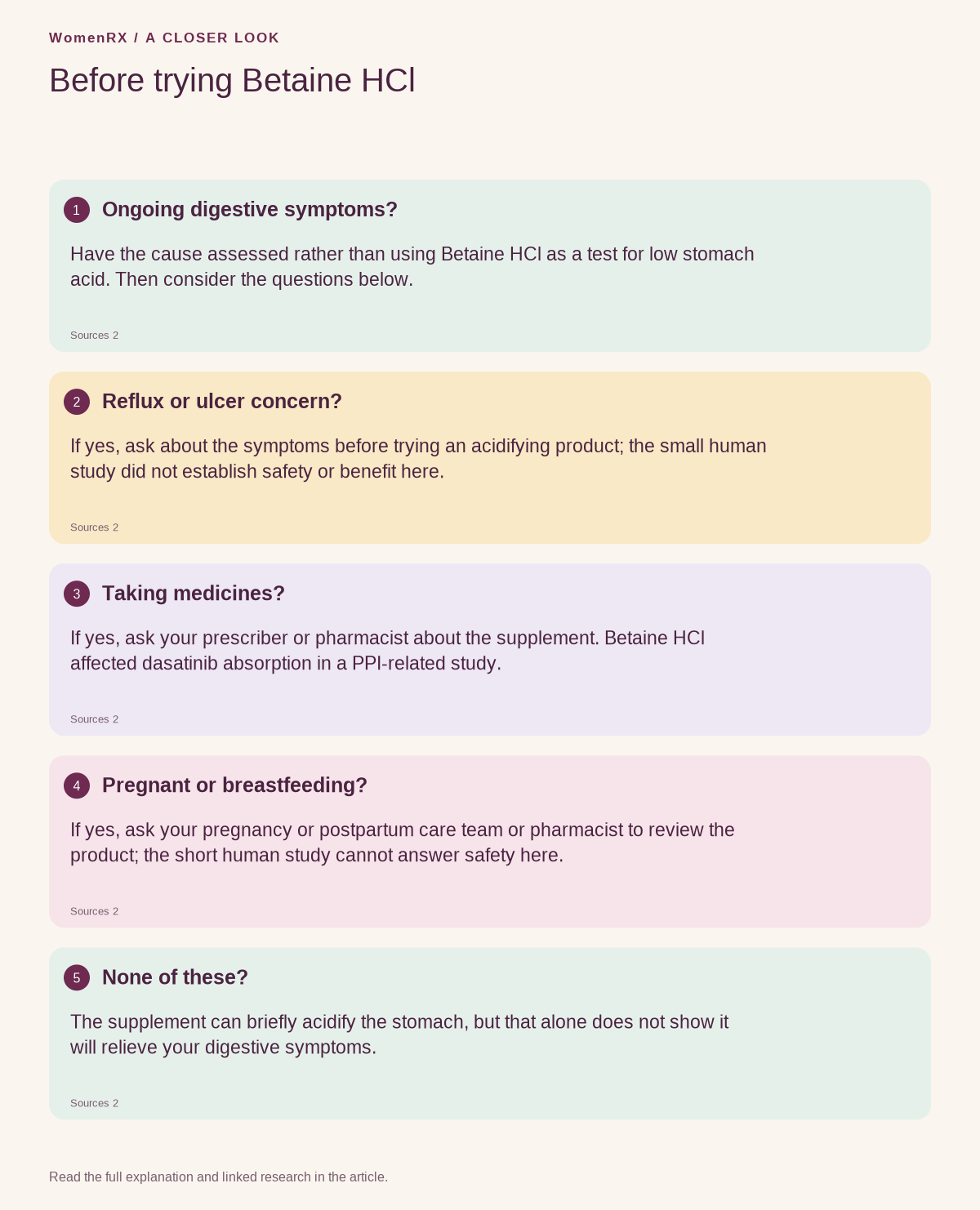
Before trying Betaine HCl
Ongoing digestive symptoms?: Have the cause assessed rather than using Betaine HCl as a test for low stomach acid. Then consider the questions below.2
Reflux or ulcer concern?: If yes, ask about the symptoms before trying an acidifying product; the small human study did not establish safety or benefit here.2
Taking medicines?: If yes, ask your prescriber or pharmacist about the supplement. Betaine HCl affected dasatinib absorption in a PPI-related study.2
Pregnant or breastfeeding?: If yes, ask your pregnancy or postpartum care team or pharmacist to review the product; the short human study cannot answer safety here.2
None of these?: The supplement can briefly acidify the stomach, but that alone does not show it will relieve your digestive symptoms.2
Read the figure as text
Start with your symptoms, then follow each question that applies before deciding whether to try a supplement.- Ongoing digestive symptoms?: Have the cause assessed rather than using Betaine HCl as a test for low stomach acid. Then consider the questions below.2
- Reflux or ulcer concern?: If yes, ask about the symptoms before trying an acidifying product; the small human study did not establish safety or benefit here.2
- Taking medicines?: If yes, ask your prescriber or pharmacist about the supplement. Betaine HCl affected dasatinib absorption in a PPI-related study.2
- Pregnant or breastfeeding?: If yes, ask your pregnancy or postpartum care team or pharmacist to review the product; the short human study cannot answer safety here.2
- None of these?: The supplement can briefly acidify the stomach, but that alone does not show it will relieve your digestive symptoms.2
More questions, answered
Does indigestion mean I have low stomach acid?
No. A digestive symptom by itself doesn’t measure stomach acidity or establish a cause. Betaine HCl’s ability to lower stomach pH doesn’t show that low acid is behind your symptoms or that the supplement will help. 2
Can Betaine HCl affect prescription medicines?
It can change stomach acidity, which may affect how some medicines are absorbed. Research described in a review found an effect on absorption of the cancer medicine dasatinib in people taking a PPI; that result doesn’t establish the effect on every medication. Ask a pharmacist or prescriber about your own medicines before using it. 2
Sources you can check
- Breastfeeding | Benefits of Breastfeeding | MedlinePlusAccessed 2026-09-25Return to first citation
- Creating a Framework for Treating Autoimmune Gastritis-The Case for Replacing Lost Acid.Taylor L, McCaddon A, Wolffenbuttel BHR. · Nutrients · 2024Return to first citation