Betaine HCl Labels: What to Check Before Buying
Check the exact form, the evidence behind the product’s claims, and whether its acidifying effect makes self-treatment a poor fit.
Betaine HCl is an acidifying ingredient, but the human evidence described in a 2024 review is limited: a small experiment tested its effect on stomach acidity, not whether it reliably treats everyday digestive symptoms. Before comparing products, confirm the label says betaine hydrochloride, check what else is included, and don’t treat a product claim or a burning sensation as proof you need extra acid. Pregnancy and breastfeeding safety aren’t established by the limited human findings discussed here. 2
Betaine HCl products are sometimes promoted as a way to increase stomach acid. The label can tell you what a capsule contains; it can’t show that you have low stomach acid or that taking the product will help your symptoms. The human evidence discussed in a 2024 review is narrow, so a useful buyer’s checklist starts with the formulation and the reason for the claim, not a brand ranking. 2
First, check which betaine you’re looking at
Look for betaine hydrochloride in the ingredient list. Betaine HCl is the hydrochloride form that releases acid in the stomach. It isn’t interchangeable with betaine anhydrous simply because both labels say “betaine.” The review distinguishes betaine HCl from betaine anhydrous, which is used for a different purpose. Evidence for one form shouldn’t be carried over to the other. 2
Next, check the amount per serving and how many capsules make up that serving. If the label includes pepsin or other active ingredients, note those separately. A product with several ingredients isn’t evidence that each one is useful, and its claims shouldn’t be assumed to apply to the combination as a whole. 2
Ask what the evidence actually tested
The human research summarized in the review includes a small experiment in six volunteers whose stomach acidity had been reduced with a proton-pump inhibitor. Researchers monitored stomach pH after betaine HCl; the study examined short-term acidification, not whether the product relieves common digestive complaints over time. A separate study looked at absorption of a particular medicine in the setting of acid suppression. That narrow finding isn’t a reason to use betaine HCl to manage a medication or to assume it improves absorption generally. 2
The review discusses possible uses in autoimmune gastritis, a condition in which damage to acid-producing stomach cells can reduce acid. But it says clinical trials are needed to assess betaine HCl’s effectiveness in people with that condition. A proposed mechanism or a change in stomach pH is not the same as demonstrated symptom relief or a proven benefit for a specific diagnosis. 2
A label promising to “restore stomach acid” or improve digestion may sound decisive. Ask whether the claim is supported by human studies of the same ingredient, for the same reason you’re considering it, with outcomes that matter to you. The findings described above don’t establish those broader benefits. 2
Treat acidification as a real tradeoff
Betaine HCl is intended to acidify stomach contents. The review describes capsules as a way to limit contact between acid and the teeth and esophagus, but that does not establish that a product is harmless or suitable for everyone. It also describes a “burning” sensation as part of an informal approach to adjusting use. That sensation isn’t a validated test for low stomach acid or a reliable way to establish a safe amount, so it’s not a sound basis for self-titrating. 2
The small experiment in six volunteers reported no significant adverse effects during the monitored period. That short, limited observation can’t establish safety with repeated use or for people who weren’t studied. The evidence summarized in the review doesn’t provide a dependable estimate of how often unwanted effects occur. 2
Make pregnancy and breastfeeding part of the check
The human findings described in the review don’t establish safety during pregnancy or breastfeeding. A study in pregnant and nursing pigs examined betaine HCl in animal feed and reported changes in measures in their piglets. It is animal research, not evidence that a supplement is safe or beneficial for pregnant or breastfeeding women. 1
If you’re pregnant, breastfeeding, or planning pregnancy, don’t infer safety from a product label or animal findings. This evidence doesn’t resolve those questions.
A practical label check
Before choosing a product, see whether you can answer these questions from the label and the evidence behind its claims:
- Does the ingredient list say betaine hydrochloride, rather than only betaine?
- What is the amount per serving, and what other active ingredients are included?
- Is the claim based on a human study of this form for the same intended use?
- Is the evidence about a short-term change in stomach acidity, or an outcome such as symptom relief?
- Could pregnancy, breastfeeding, or an acid-related concern make self-treatment a poor choice?
If the product’s purpose is to correct “low stomach acid,” pause before treating that label claim as a diagnosis. Autoimmune gastritis is one specific cause of low acid described in the review; a supplement’s ability to lower stomach pH in a small experiment doesn’t establish that you have this condition or that the product addresses the cause. 2
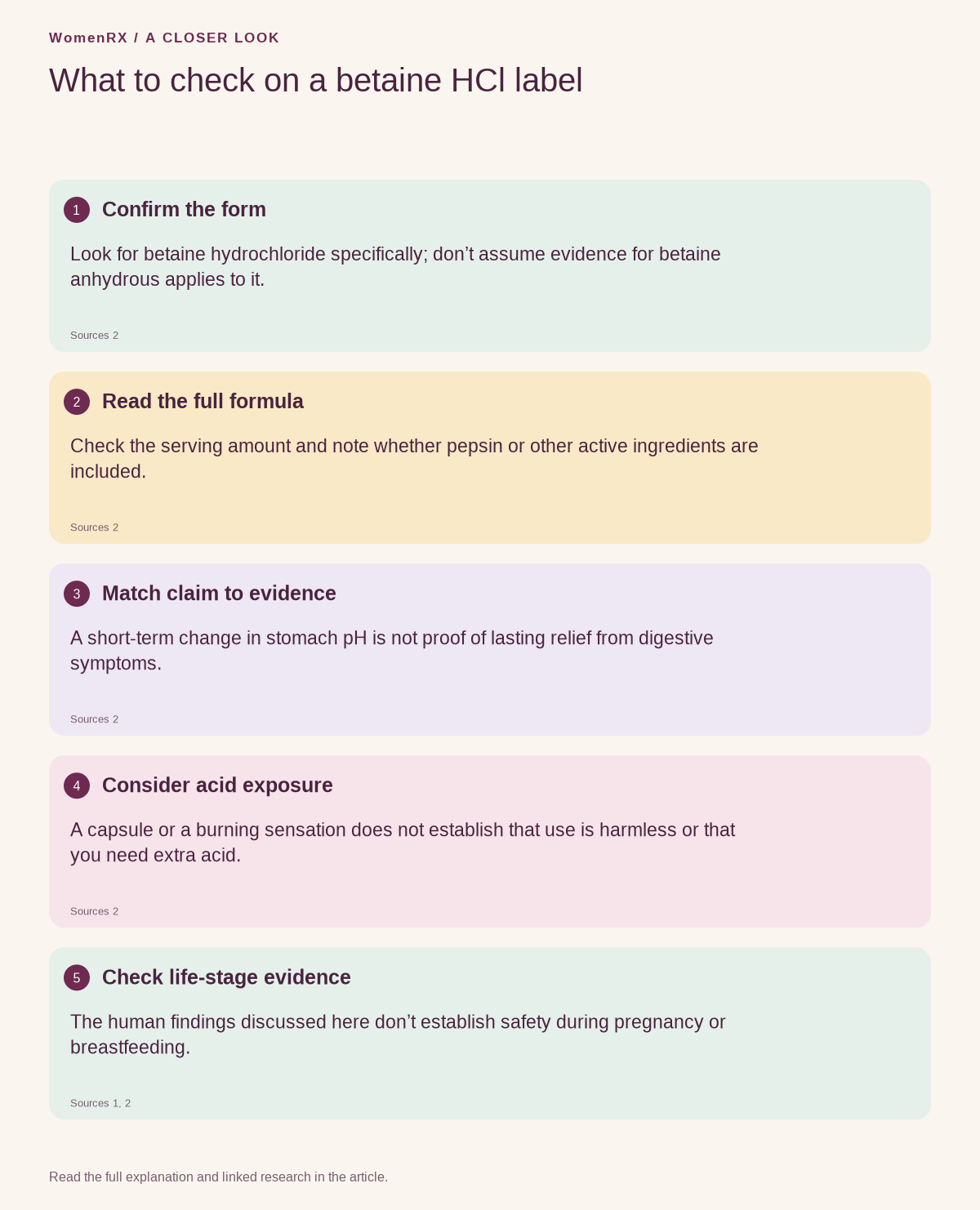
What to check on a betaine HCl label
Confirm the form: Look for betaine hydrochloride specifically; don’t assume evidence for betaine anhydrous applies to it.2
Read the full formula: Check the serving amount and note whether pepsin or other active ingredients are included.2
Match claim to evidence: A short-term change in stomach pH is not proof of lasting relief from digestive symptoms.2
Consider acid exposure: A capsule or a burning sensation does not establish that use is harmless or that you need extra acid.2
Check life-stage evidence: The human findings discussed here don’t establish safety during pregnancy or breastfeeding.12
Read the figure as text
Use these questions to separate what the product contains from what the evidence actually shows.- Confirm the form: Look for betaine hydrochloride specifically; don’t assume evidence for betaine anhydrous applies to it.2
- Read the full formula: Check the serving amount and note whether pepsin or other active ingredients are included.2
- Match claim to evidence: A short-term change in stomach pH is not proof of lasting relief from digestive symptoms.2
- Consider acid exposure: A capsule or a burning sensation does not establish that use is harmless or that you need extra acid.2
- Check life-stage evidence: The human findings discussed here don’t establish safety during pregnancy or breastfeeding.12
More questions, answered
Does a burning feeling show that I need betaine HCl?
No. The review describes burning as a sensation used in an informal approach to adjusting use, but it does not establish burning as a diagnostic test for low stomach acid or a validated way to find a safe amount. 2
Is betaine HCl the same as betaine anhydrous?
No. They are different forms. The review discusses betaine HCl as an acidifying agent and distinguishes it from betaine anhydrous; claims or evidence for one form shouldn’t automatically be applied to the other. 2
Sources you can check
- Betaine hydrochloride addition in Bama mini-pig's diets during gestation and lactation enhances immunity and alters intestine microbiota of suckling piglets.Azad MAK, Gao Q, Ma C, Wang K, Kong X. · Journal of the science of food and agriculture · 2022Return to first citation
- Creating a Framework for Treating Autoimmune Gastritis-The Case for Replacing Lost Acid.Taylor L, McCaddon A, Wolffenbuttel BHR. · Nutrients · 2024Return to first citation