Chromium After 40: Does Age Change the Case?
Being over 40 isn’t, by itself, a reason to take chromium; the useful question is what health outcome you expect it to change.
There’s no established chromium benefit specific to women over 40 or to menopause. Some studies in adults with diabetes found small improvements in blood sugar when chromium was added to treatment, but the clinical value is unclear. Cholesterol results conflict. Even the chromium intake reference goes down, not up, after age 50. Consider a supplement claim in light of a specific health concern, not an age-based promise. 123
The age change on the label isn’t a supplement recommendation
If chromium is being marketed to you as a midlife metabolism fix, start with the distinction between how much people typically need to take in and whether an extra supplement improves health. They’re different questions.
The Adequate Intake (AI) for chromium is 25 micrograms (mcg) a day for women ages 19 to 50 and 20 mcg a day from age 51 onward. Researchers set an AI, rather than a more precise requirement, because the evidence was insufficient to establish one. The lower reference after 50 doesn’t show that menopause changes your need for a supplement. 1
Chromium occurs in foods such as meats, grain products, fruits, vegetables, and nuts, though amounts vary with growing and processing conditions. A food list therefore won’t give you a precise personal chromium total. That uncertainty isn’t evidence of a deficiency, or a reason to buy chromium because you’ve had a birthday. 1
What adult studies can, and can’t, tell you
For blood sugar: Chromium has been investigated because it might affect insulin’s action. A review summarized by the NIH Office of Dietary Supplements brought together eight systematic reviews and meta-analyses covering 58 clinical trials. In people with diabetes, chromium used alongside other treatment produced small overall reductions in fasting blood glucose and HbA1c, a measure of longer-term blood glucose. The clinical importance of those changes was unclear, and other trials have had inconsistent results. The fact sheet reports that diabetes guidance does not support routine chromium supplementation for glucose control. These are not findings that establish a special benefit after 40. 1
For cholesterol: The answer depends partly on which outcome and which review you read. A meta-analysis of 38 studies involving 7,605 participants found an overall reduction in total cholesterol, but not LDL cholesterol. It also reported subgroup signals for women and for older adults on some lipid measures. Those are separate subgroup findings, not a demonstrated result for women over 40 or women in menopause. 3
An umbrella review pooling eight meta-analyses, meanwhile, found no significant overall effect on triglycerides, total cholesterol, LDL, or HDL cholesterol. Taken together, the reviews don’t make chromium a dependable cholesterol treatment. 23
A study doesn’t become menopause-specific simply because its participants were middle-aged. For example, a trial in adults with metabolic syndrome and impaired glucose tolerance had a mean participant age of 58; chromium did not improve fasting glucose, HbA1c, waist circumference, blood pressure, or lipids over 24 weeks. The result is relevant to that health condition, but it does not isolate the effect of menopause or tell us whether midlife women respond differently. 1
Put a specific claim next to your care plan
Suppose a product promises “metabolism support.” What would count as success for you: a change in HbA1c, a particular cholesterol measure, or something else? If the claim says “for menopause,” did the research actually report results by menopausal status? A study of adults across a wide age range can’t answer that question on its own.
Then ask what place the supplement would have alongside care you already use. For blood sugar, the modest results in some studies came from chromium added to other treatment, not chromium replacing it. For cholesterol, the conflicting reviews don’t establish a reliable benefit to build a treatment plan around. 123
Finally, check what the product contains. Chromium-only supplements commonly provide 200 to 500 mcg, while many multivitamins provide 35 to 120 mcg. Neither a larger number nor the words “chromium picolinate” establish that a product will help your particular concern. The absence of an established upper intake limit is not proof that high intakes are risk-free: safety data are limited, and people with kidney or liver disease may be more susceptible to adverse effects. 1
The most useful filter is a concrete one: What outcome am I hoping to change, and is there evidence that chromium helps people in my situation? Being over 40, on its own, doesn’t answer either part.
What chromium evidence answers
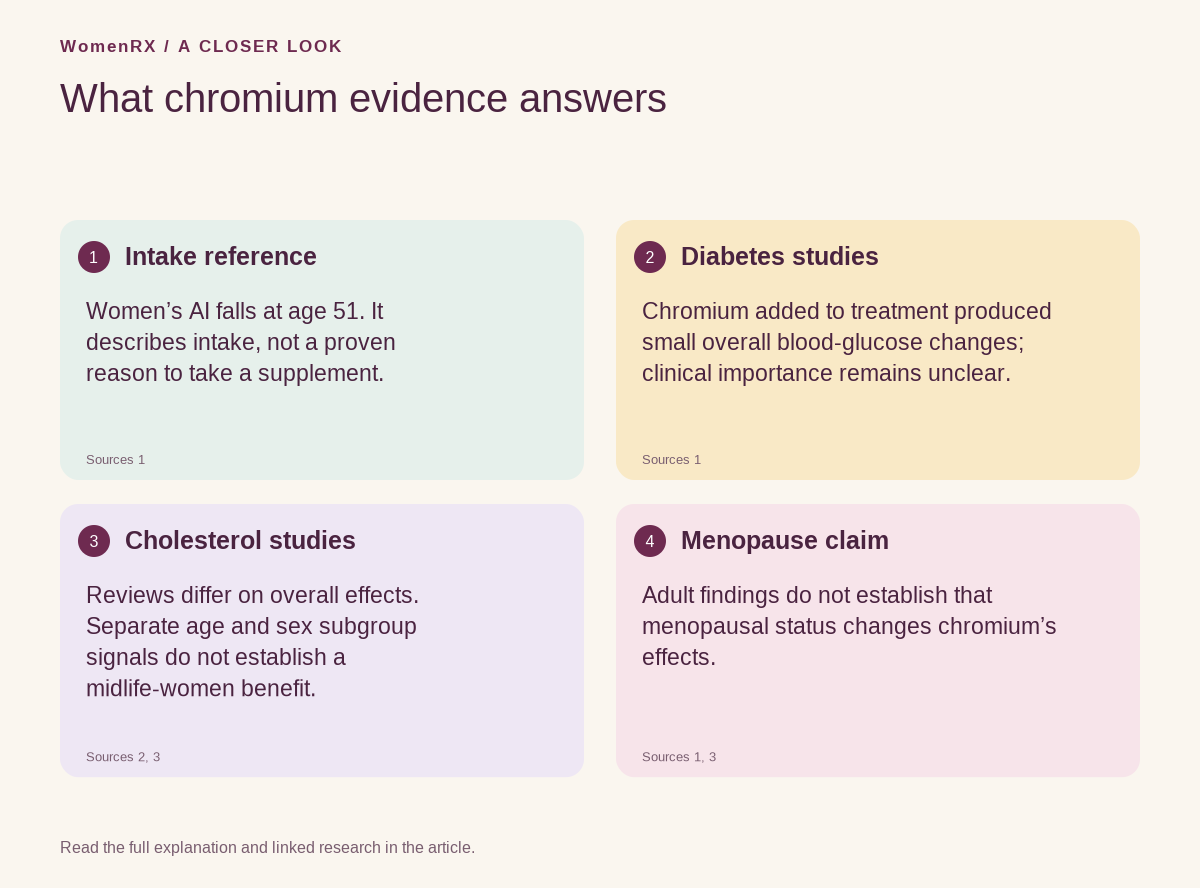
Intake reference: Women’s AI falls at age 51. It describes intake, not a proven reason to take a supplement.1
Diabetes studies: Chromium added to treatment produced small overall blood-glucose changes; clinical importance remains unclear.1
Cholesterol studies: Reviews differ on overall effects. Separate age and sex subgroup signals do not establish a midlife-women benefit.23
Menopause claim: Adult findings do not establish that menopausal status changes chromium’s effects.13
Read the figure as text
An intake reference and studies in adults answer different questions from a claim aimed specifically at midlife women.- Intake reference: Women’s AI falls at age 51. It describes intake, not a proven reason to take a supplement.1
- Diabetes studies: Chromium added to treatment produced small overall blood-glucose changes; clinical importance remains unclear.1
- Cholesterol studies: Reviews differ on overall effects. Separate age and sex subgroup signals do not establish a midlife-women benefit.23
- Menopause claim: Adult findings do not establish that menopausal status changes chromium’s effects.13
More questions, answered
Is chromium picolinate proven to work better for midlife women?
No midlife- or menopause-specific advantage is established. Chromium picolinate is a commonly studied supplement form, but adult results for blood sugar and cholesterol don’t demonstrate that it works better because of a woman’s age or menopausal status. 13
Sources you can check
- Chromium - Health Professional Fact SheetAccessed 2026-09-25Return to first citation
- Effects of Chromium Supplementation on Lipid Profile: an Umbrella of Systematic Review and Meta-analysis.Vajdi M, Musazadeh V, Karimi A, Heidari H, Tarrahi MJ, Askari G. · Biological trace element research · 2023Return to first citation
- The effects of chromium supplementation on lipidprofile in humans: A systematic review and meta-analysis ofrandomized controlled trials.Tarrahi MJ, Tarrahi MA, Rafiee M, Mansourian M. · Pharmacological research · 2021Return to first citation