Chromium Supplements: Does Timing Matter?
Human studies don’t establish a best time of day for chromium, and the evidence for blood sugar and weight benefits is mixed.
There’s no established best time to take chromium: the human trials discussed here studied effects over weeks or months, not morning versus evening or taking it with food. Some trials reported changes in glucose or weight, but results aren’t consistent or broadly applicable. If you take medicine for blood sugar, review chromium with your care team before adding it, since a trial found improved glucose measures when it was added to a diabetes medicine. 123
Timing hasn’t been tested as the deciding factor
If you’re deciding between taking chromium in the morning, at night, or with a meal, this research doesn’t point to a winner. Human trials measured outcomes after weeks or months of supplementation; they did not compare times of day or meal timing. That means there isn’t an evidence-based “best time” to recommend from these studies. 134
This is different from evidence that timing makes no difference. It means the trials don’t answer that question. If you’re already taking chromium, timing alone shouldn’t be treated as a way to make its effects more reliable.
Blood sugar results vary by study
A 2025 review pooled 20 trials involving people with overweight or obesity. The estimated change in fasting glucose was small and didn’t meet the usual threshold for statistical significance: −1.60 mg/dL, with a confidence interval that included no change. The pooled A1C change was also not statistically significant. The review reported changes in some other metabolic measures, but these glucose results don’t establish chromium as a dependable way to improve blood sugar. 2
Individual trials have reported more favorable results in narrower groups. For example, a 12-week trial in 64 people with type 2 diabetes and coronary heart disease found lower fasting glucose in the chromium group than in the placebo group. A separate six-month trial in people with type 2 diabetes who were taking glipizide reported improved glucose control when chromium was added. Those findings are worth noting, but they don’t show that everyone with diabetes will benefit. 31
A change in weight isn’t proof of a weight-loss supplement
Weight findings also need context. In the 12-week trial of people with diabetes and coronary heart disease, the chromium group’s average weight fell by 0.9 kg while the placebo group’s rose by 0.1 kg. That result comes from one specific study population and timeframe; it doesn’t show that chromium reliably produces meaningful or lasting weight loss for other people. 3
A trial in overweight women with polycystic ovary syndrome (PCOS) reported weight and glucose changes after participants took chromium with carnitine. Since both supplements were given together, the study can’t tell whether chromium alone caused the changes. It also can’t establish the same effect for women without PCOS. 4
Check before combining it with diabetes medicine
The glipizide trial is a reason to discuss chromium before adding it to a blood-sugar treatment plan: glucose measures improved in the group taking both. It does not prove that chromium causes a harmful interaction, or that the combination is safe for every person. Tell the clinician or pharmacist managing your diabetes which product you’re considering so they can assess it alongside your medicines and glucose results. Don’t use a supplement to replace prescribed treatment. 1
The women-specific evidence here is limited. One PCOS trial included women, but tested chromium alongside carnitine. The other trials summarized here don’t report results by sex in their abstracts. These studies also don’t provide pregnancy-specific results, so they can’t guide a decision about chromium during pregnancy. 1234
A practical way to read the claims
When a product promises better blood sugar and weight loss, separate those outcomes. A change in an insulin measure or fasting glucose is not the same as reliable improvement in A1C, and neither by itself proves lasting weight loss. For chromium, the pooled glucose estimates are uncertain, and the weight findings come from particular study groups rather than a consistent result across everyday users. 23
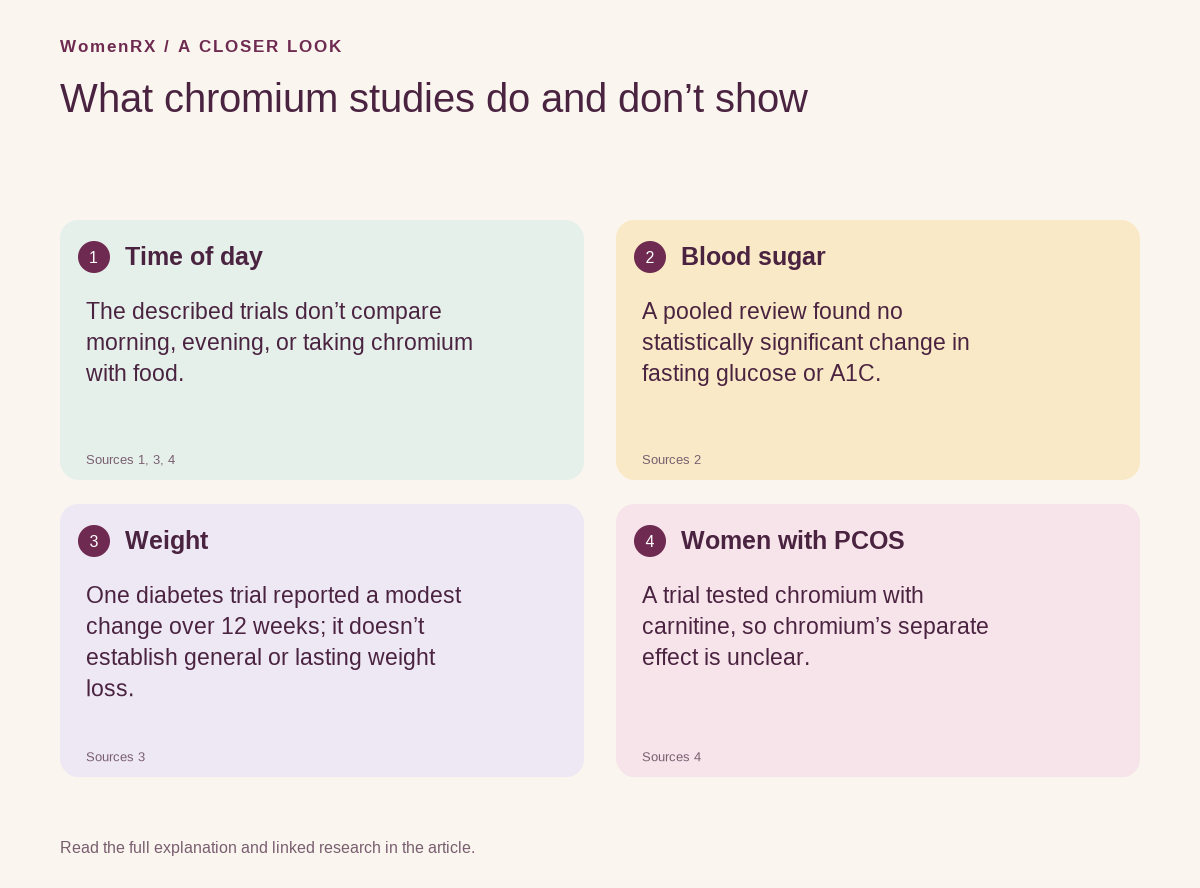
What chromium studies do and don’t show
Time of day: The described trials don’t compare morning, evening, or taking chromium with food.134
Blood sugar: A pooled review found no statistically significant change in fasting glucose or A1C.2
Weight: One diabetes trial reported a modest change over 12 weeks; it doesn’t establish general or lasting weight loss.3
Women with PCOS: A trial tested chromium with carnitine, so chromium’s separate effect is unclear.4
Read the figure as text
Compare the question people ask about chromium with the outcomes and limits reported in human studies.- Time of day: The described trials don’t compare morning, evening, or taking chromium with food.134
- Blood sugar: A pooled review found no statistically significant change in fasting glucose or A1C.2
- Weight: One diabetes trial reported a modest change over 12 weeks; it doesn’t establish general or lasting weight loss.3
- Women with PCOS: A trial tested chromium with carnitine, so chromium’s separate effect is unclear.4
More questions, answered
Does chromium need to be taken with food?
The human studies discussed here don’t compare taking chromium with food against taking it without food, so they don’t establish a meal-related advantage. Follow the product directions, and check with your pharmacist if you take glucose-lowering medicine. 134
Is chromium proven to help with weight loss?
No. Some trials report modest weight changes in specific groups, but the findings don’t establish reliable, lasting weight loss from chromium alone. In a PCOS trial, chromium was combined with carnitine, so its separate effect can’t be determined. 34
Sources you can check
- Chromium picolinate supplementation attenuates body weight gain and increases insulin sensitivity in subjects with type 2 diabetes.Martin J, Wang ZQ, Zhang XH, Wachtel D, Volaufova J, Matthews DE, Cefalu WT. · Diabetes care · 2006Return to first citation
- The effect of chromium supplementation on cardio-metabolic risk factors in overweight and obese patients. A systematic review and meta-analysis of randomized controlled trial.Monfared V, Rashin H, Malekinejad S, Sheikhi L, Yousefi M, Vakili MA, Hasani M. · Journal of trace elements in medicine and biology : organ of the Society for Minerals and Trace Elements (GMS) · 2025Return to first citation
- The Influences of Chromium Supplementation on Metabolic Status in Patients with Type 2 Diabetes Mellitus and Coronary Heart Disease.Farrokhian A, Mahmoodian M, Bahmani F, Amirani E, Shafabakhsh R, Asemi Z. · Biological trace element research · 2020Return to first citation
- Effects of Chromium and Carnitine Co-supplementation on Body Weight and Metabolic Profiles in Overweight and Obese Women with Polycystic Ovary Syndrome: a Randomized, Double-Blind, Placebo-Controlled Trial.Jamilian M, Foroozanfard F, Kavossian E, Kia M, Aghadavod E, Amirani E, Asemi Z. · Biological trace element research · 2020Return to first citation