Chromium for Blood Sugar: What the Trials Show
Chromium improved glucose markers in some type 2 diabetes trials, but results vary and don’t show that it prevents complications.
Chromium supplements may improve fasting glucose or A1C for some people with type 2 diabetes, but trial results are inconsistent. The research largely measures glucose markers over months, not whether people have fewer diabetes complications. It also doesn’t establish a benefit for gestational diabetes or PCOS. Chromium isn’t a reason to replace or change your diabetes treatment. 3 5 6
If a chromium bottle promises blood sugar support, the useful question is what kind of support has actually been tested. The strongest evidence concerns glucose measurements in people who already have type 2 diabetes. It’s less clear whether a particular product would help you, and the trials don’t show that chromium prevents the health problems diabetes can cause. 3 6
An improved average isn’t a predictable result
A 2020 meta-analysis of randomized trials in people with type 2 diabetes found average improvements in fasting glucose and A1C, along with insulin-related measures. But fasting-glucose results varied enormously across studies. The pooled result suggests a possible benefit, not an amount of improvement you should expect from a bottle on the shelf. 3
A separate review of supplements used alongside diabetes medicines also found improvements in A1C, fasting glucose, and an estimate of insulin resistance with chromium. That add-on setting matters: these findings don’t test chromium as a substitute for treatment. 7
A1C reflects average blood glucose over roughly three months, while a fasting glucose test captures a particular moment. Both can help assess glucose control. Neither tells us, by itself, whether taking chromium leads to fewer diabetes complications. 1 3
Does the form of chromium make a difference?
Possibly, but the trials don’t give shoppers a reliable winner. A systematic review includes studies of chromium picolinate, nicotinate, yeast, and chloride. It identifies differences in formulation, amount, and study duration as reasons the findings are hard to reconcile. 6
For example, a four-month randomized trial enrolled 71 people whose type 2 diabetes was not well controlled. Those assigned chromium picolinate or placebo continued their prescribed medicines and received nutrition guidance. Fasting and after-meal glucose fell from baseline in both groups, so this trial does not show that picolinate lowered those readings more than placebo. A1C also fell in both groups, and the chromium group had a lower A1C than the placebo group after treatment. 4
In another randomized trial, 56 people with type 2 diabetes were assigned chromium nicotinate or placebo. After 90 days, the groups did not differ significantly in fasting glucose, A1C, or an estimate of insulin resistance. These trials tested different groups of people under different conditions. Their contrasting results don’t prove that picolinate is better than nicotinate. 5 4
What changes in your treatment plan?
Chromium is best viewed as an uncertain add-on, not a replacement for the care that helps you manage diabetes. If you’re considering it, bring the exact product label to a medication review. A focused question is: “Does this product make sense with the medicines I take, and how would we judge whether it’s helping?” The research above doesn’t provide a dependable interaction answer for every chromium product and diabetes medicine. 4 6 7
If you use insulin or another diabetes medicine that can cause low blood glucose, mention that specifically. Low blood glucose can be dangerous, and glucose readings need to be interpreted in the context of your treatment plan. That’s a reason to review a supplement before changing your routine, not evidence that chromium itself has been shown to cause a low. 1
Pregnancy and PCOS are different questions
Gestational diabetes develops during pregnancy and has its own treatment considerations. Findings from type 2 diabetes trials don’t establish that chromium helps during pregnancy. Nor do those trials establish a benefit for PCOS. If either is the reason you’re considering chromium, a promising result in a general type 2 diabetes study isn’t enough to answer your question. 2 3 6
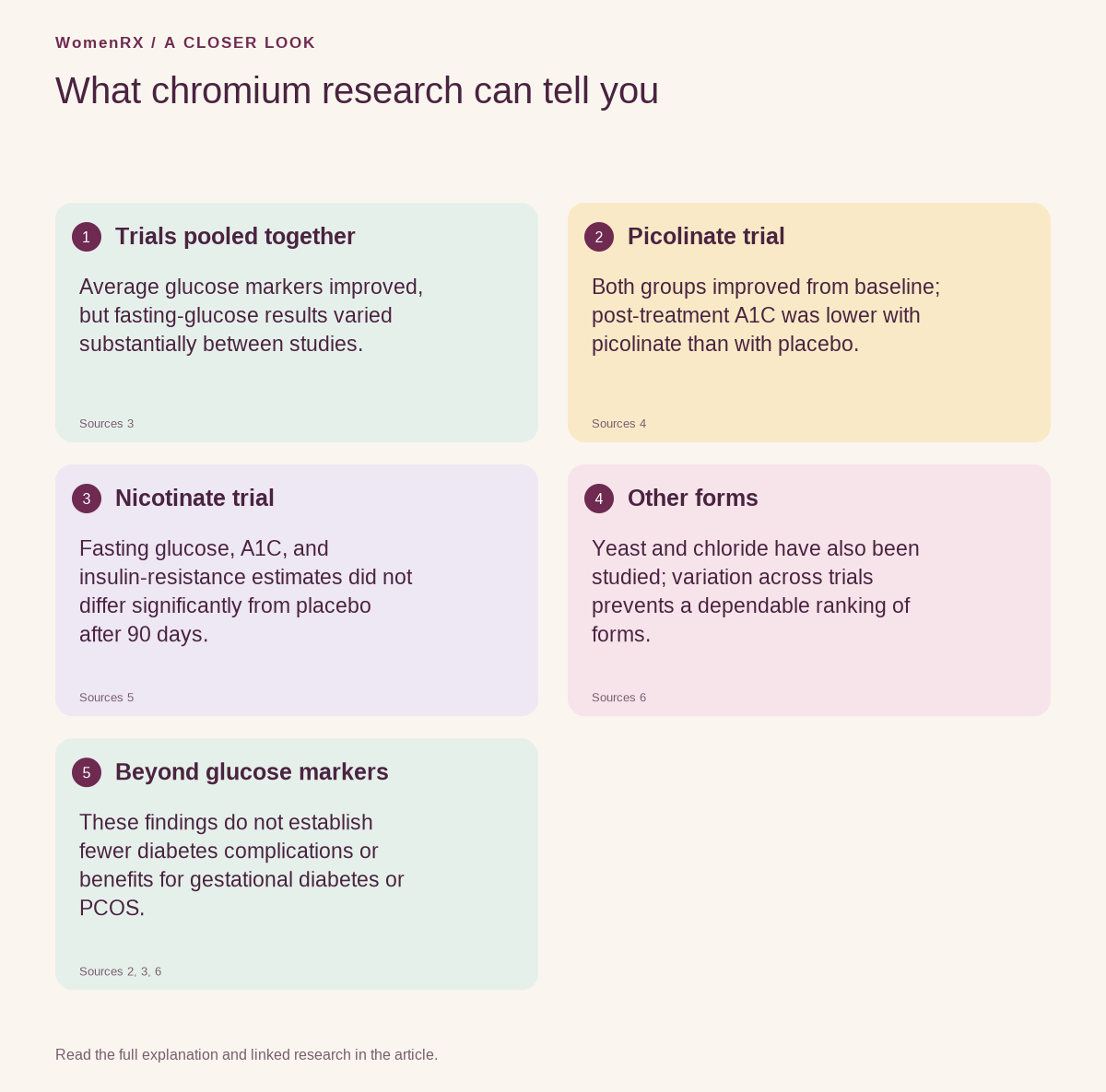
What chromium research can tell you
Trials pooled together: Average glucose markers improved, but fasting-glucose results varied substantially between studies.3
Picolinate trial: Both groups improved from baseline; post-treatment A1C was lower with picolinate than with placebo.4
Nicotinate trial: Fasting glucose, A1C, and insulin-resistance estimates did not differ significantly from placebo after 90 days.5
Other forms: Yeast and chloride have also been studied; variation across trials prevents a dependable ranking of forms.6
Beyond glucose markers: These findings do not establish fewer diabetes complications or benefits for gestational diabetes or PCOS.236
Read the figure as text
Different trials measured glucose markers in different type 2 diabetes populations. Their results cannot establish a best form or long-term health benefit.- Trials pooled together: Average glucose markers improved, but fasting-glucose results varied substantially between studies.3
- Picolinate trial: Both groups improved from baseline; post-treatment A1C was lower with picolinate than with placebo.4
- Nicotinate trial: Fasting glucose, A1C, and insulin-resistance estimates did not differ significantly from placebo after 90 days.5
- Other forms: Yeast and chloride have also been studied; variation across trials prevents a dependable ranking of forms.6
- Beyond glucose markers: These findings do not establish fewer diabetes complications or benefits for gestational diabetes or PCOS.236
More questions, answered
Can chromium prevent type 2 diabetes?
That hasn’t been established by the type 2 diabetes treatment trials reviewed here. Improvements in glucose markers among people who already have diabetes do not demonstrate that taking chromium prevents it. 3 6
Sources you can check
- Blood Glucose | Blood Sugar | Diabetes | MedlinePlusAccessed 2026-09-25Return to first citation
- Diabetes | Type 1 Diabetes | Type 2 Diabetes | MedlinePlusAccessed 2026-09-25Return to first citation
- Effects of chromium supplementation on glycemic control in patients with type 2 diabetes: a systematic review and meta-analysis of randomized controlled trials.Asbaghi O, Fatemeh N, Mahnaz RK, Ehsan G, Elham E, Behzad N, Damoon AL, Amirmansour AN. · Pharmacological research · 2020Return to first citation
- Beneficial effects of oral chromium picolinate supplementation on glycemic control in patients with type 2 diabetes: A randomized clinical study.Paiva AN, Lima JG, Medeiros AC, Figueiredo HA, Andrade RL, Ururahy MA, Rezende AA, Brandão-Neto J, Almeida Md. · Journal of trace elements in medicine and biology : organ of the Society for Minerals and Trace Elements (GMS) · 2015Return to first citation
- Chromium nicotinate has no effect on insulin sensitivity, glycemic control, and lipid profile in subjects with type 2 diabetes.Guimarães MM, Martins Silva Carvalho AC, Silva MS. · Journal of the American College of Nutrition · 2013Return to first citation
- Chromium supplementation and type 2 diabetes mellitus: an extensive systematic review.Georgaki MN, Tsokkou S, Keramas A, Papamitsou T, Karachrysafi S, Kazakis N. · Environmental geochemistry and health · 2024Return to first citation
- Could nutrient supplements provide additional glycemic control in diabetes management? A systematic review and meta-analysis of randomized controlled trials of as an add-on nutritional supplementation therapy.Kim Y, Oh YK, Lee J, Kim E. · Archives of pharmacal research · 2022Return to first citation