Chromium for Blood Sugar: What Studies Actually Measure
Trials measure more than one kind of blood-sugar change, and a shift in a lab result doesn’t by itself show that chromium improves diabetes care.
Chromium studies have measured fasting glucose, glucose after a challenge or meal, insulin-related markers, and HbA1c, usually over weeks or months. Results vary by population and trial: some show changes, while broader reviews find any average improvement in people with diabetes small and of unclear clinical importance. Chromium picolinate is the most frequently studied form, but that doesn’t establish it as a treatment or a replacement for prescribed care. 1
First, separate the outcomes
“Blood sugar improved” can describe several different measurements. Fasting glucose is a snapshot taken after a period without food. Post-meal or glucose-challenge results show how the body responds to glucose at a particular time. Insulin and calculated measures such as insulin resistance are related markers, but they aren’t interchangeable with blood glucose. HbA1c reflects longer-term glucose levels and is often more useful for judging sustained change than one reading. 1
That distinction matters when comparing headlines. A supplement might change fasting insulin or an insulin-resistance measure without changing fasting glucose or HbA1c. That is a change in a measured marker, not proof of a meaningful improvement in health or diabetes outcomes.
What trials in type 2 diabetes found
The results aren’t consistent. In one four-month randomized trial, 71 adults with poorly controlled type 2 diabetes continued their prescribed medications and received nutritional guidance; the chromium picolinate group had a larger average HbA1c reduction than the placebo group. Fasting and after-meal glucose also fell in both groups. This is a result from one trial, not a reliable estimate of what an individual will experience. 3
A 2019 review summarized eight systematic reviews and meta-analyses covering 58 clinical trials. Those trials varied in population, chromium form, amount, and duration. Overall, when chromium was used as an add-on by people with diabetes, reviews found slight reductions in fasting glucose and HbA1c, but the clinical significance was unclear. Another trial in adults with type 2 diabetes found no significant difference from placebo in fasting glucose, HbA1c, or insulin sensitivity after 24 weeks. 1
A separate 2025 meta-analysis of trials in people with overweight or obesity reported no statistically significant average effect on fasting glucose or HbA1c. These groups and study designs aren’t identical, but together they underline why a favorable result in one study shouldn’t be read as a dependable treatment effect. 4
The form is part of the comparison, not the conclusion
Chromium picolinate is the form most frequently used in the trials summarized by NIH. Other studies used chromium yeast or chromium chloride. NIH reports similar absorption across several supplement forms, but that doesn’t show that every form produces the same clinical outcomes. A label naming a form tells you what was tested; it doesn’t establish that the product will improve your glucose. 1
For example, a small trial in 40 women with PCOS who were planning IVF tested 200 μg/day of chromium for eight weeks. It found a modest between-group difference in fasting glucose and changes in insulin-related measures. That study was short and limited to a specific group; it can’t establish a benefit for women generally, or for PCOS care overall. Reviews of PCOS trials have found mixed results, including no clear effect on fasting glucose in one analysis. 2 1
One trial in overweight women with PCOS tested chromium picolinate together with carnitine. Because both were given together, its results can’t show that chromium alone caused the changes. 5
Use study results to ask better questions
Before comparing a study result with your own care, check who was enrolled, what form was used, what else participants were taking, and which outcome changed. Then ask whether the study measured the result that matters for your plan, and whether the change was large enough to affect care. A difference in an insulin marker, for instance, doesn’t automatically mean a meaningful difference in HbA1c.
If you’re considering a chromium supplement, tell the clinician managing your blood sugar what product and form you’re considering, and ask how it fits with your current monitoring and treatment. NIH notes that chromium might add to the glucose-lowering effects of insulin, metformin, or other diabetes medicines, potentially increasing the chance of low blood sugar. A small study also found that taking chromium picolinate at the same time as levothyroxine reduced levothyroxine absorption over six hours. 1
The practical bottom line: treat chromium trial results as mixed, outcome-specific evidence, not as a reason to change prescribed diabetes treatment. For your own comparison, focus on sustained measures such as HbA1c as well as glucose readings, and make medication questions part of the discussion before adding a supplement.
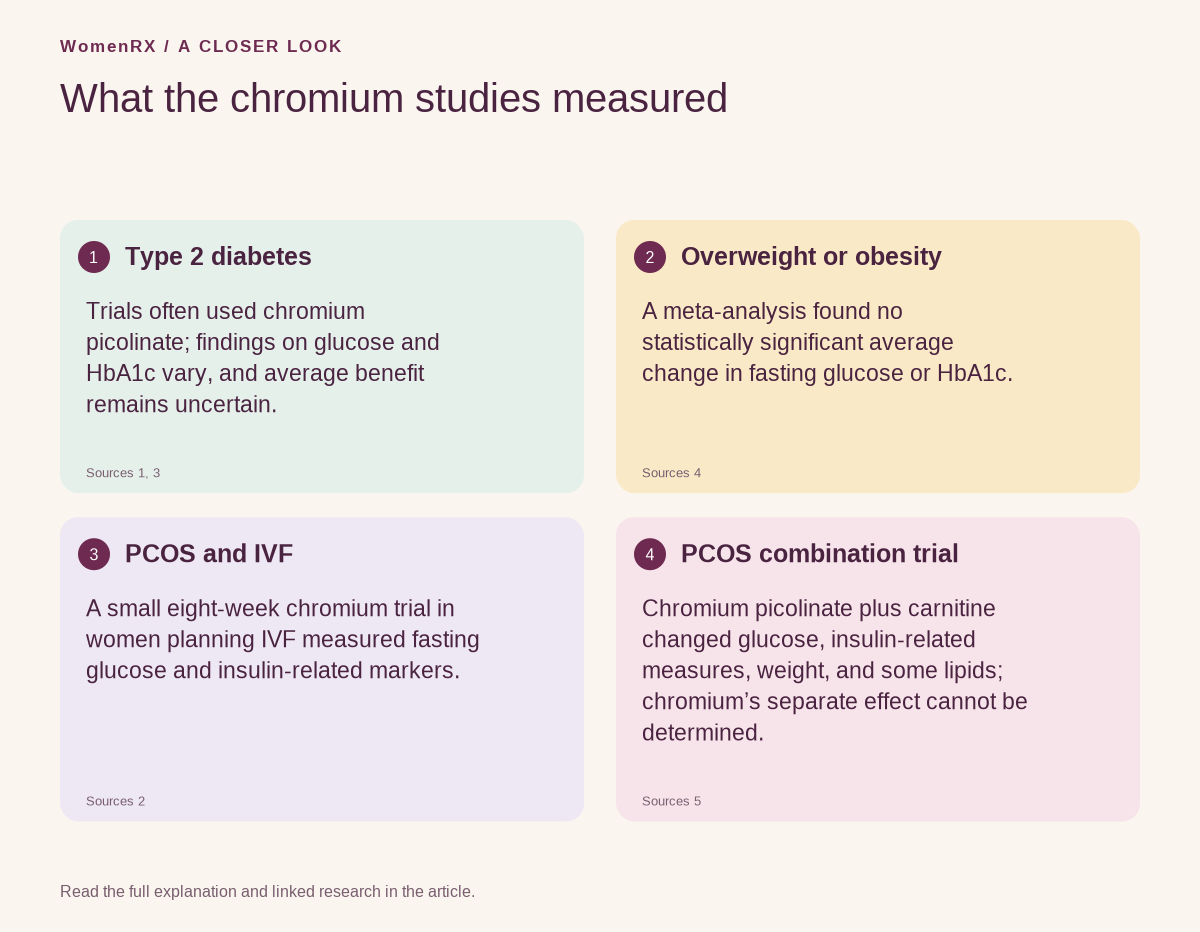
What the chromium studies measured
Type 2 diabetes: Trials often used chromium picolinate; findings on glucose and HbA1c vary, and average benefit remains uncertain.13
Overweight or obesity: A meta-analysis found no statistically significant average change in fasting glucose or HbA1c.4
PCOS and IVF: A small eight-week chromium trial in women planning IVF measured fasting glucose and insulin-related markers.2
PCOS combination trial: Chromium picolinate plus carnitine changed glucose, insulin-related measures, weight, and some lipids; chromium’s separate effect cannot be determined.5
Read the figure as text
Compare the population, supplement form, and outcome before treating a study result as relevant to your own plan.- Type 2 diabetes: Trials often used chromium picolinate; findings on glucose and HbA1c vary, and average benefit remains uncertain.13
- Overweight or obesity: A meta-analysis found no statistically significant average change in fasting glucose or HbA1c.4
- PCOS and IVF: A small eight-week chromium trial in women planning IVF measured fasting glucose and insulin-related markers.2
- PCOS combination trial: Chromium picolinate plus carnitine changed glucose, insulin-related measures, weight, and some lipids; chromium’s separate effect cannot be determined.5
More questions, answered
Does chromium picolinate work better than other forms?
Chromium picolinate is the form most frequently used in studies, but the evidence doesn’t establish that it produces better clinical results than other forms. Similar absorption across forms does not prove equivalent effects on blood sugar. 1
Which medicines should I mention before taking chromium?
Mention insulin, metformin, other diabetes medicines, and levothyroxine. Chromium may add to the glucose-lowering effect of diabetes medicines, and a small study found reduced levothyroxine absorption when it was taken at the same time as chromium picolinate. 1
Sources you can check
- Chromium - Health Professional Fact SheetAccessed 2026-09-25Return to first citation
- The Influences of Chromium Supplementation on Glycemic Control, Markers of Cardio-Metabolic Risk, and Oxidative Stress in Infertile Polycystic ovary Syndrome Women Candidate for In vitro Fertilization: a Randomized, Double-Blind, Placebo-Controlled Trial.Jamilian M, Zadeh Modarres S, Amiri Siavashani M, Karimi M, Mafi A, Ostadmohammadi V, Asemi Z. · Biological trace element research · 2018Return to first citation
- Beneficial effects of oral chromium picolinate supplementation on glycemic control in patients with type 2 diabetes: A randomized clinical study.Paiva AN, Lima JG, Medeiros AC, Figueiredo HA, Andrade RL, Ururahy MA, Rezende AA, Brandão-Neto J, Almeida Md. · Journal of trace elements in medicine and biology : organ of the Society for Minerals and Trace Elements (GMS) · 2015Return to first citation
- The effect of chromium supplementation on cardio-metabolic risk factors in overweight and obese patients. A systematic review and meta-analysis of randomized controlled trial.Monfared V, Rashin H, Malekinejad S, Sheikhi L, Yousefi M, Vakili MA, Hasani M. · Journal of trace elements in medicine and biology : organ of the Society for Minerals and Trace Elements (GMS) · 2025Return to first citation
- Effects of Chromium and Carnitine Co-supplementation on Body Weight and Metabolic Profiles in Overweight and Obese Women with Polycystic Ovary Syndrome: a Randomized, Double-Blind, Placebo-Controlled Trial.Jamilian M, Foroozanfard F, Kavossian E, Kia M, Aghadavod E, Amirani E, Asemi Z. · Biological trace element research · 2020Return to first citation