Chromium Supplements: Is There a Useful Daily Dose?
Chromium has daily intake targets, but they’re not a proven supplement dose for blood sugar or weight loss.
There’s no established chromium supplement dose that’s recommended for blood sugar control or weight loss. For healthy adults, the daily Adequate Intake is 25 mcg for women ages 19-50 and 20 mcg from age 51; these amounts include food and aren’t treatment doses. Supplements studied for diabetes have ranged much higher, with mixed results and uncertain clinical value. 1
Chromium is a trace mineral found in food and in many multivitamins. The key distinction is that a daily intake target is not the same as a recommended supplement dose. Chromium supplements have been studied for blood sugar and weight, but the findings don’t establish a dose that women should take for either purpose. 1
Daily intake targets aren’t treatment doses
The National Academies set an Adequate Intake (AI) for chromium because there wasn’t enough evidence to establish a Recommended Dietary Allowance. For women, the AI is 25 micrograms (mcg) a day at ages 19-50 and 20 mcg at age 51 and older. It’s 30 mcg during pregnancy and 45 mcg while breastfeeding. These figures refer to total daily intake, not the amount to take as a supplement. 1
An AI is a planning reference for healthy people, not a target that proves you need a supplement. Chromium is present in many foods, and the amount can vary widely with growing and processing conditions. A supplement may contain substantially more than the daily AI: chromium-only products commonly provide 200-500 mcg, and some contain up to 1,000 mcg. 1
If you’re comparing labels, look for the amount of elemental chromium listed in Supplement Facts. That’s the chromium amount declared on the label, not the weight of the full chromium compound. 1
What blood-sugar studies can and can’t tell you
Trials have tested a wide range of chromium forms and amounts in people with type 2 diabetes. One meta-analysis of 28 trials found average improvements in several blood-sugar measures, including fasting glucose and HbA1c. But the results varied substantially between studies: for fasting glucose, the reported heterogeneity was very high. 2
That variability matters. The NIH Office of Dietary Supplements summarizes a larger body of reviews and trials as showing, at most, slight improvements in blood sugar measures overall, with unclear clinical significance. Other trials found no significant effect. Taken together, the evidence doesn’t establish a reliable dose, a dependable benefit for an individual, or that chromium can replace diabetes treatment. 1
The evidence doesn’t establish whether chromium supplement effects differ by sex or life stage. Women’s intake targets do vary by age, pregnancy, and lactation, but those intake references don’t answer whether chromium’s effects in blood-sugar studies differ for women. 14
Weight loss is a small, uncertain payoff
A review of 21 trials in 1,316 adults with overweight or obesity found that chromium users lost an average of 0.75 kilograms more than people taking placebo. The review also found small changes in BMI and body-fat percentage, but not waist circumference. The NIH summary describes the weight effect as having little clinical significance. That’s a modest result, not evidence of meaningful or lasting weight loss. 1
What about a diagnosed deficiency?
Chromium deficiency has not been reported in healthy populations, and definitive deficiency symptoms haven’t been established. Reports of possible deficiency involved people receiving long-term intravenous nutrition, but later evaluations concluded that those cases don’t demonstrate that healthy people develop chromium deficiency. Fatigue, weight changes, or blood-sugar problems on their own don’t establish chromium deficiency. 1
Safety and medicines to consider
The National Academies haven’t set an upper limit for chromium because evidence linking high intake to harm is limited. That doesn’t establish that high-dose supplements are safe. The NIH fact sheet says people with kidney or liver disease may be more susceptible to adverse effects from high intakes, and isolated case reports have described hypoglycemia and other serious problems. 1
If you take medicine to lower blood sugar, discuss a chromium supplement with your prescriber or pharmacist before adding it. Trials have studied chromium alongside diabetes medicines, and hypoglycemia has appeared in isolated case reports; the evidence doesn’t establish a predictable interaction or quantify the risk. 13
The NIH fact sheet also notes that aspirin and other prostaglandin inhibitors can increase chromium absorption, while antacids can reduce it. This is an absorption effect, not proof of a harmful interaction or a reason to stop a medicine. 1
For most women considering chromium for weight loss or blood-sugar control, there’s no well-established supplement dose to choose. If a clinician has raised a specific concern about your chromium intake, the useful next step is to clarify what evidence supports that concern and whether a supplement is being recommended for you, rather than treating a trial dose as a general daily target.
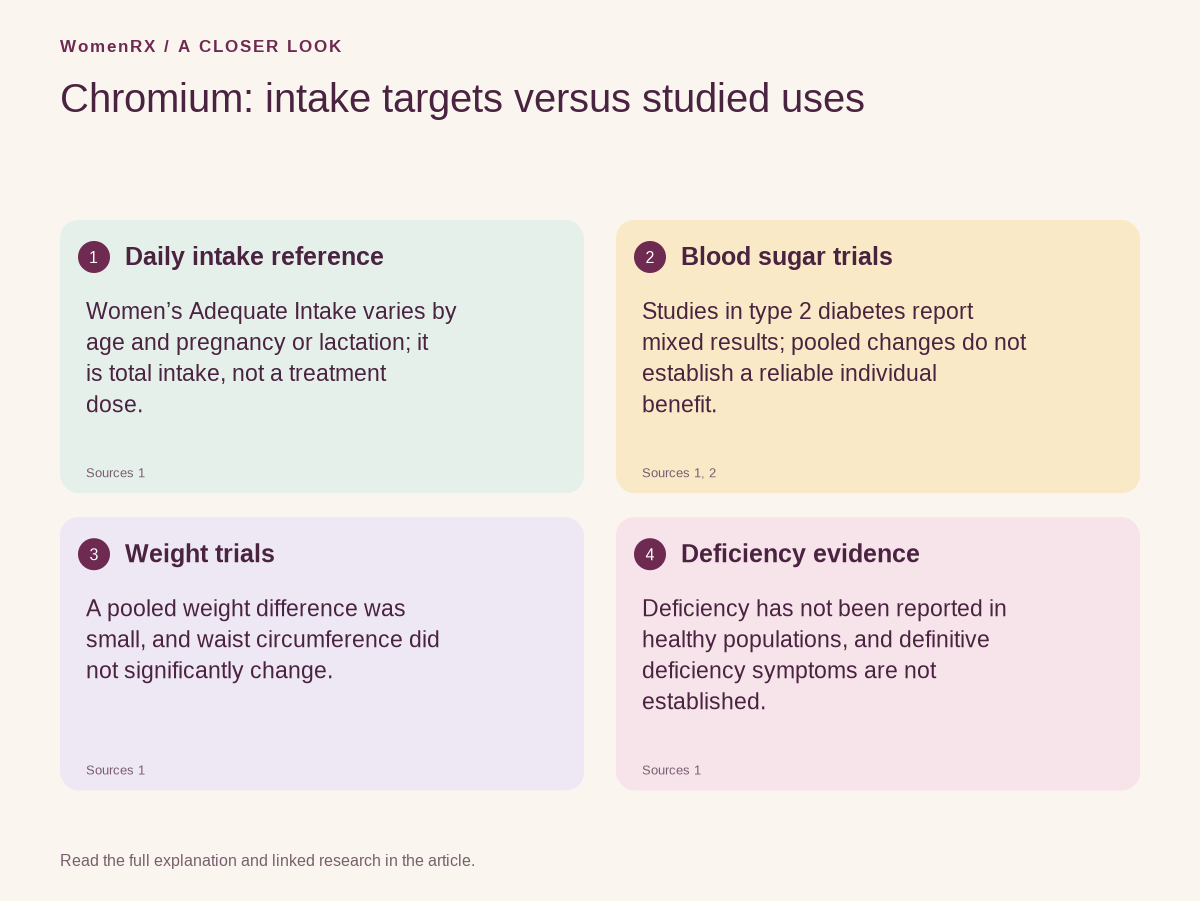
Chromium: intake targets versus studied uses
Daily intake reference: Women’s Adequate Intake varies by age and pregnancy or lactation; it is total intake, not a treatment dose.1
Blood sugar trials: Studies in type 2 diabetes report mixed results; pooled changes do not establish a reliable individual benefit.12
Weight trials: A pooled weight difference was small, and waist circumference did not significantly change.1
Deficiency evidence: Deficiency has not been reported in healthy populations, and definitive deficiency symptoms are not established.1
Read the figure as text
These distinctions show why an intake reference or trial amount should not be read as a proven supplement dose.- Daily intake reference: Women’s Adequate Intake varies by age and pregnancy or lactation; it is total intake, not a treatment dose.1
- Blood sugar trials: Studies in type 2 diabetes report mixed results; pooled changes do not establish a reliable individual benefit.12
- Weight trials: A pooled weight difference was small, and waist circumference did not significantly change.1
- Deficiency evidence: Deficiency has not been reported in healthy populations, and definitive deficiency symptoms are not established.1
More questions, answered
Does the Adequate Intake mean I should take that much in a supplement?
No. The AI is a reference for total daily chromium intake from food and supplements combined. It isn’t a supplement prescription or a dose shown to treat a condition. 1
Is there a chromium upper limit?
No tolerable upper intake level has been set. That reflects limited evidence for defining one, not proof that any supplement amount is safe. 1
Sources you can check
- Chromium - Health Professional Fact SheetAccessed 2026-09-25Return to first citation
- Effects of chromium supplementation on glycemic control in patients with type 2 diabetes: a systematic review and meta-analysis of randomized controlled trials.Asbaghi O, Fatemeh N, Mahnaz RK, Ehsan G, Elham E, Behzad N, Damoon AL, Amirmansour AN. · Pharmacological research · 2020Return to first citation
- Could nutrient supplements provide additional glycemic control in diabetes management? A systematic review and meta-analysis of randomized controlled trials of as an add-on nutritional supplementation therapy.Kim Y, Oh YK, Lee J, Kim E. · Archives of pharmacal research · 2022Return to first citation
- Chromium supplementation and type 2 diabetes mellitus: an extensive systematic review.Georgaki MN, Tsokkou S, Keramas A, Papamitsou T, Karachrysafi S, Kazakis N. · Environmental geochemistry and health · 2024Return to first citation