Cinnamon Supplements: Is There an Evidence-Based Daily Dose?
A trial tested one Ceylon cinnamon extract, but its amounts aren’t a daily dose for every cinnamon product.
One four-month randomized trial studied 250 mg and 500 mg of a Ceylon cinnamon extract in individuals with type 2 diabetes. Those amounts don’t establish a general daily dose or apply to other products. Check the cinnamon species, form, and amount on the label. If you take diabetes medicine, review the product with your diabetes care team before adding it. 45
A trial amount isn’t a recommended dose
If you’re considering cinnamon for blood sugar, the most useful question isn’t simply “How many milligrams?” It’s what kind of cinnamon the product contains, whether it’s an extract or ground spice, and whether the studied product resembles the one you’re considering.
A randomized trial assigned 210 individuals with type 2 diabetes to Ceylon cinnamon extract groups labeled 250 mg and 500 mg or placebo. After four months, the researchers reported decreases in fasting glucose and A1C from baseline in the extract groups. The reported results don’t quantify the size of those changes. This was one trial of a particular extract, so it doesn’t establish a general dose for other cinnamon products. 4
So if a label says “1,000 mg cinnamon,” that number alone doesn’t tell you it matches the extract studied, or that the product will have the same effects. Cinnamon supplements shouldn’t replace diabetes treatment or changes to prescribed medicine. Keeping blood sugar in a target range matters for preventing diabetes complications. 12
Cinnamon types and forms aren’t interchangeable
Ceylon cinnamon, also called Cinnamomum verum or Cinnamomum zeylanicum, differs from cassia, sometimes called Chinese cinnamon. Cassia contains high amounts of coumarin, which the review describes as a toxic ingredient. That makes the species name useful when comparing products, although a species name alone doesn’t tell you the exact coumarin amount in a particular capsule. 3
Ground cinnamon used in food, a capsule of cinnamon powder, and a concentrated extract are different forms. The clinical trial used a Ceylon extract. Its findings can’t automatically be applied to cassia, a spoonful of kitchen spice, or an extract made in a different way. You can’t convert the studied extract amounts into an equivalent dose of spice or another supplement from those results. 34
Ceylon cinnamon is recognized as safe for use as a flavoring, but that statement is about flavoring use. It doesn’t establish the safety or effectiveness of taking a concentrated supplement. 3
A quick label check
Before buying or taking a product, look for:
- The species: Does it name Ceylon/Cinnamomum verum or cassia? If the species isn’t stated, you can’t use the label to distinguish them.
- The form: Is it ground bark, powder, or an extract? Don’t treat the amounts as equivalent.
- The amount and serving: Can you tell how much cinnamon or extract is in one serving, and how many capsules make that serving?
- Other ingredients: Is cinnamon blended with other herbs or active ingredients? A blend makes it harder to compare with a trial of one extract.
- Quality verification: An independent quality check may help verify a product’s ingredients or quality, but it does not prove the supplement works or is safe. Supplement labels and actual contents can differ. 3
If the label leaves the species, form, or amount unclear, there isn’t enough information to match the product to the trial. That’s a reason to pause, not a cue to guess at a dose.
Blood sugar medicines and supplements
The interaction evidence is not clear-cut. A practical review of natural health products notes the possibility that some products could add to the blood-sugar-lowering effect of diabetes medicines. Another review says cinnamon at amounts recommended on commercial products should have minimal impact on diabetes management. Together, these reviews don’t establish a specific, confirmed cinnamon-medicine interaction or tell you what will happen with your product. 56
If you use insulin or other glucose-lowering medicine, show your diabetes care team or pharmacist the product label before starting cinnamon capsules or extract. 56 Don’t change prescribed treatment based on a supplement. Your glucose targets and monitoring needs are individual. 12
Pregnancy is a different question
The reported results from the Ceylon extract trial in individuals with type 2 diabetes don’t establish safety or blood-sugar benefit during pregnancy. If blood sugar during pregnancy is your concern, use your pregnancy care team’s treatment plan rather than treating a cinnamon capsule as a substitute. 42
Breastfeeding needs a separate answer
A cinnamon supplement is not the same as using cinnamon as a food flavoring. The LactMed review says there are no safety data for cinnamon in nursing mothers or infants. It also says it could not locate studies evaluating cinnamon’s effect on milk supply. That means a supplement shouldn’t be treated as an evidence-based way to boost supply. 3
judge a cinnamon product by its species, form, and clearly stated amount, not by a milligram number alone. The trial provides a starting point for discussion about one Ceylon extract, not a daily dose that applies to every woman or product.
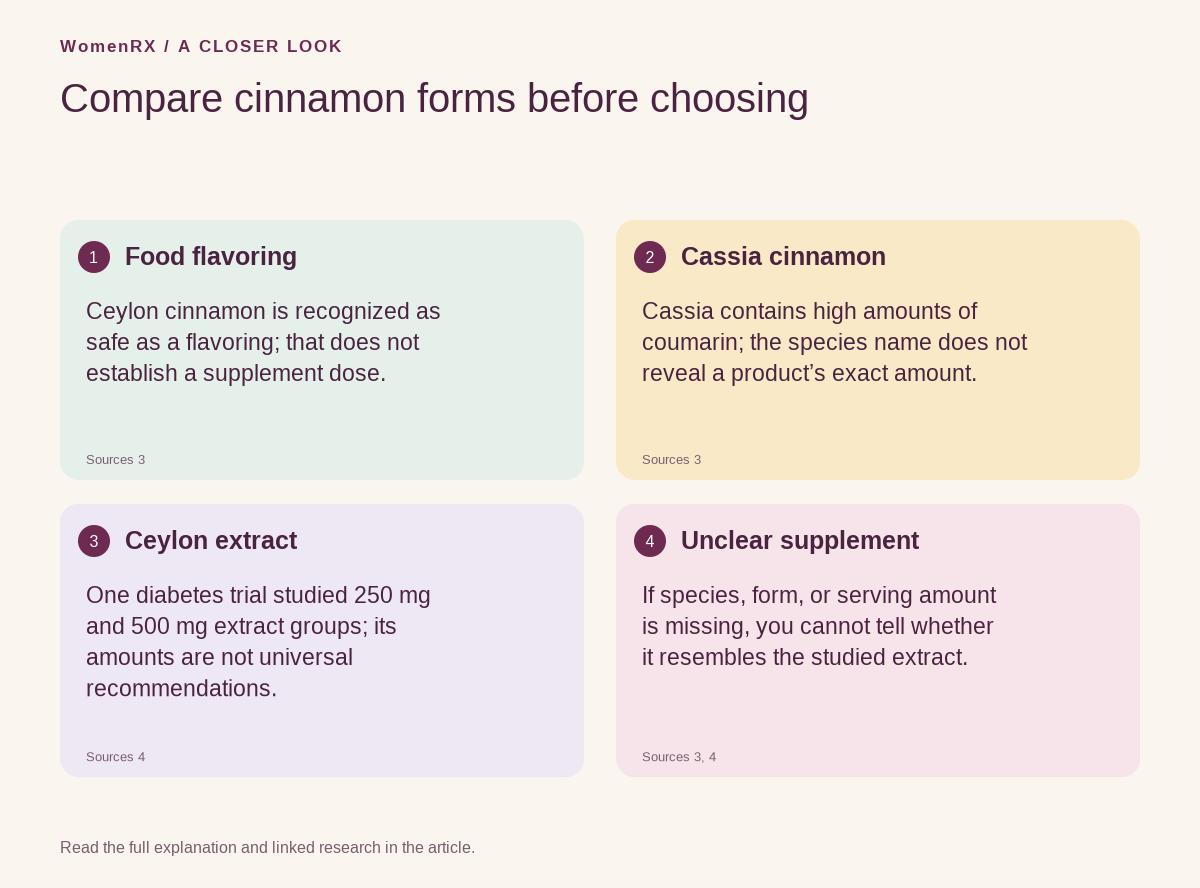
Compare cinnamon forms before choosing
Food flavoring: Ceylon cinnamon is recognized as safe as a flavoring; that does not establish a supplement dose.3
Cassia cinnamon: Cassia contains high amounts of coumarin; the species name does not reveal a product’s exact amount.3
Ceylon extract: One diabetes trial studied 250 mg and 500 mg extract groups; its amounts are not universal recommendations.4
Unclear supplement: If species, form, or serving amount is missing, you cannot tell whether it resembles the studied extract.34
Read the figure as text
The name and form on the label change what you can infer from research and coumarin information.- Food flavoring: Ceylon cinnamon is recognized as safe as a flavoring; that does not establish a supplement dose.3
- Cassia cinnamon: Cassia contains high amounts of coumarin; the species name does not reveal a product’s exact amount.3
- Ceylon extract: One diabetes trial studied 250 mg and 500 mg extract groups; its amounts are not universal recommendations.4
- Unclear supplement: If species, form, or serving amount is missing, you cannot tell whether it resembles the studied extract.34
More questions, answered
What should I know about cassia and coumarin?
The review says cassia contains high amounts of coumarin, but it doesn’t give the coumarin amount in a particular product. A species name can help identify the cinnamon, but it doesn’t measure your exposure. 3
Can cinnamon supplements increase breast milk supply?
The LactMed review says no scientific studies could be located evaluating cinnamon’s effect on milk supply. Cinnamon has been used traditionally for this purpose, but that use isn’t evidence that it works. 3
Sources you can check
- Blood Glucose | Blood Sugar | Diabetes | MedlinePlusAccessed 2026-09-25Return to first citation
- Diabetes | Type 1 Diabetes | Type 2 Diabetes | MedlinePlusAccessed 2026-09-25Return to first citation
- Cinnamon2006Return to first citation
- Efficacy and Safety of Cinnamomum zeylanicum (Ceylon cinnamon) for diabetes mellitus: a randomized, double blind, placebo-controlled clinical trial.Ranasinghe P, Galappatthy P, Constantine GR, Jayawardena R, Weeratunga HD, Premakumara S, Katulanda P. · Diabetes & metabolic syndrome · 2025Return to first citation
- Natural Health Products and Diabetes: A Practical Review.Necyk C, Zubach-Cassano L. · Canadian journal of diabetes · 2017Return to first citation
- Over-the-Counter Medicines and Diabetes Care.Taylor J. · Canadian journal of diabetes · 2017Return to first citation