Cinnamon Supplements for Blood Sugar or Weight
Cinnamon supplements show a possible blood-sugar effect in type 2 diabetes studies, but the weight evidence is much thinner.
In trials involving people with type 2 diabetes, cinnamon supplements lowered fasting blood sugar on average, though results varied substantially. A reported BMI change in a subgroup is not proof of dependable weight loss. The studies also used different forms of cinnamon, so a finding for one preparation may not apply to the product you’re considering or to cinnamon used in food. 6 9
What the blood-sugar studies actually measured
If you’re looking at cinnamon because of a blood-sugar goal, the most relevant research is in people who already have type 2 diabetes. A 2025 review combined 28 randomized trials enrolling 3,054 people with type 2 diabetes. Across trials lasting 30 to 120 days, fasting blood glucose was lower in the cinnamon groups than in control groups by an average of about 15 mg/dL. Results varied substantially between trials, so that average isn’t a prediction of what will happen for one person. 9
Other reviews also report improvements in some blood-sugar measures, but the findings aren’t uniform. A review of 24 randomized trials found lower fasting blood sugar and HbA1c with cinnamon supplementation, while an umbrella review described conflicting findings across earlier analyses. These are measures of glucose control, not evidence that cinnamon prevents diabetes complications or can replace diabetes treatment. 4 6
One study offers a useful counterpoint to the pooled results. In a six-week trial of 25 postmenopausal women with type 2 diabetes, Cinnamomum cassia did not improve glucose tolerance or whole-body insulin sensitivity compared with placebo. That small trial doesn’t cancel out the reviews, but it shows why a positive average across studies shouldn’t be read as a dependable effect for every group or product. 8
Weight is a different question
The blood-sugar findings shouldn’t be turned into a weight-loss claim. The 2025 review reported a lower BMI in one subgroup of its type 2 diabetes trials. BMI uses height and weight; it doesn’t directly measure body fat. A subgroup result doesn’t establish meaningful, lasting weight loss, particularly for someone who doesn’t have type 2 diabetes. 9 3
If weight is your main goal, there’s a clearer basis for choosing an approach than a cinnamon capsule: general weight-control guidance supports healthy eating patterns and regular physical activity, while recognizing that weight is affected by factors beyond any single food or ingredient. 1 2
Check what kind of cinnamon was studied
A bottle labeled simply “cinnamon” may tell you less than you need to compare it with a study. The postmenopausal trial identified its cinnamon as Cinnamomum cassia, but its abstract doesn’t specify whether the supplement was a powder or extract. A separate randomized trial in people with type 2 diabetes explicitly tested powdered cinnamon alongside participants’ usual diabetes medicines, but its abstract doesn’t identify the cinnamon species. An umbrella review notes that it’s unclear whether cinnamon powder and extract have equal effects. 8 7 6
That leaves two practical distinctions. First, check whether a supplement label names the species and identifies the preparation as a powder or extract. A closer match to a study still doesn’t guarantee the same result. Second, cinnamon used to season food is not the same question as taking a supplement regularly: these supplement trials don’t establish a blood-sugar or weight benefit from ordinary cooking use. 6 9
Where pregnancy and medicines change the decision
The type 2 diabetes review excluded gestational diabetes studies. Its findings therefore don’t establish whether concentrated cinnamon supplements are safe or useful during pregnancy. Enjoying cinnamon as an ingredient in food isn’t evidence for taking a concentrated product while pregnant. 9
If you take medicine for diabetes, don’t use a cinnamon study as a reason to change that medicine. The trial that tested powdered cinnamon alongside routine diabetes treatment doesn’t verify every supplement-and-medicine combination. Showing a prescriber or pharmacist the exact product label is more useful than asking whether “cinnamon” in general is okay; NIH guidance specifically flags diabetes as a reason to discuss the potential benefits and risks of weight-loss supplements. 7 2
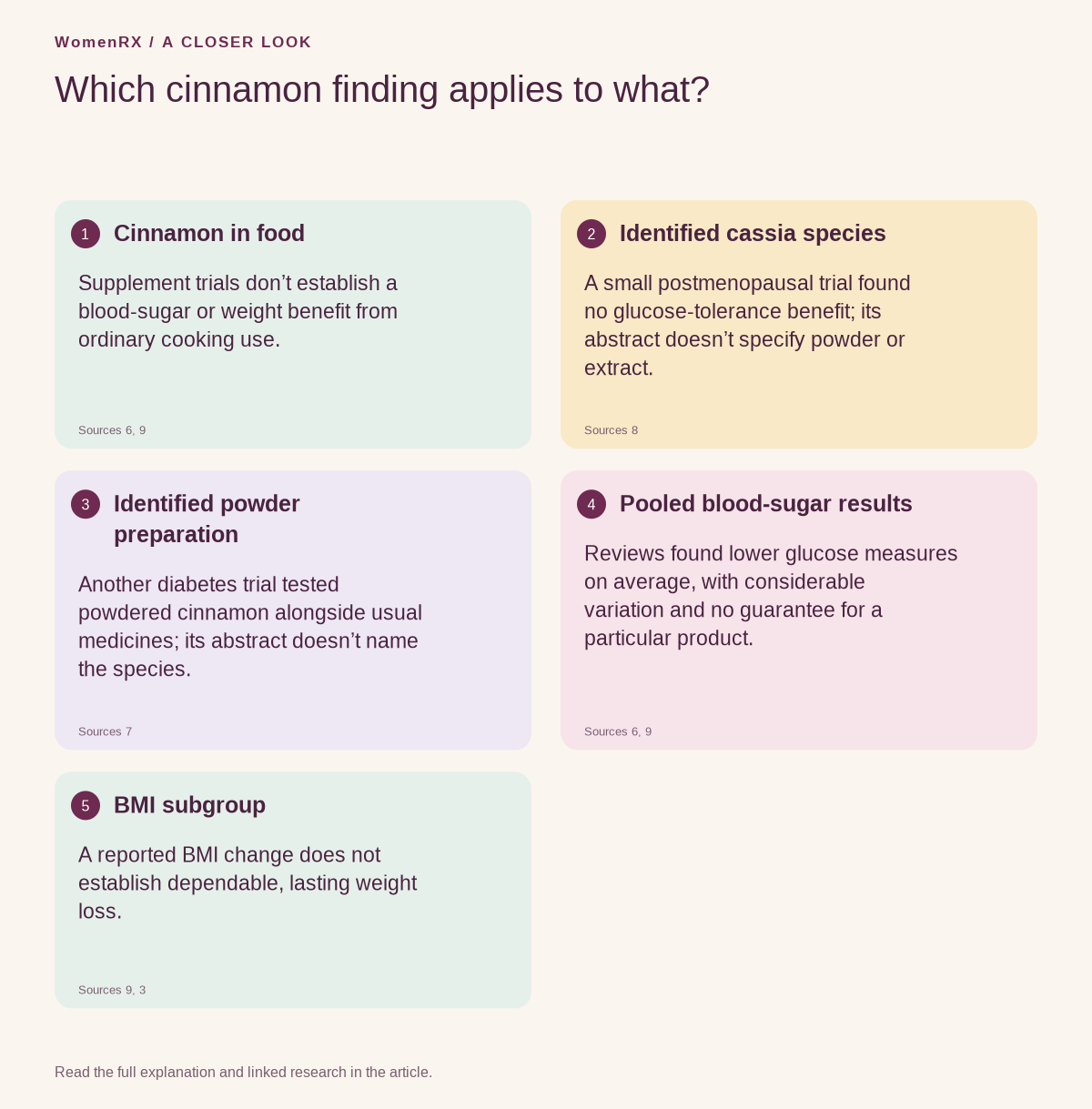
Which cinnamon finding applies to what?
Cinnamon in food: Supplement trials don’t establish a blood-sugar or weight benefit from ordinary cooking use.69
Identified cassia species: A small postmenopausal trial found no glucose-tolerance benefit; its abstract doesn’t specify powder or extract.8
Identified powder preparation: Another diabetes trial tested powdered cinnamon alongside usual medicines; its abstract doesn’t name the species.7
Pooled blood-sugar results: Reviews found lower glucose measures on average, with considerable variation and no guarantee for a particular product.69
BMI subgroup: A reported BMI change does not establish dependable, lasting weight loss.93
Read the figure as text
The form studied and the outcome measured both matter when you compare research with a product or a goal.- Cinnamon in food: Supplement trials don’t establish a blood-sugar or weight benefit from ordinary cooking use.69
- Identified cassia species: A small postmenopausal trial found no glucose-tolerance benefit; its abstract doesn’t specify powder or extract.8
- Identified powder preparation: Another diabetes trial tested powdered cinnamon alongside usual medicines; its abstract doesn’t name the species.7
- Pooled blood-sugar results: Reviews found lower glucose measures on average, with considerable variation and no guarantee for a particular product.69
- BMI subgroup: A reported BMI change does not establish dependable, lasting weight loss.93
More questions, answered
Does the research in women with PCOS change the answer?
A review of five randomized trials in women with PCOS found lower HOMA-IR, a measure of insulin resistance, with cinnamon than with placebo. That finding addresses a specific group and laboratory measure. It doesn’t show that cinnamon causes weight loss or has the same effect in women without PCOS. 5
Sources you can check
- Weight Control: MedlinePlusAccessed 2026-09-25Return to first citation
- Dietary Supplements for Weight Loss - Health Professional Fact SheetAccessed 2026-09-25Return to first citation
- Body Weight: MedlinePlusAccessed 2026-09-25Return to first citation
- The effect of cinnamon supplementation on glycemic control in patients with type 2 diabetes mellitus: An updated systematic review and dose-response meta-analysis of randomized controlled trials.Moridpour AH, Kavyani Z, Khosravi S, Farmani E, Daneshvar M, Musazadeh V, Faghfouri AH. · Phytotherapy research : PTR · 2024Return to first citation
- The effect of cinnamon supplementation on glycemic control in women with polycystic ovary syndrome: A systematic review and meta-analysis.Heshmati J, Sepidarkish M, Morvaridzadeh M, Farsi F, Tripathi N, Razavi M, Rezaeinejad M. · Journal of food biochemistry · 2021Return to first citation
- The effect of cinnamon supplementation on glycemic control in patients with type 2 diabetes or with polycystic ovary syndrome: an umbrella meta-analysis on interventional meta-analyses.Zarezadeh M, Musazadeh V, Foroumandi E, Keramati M, Ostadrahimi A, Mekary RA. · Diabetology & metabolic syndrome · 2023Return to first citation
- Effects of probiotic, cinnamon, and synbiotic supplementation on glycemic control and antioxidant status in people with type 2 diabetes; a randomized, double-blind, placebo-controlled study.Mirmiranpour H, Huseini HF, Derakhshanian H, Khodaii Z, Tavakoli-Far B. · Journal of diabetes and metabolic disorders · 2020Return to first citation
- Cinnamon supplementation does not improve glycemic control in postmenopausal type 2 diabetes patients.Vanschoonbeek K, Thomassen BJ, Senden JM, Wodzig WK, van Loon LJ. · The Journal of nutrition · 2006Return to first citation
- Effects of cinnamon supplementation on metabolic biomarkers in individuals with type 2 diabetes: a systematic review and meta-analysis.de Moura SL, Gomes BGR, Guilarducci MJ, Coelho OGL, Guimarães NS, Gomes JMG. · Nutrition reviews · 2025Return to first citation