Cinnamon Supplements and Blood Sugar: What to Weigh
Cinnamon may modestly improve some glucose measures in adults with type 2 diabetes, but the results vary and don’t establish it as a replacement for treatment.
Cinnamon supplements have lowered some blood sugar measures in studies of adults with type 2 diabetes, but results varied widely across trials, and the evidence doesn’t show that cinnamon can replace diabetes treatment. If you’re considering a product, check whether it identifies the cinnamon species and reports coumarin content; cassia cinnamon can contain much more coumarin than Ceylon cinnamon. 6 1 3
If your goal is to improve blood sugar, cinnamon is worth viewing as a possible supplement with uncertain, variable effects, not as a diabetes treatment. Research in adults with type 2 diabetes has found reductions in glucose measures on average, but the studies differ enough that you can’t assume a particular product will produce the same result for you. 6
What the glucose research does and doesn’t show
A systematic review pooled 28 randomized trials involving 3,054 adults with type 2 diabetes. The trials lasted 30 to 120 days. Compared with control groups, participants taking cinnamon had, on average, lower fasting glucose, post-meal glucose, and HbA1c. The pooled average difference in fasting glucose was about 15 mg/dL lower. But results varied greatly between trials, including for fasting glucose and HbA1c, so that average doesn’t predict what one person or one supplement will experience. 6
The review studied people who already had type 2 diabetes. It doesn’t establish cinnamon as a way to prevent diabetes, treat gestational diabetes, or replace prescribed care. The evidence also doesn’t tell you to change your medication or blood sugar plan. A separate randomized trial tested a Ceylon cinnamon extract in 210 adults with type 2 diabetes, 42.9% of whom were men. The abstract reports changes from baseline over four months, but doesn’t give enough detail to treat its findings as proof of a reliable effect for women specifically. 5
Women weren’t established as a separate group with a different response in the reported evidence. So there’s no sound basis here for assuming cinnamon works better, or differently, because you’re a woman. The trial population and the wide variation across the larger review are more useful context than a women-specific promise. 5 6
The cinnamon name on the label matters
“Cinnamon” can refer to different species. Cassia cinnamon can have substantially more coumarin than Ceylon cinnamon (Cinnamomum verum or C. zeylanicum). A review reports much higher coumarin levels in some cassia varieties than in Ceylon cinnamon, while testing of cassia samples found wide variation, even among samples from one tree. That means the word “cinnamon” alone doesn’t tell you how much coumarin a supplement contains. 1 3
Coumarin can harm the liver in some people. That doesn’t mean every cinnamon supplement has the same risk: species and coumarin levels differ, and the research on coumarin exposure from traditional Japanese herbal medicines isn’t a direct estimate of risk from every retail supplement. In that study of 129 outpatients taking a particular herbal preparation, researchers found no significant difference in abnormal liver test changes between those above and below a European tolerable-intake threshold. The result is specific to that group and those preparations, not proof that all products are safe. 2 4
When comparing products, look for the species name and whether the label gives a coumarin amount. If either is missing, you can’t use the label to make a clear comparison on those points. A Ceylon label may help identify the species, but it doesn’t by itself establish a product’s quality or its effect on blood sugar. 1 3
A practical decision path
- Your goal is diabetes treatment: Don’t substitute cinnamon for prescribed treatment. The studies show average changes in glucose measures, not a dependable replacement for diabetes care. 6
- You’re comparing supplements: Check for the species and coumarin information. If the label doesn’t provide them, an important safety comparison is missing. 1 3
- You take glucose-lowering medicine: Don’t adjust your medicine to make room for a supplement. The studies don’t establish how reliably different cinnamon products work alongside individual medication plans. Bring the product label to your prescriber or pharmacist before adding it.
- You’re pregnant or breastfeeding: These studies don’t establish safety or benefit for those situations. Don’t assume results from studies of adults with type 2 diabetes apply during pregnancy or breastfeeding. 5 6
For many people, skipping a cinnamon supplement is a reasonable choice: the possible glucose benefit is uncertain for an individual, while the product’s species and coumarin content may not be clear. If you’re still considering one, the label can help you assess what it contains, but it can’t promise a blood sugar result.
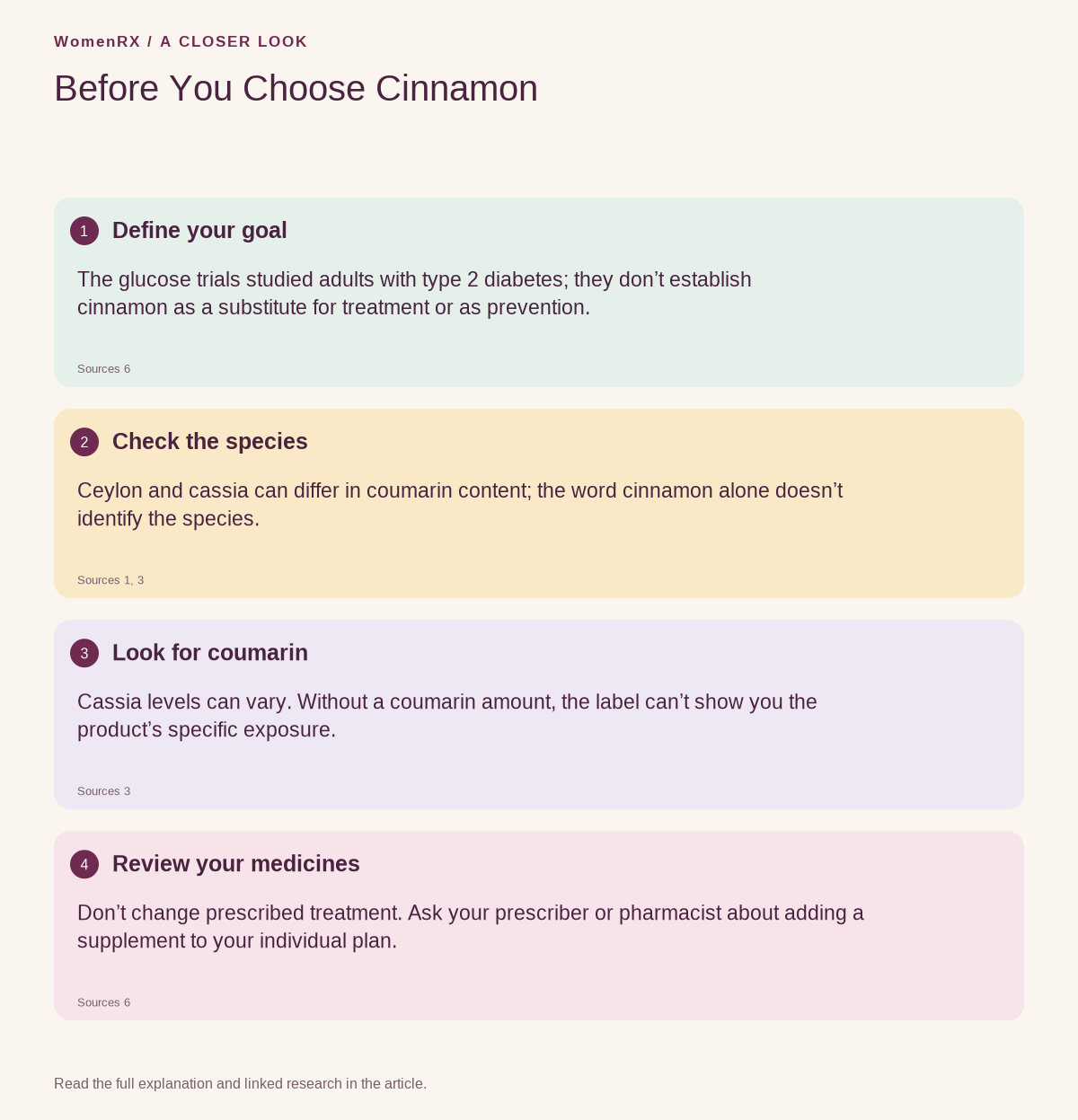
Before You Choose Cinnamon
Define your goal: The glucose trials studied adults with type 2 diabetes; they don’t establish cinnamon as a substitute for treatment or as prevention.6
Check the species: Ceylon and cassia can differ in coumarin content; the word cinnamon alone doesn’t identify the species.13
Look for coumarin: Cassia levels can vary. Without a coumarin amount, the label can’t show you the product’s specific exposure.3
Review your medicines: Don’t change prescribed treatment. Ask your prescriber or pharmacist about adding a supplement to your individual plan.6
Read the figure as text
Use this path to match your goal to the evidence, then check what the label does and doesn’t tell you.- Define your goal: The glucose trials studied adults with type 2 diabetes; they don’t establish cinnamon as a substitute for treatment or as prevention.6
- Check the species: Ceylon and cassia can differ in coumarin content; the word cinnamon alone doesn’t identify the species.13
- Look for coumarin: Cassia levels can vary. Without a coumarin amount, the label can’t show you the product’s specific exposure.3
- Review your medicines: Don’t change prescribed treatment. Ask your prescriber or pharmacist about adding a supplement to your individual plan.6
More questions, answered
Does Ceylon cinnamon have less coumarin than cassia?
Generally, yes: the review describes much lower coumarin levels in Ceylon cinnamon than in some cassia varieties. But cassia levels can vary widely, so the species name alone doesn’t tell you the exact coumarin content of a particular product. 1 3
Can cinnamon replace diabetes medication?
No. Trials have reported changes in glucose measures, but they don’t establish cinnamon as a substitute for diabetes treatment. Don’t change prescribed medication based on a supplement. 6
Sources you can check
- A critical appraisal of anti-hyperglycemic mechanisms, matrix-dependent bioavailability, and species-stratified safety of Cinnamomum spp. as functional food ingredients.Balkrishna A, Tripathi SK, Singh SK, Verma S, Arya V. · Food research international (Ottawa, Ont.) · 2026Return to first citation
- The Relation between Hepatotoxicity and the Total Coumarin Intake from Traditional Japanese Medicines Containing Cinnamon Bark.Iwata N, Kainuma M, Kobayashi D, Kubota T, Sugawara N, Uchida A, Ozono S, Yamamuro Y, Furusyo N, Ueda K, Tahara E, Shimazoe T. · Frontiers in pharmacology · 2016Return to first citation
- Quantification of flavoring constituents in cinnamon: high variation of coumarin in cassia bark from the German retail market and in authentic samples from indonesia.Woehrlin F, Fry H, Abraham K, Preiss-Weigert A. · Journal of agricultural and food chemistry · 2010Return to first citation
- Toxicology and risk assessment of coumarin: focus on human data.Abraham K, Wöhrlin F, Lindtner O, Heinemeyer G, Lampen A. · Molecular nutrition & food research · 2010Return to first citation
- Efficacy and Safety of Cinnamomum zeylanicum (Ceylon cinnamon) for diabetes mellitus: a randomized, double blind, placebo-controlled clinical trial.Ranasinghe P, Galappatthy P, Constantine GR, Jayawardena R, Weeratunga HD, Premakumara S, Katulanda P. · Diabetes & metabolic syndrome · 2025Return to first citation
- Effects of cinnamon supplementation on metabolic biomarkers in individuals with type 2 diabetes: a systematic review and meta-analysis.de Moura SL, Gomes BGR, Guilarducci MJ, Coelho OGL, Guimarães NS, Gomes JMG. · Nutrition reviews · 2025Return to first citation