Cinnamon Supplements After 40: What the Evidence Shows
Turning 40 or entering menopause isn’t a reason to start cinnamon, though blood-sugar research may be relevant if you have type 2 diabetes.
Age alone isn’t a reason to take a cinnamon supplement. Research in adults with type 2 diabetes suggests possible, generally modest improvements in blood-sugar measures, but it doesn’t establish a benefit tied to perimenopause or postmenopause. The trials in one large review lasted 30 to 120 days, leaving longer-term use uncertain. 1 3
Start with the reason you’re considering it
If you’re thinking about cinnamon because you’ve turned 40, there’s no demonstrated age-based need for a supplement. If your goal is relief from hot flashes or other menopause symptoms, blood-sugar studies don’t answer that question. If you have type 2 diabetes and are considering cinnamon for glucose control, the research is more relevant, though it still doesn’t predict what a particular product will do for you. 1 3
These are different decisions. A woman in perimenopause may also have type 2 diabetes, but a finding in people with diabetes isn’t automatically a finding about menopause.
What the diabetes research found
A 2025 review pooled 28 randomized trials involving 3,054 adults with type 2 diabetes. Compared with control groups, cinnamon groups had lower fasting and after-meal glucose and lower HbA1c on average. The trials lasted 30 to 120 days, and results differed substantially across studies for several outcomes. That makes the pooled finding worth considering, but not a dependable estimate of what you’d get from a bottle on a shelf. 3
Another systematic review assessed 45 human studies of cinnamon and blood glucose. Before accounting for study quality and risk of bias, 62% found a statistically significant improvement in at least one glucose measure. After the reviewers ranked the studies on those factors, the share was closer to half. They judged a modest glucose effect likely, while noting that differences in what the studies measured prevented them from pooling the results. 1
The product matters, too. One randomized, placebo-controlled trial tested a specific Ceylon cinnamon extract in 210 people with type 2 diabetes. Their mean age was 58.6 years, and 42.9% were men. The reported results describe improvements over four months, but don’t establish an effect specific to women in their 40s or to any menopause stage. A result for that extract also shouldn’t be assumed to apply to every cinnamon capsule. 2
Where menopause fits, and where it doesn’t
Perimenopause and postmenopause are not interchangeable with an age cutoff. The diabetes findings above don’t show that cinnamon treats menopause symptoms, prevents changes associated with menopause, or works differently before and after periods stop. They also don’t establish a benefit for someone without diabetes who wants general blood-sugar support. 1 2 3
So match the evidence to your goal. For menopause symptoms, cinnamon’s diabetes results aren’t a useful reason to choose it. For type 2 diabetes, it’s reasonable to view cinnamon as a possible add-on with uncertain individual benefit, not as a substitute for your existing treatment. 1 3
Think beyond the length of a trial
Few adverse effects were reported in the studies assessed by one glucose-focused review. That’s reassuring within those studies, but it doesn’t settle the safety of taking a supplement for months or years: the trials in the 2025 meta-analysis lasted at most 120 days. 1 3
If you’re considering a product, check which cinnamon species or extract it contains and whether that matches the research behind the claim. If you take diabetes medicines, bringing the exact product and your medication list to a pharmacist or prescriber is a practical way to review your plan. That’s a product-specific safety check, not a claim that these studies identified a particular medicine interaction. 1 2
Enjoying cinnamon in food is a separate choice. Supplement findings don’t tell you that adding cinnamon to a meal will have the same effect on blood sugar. 1 3
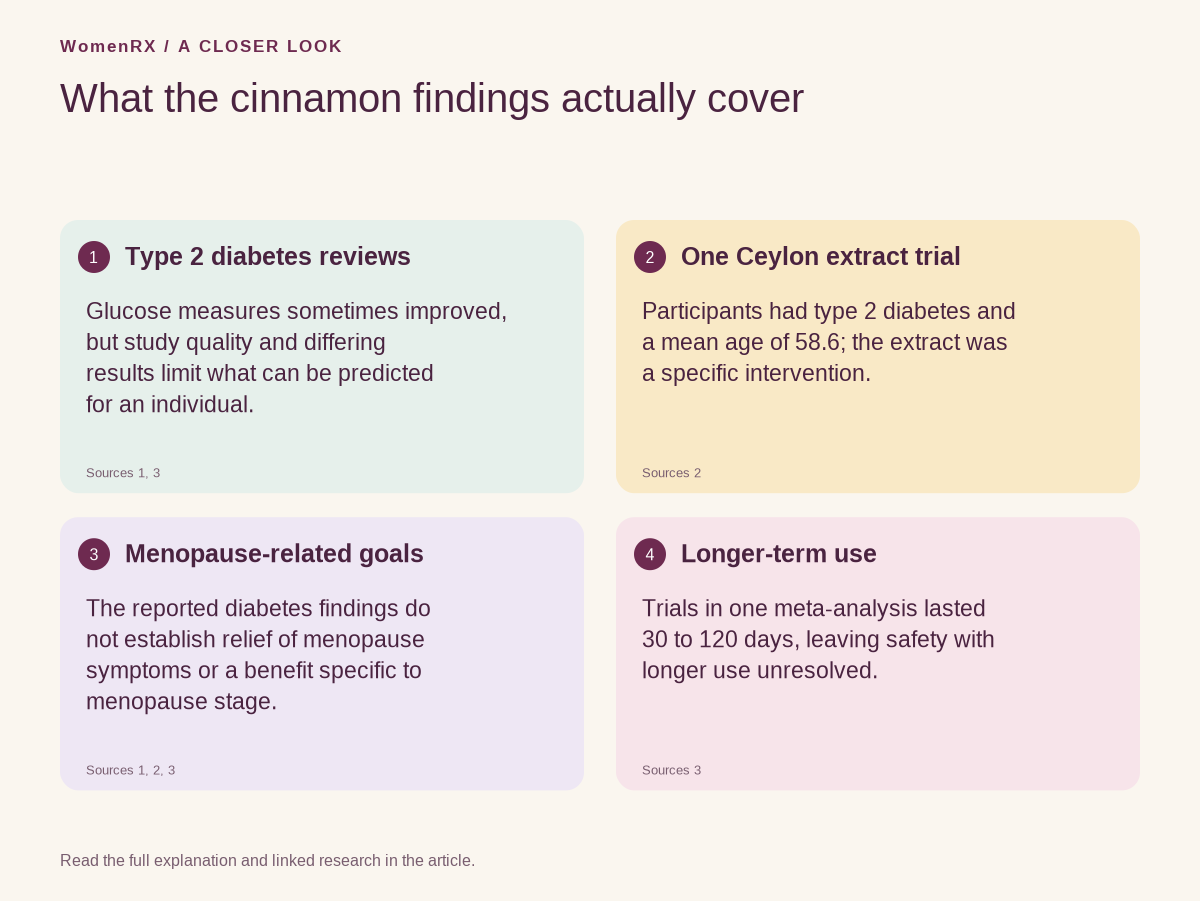
What the cinnamon findings actually cover
Type 2 diabetes reviews: Glucose measures sometimes improved, but study quality and differing results limit what can be predicted for an individual.13
One Ceylon extract trial: Participants had type 2 diabetes and a mean age of 58.6; the extract was a specific intervention.2
Menopause-related goals: The reported diabetes findings do not establish relief of menopause symptoms or a benefit specific to menopause stage.123
Longer-term use: Trials in one meta-analysis lasted 30 to 120 days, leaving safety with longer use unresolved.3
Read the figure as text
The strongest distinction is between a studied health condition and an age or menopause stage.- Type 2 diabetes reviews: Glucose measures sometimes improved, but study quality and differing results limit what can be predicted for an individual.13
- One Ceylon extract trial: Participants had type 2 diabetes and a mean age of 58.6; the extract was a specific intervention.2
- Menopause-related goals: The reported diabetes findings do not establish relief of menopause symptoms or a benefit specific to menopause stage.123
- Longer-term use: Trials in one meta-analysis lasted 30 to 120 days, leaving safety with longer use unresolved.3
More questions, answered
Does a trial with an average age near 59 prove cinnamon works after 40?
No. That trial enrolled people with type 2 diabetes and reported a mean age of 58.6 years. Its reported findings don’t establish an age-specific or menopause-specific benefit. 2
Sources you can check
- A Systematic Review Evaluating Cinnamon's Effects on Glucose Utilizing a Ranking System to Assess Bias and Study Quality.Bakhach H, Nuffer M, Tall Bull S, Nuffer W. · Journal of medicinal food · 2024Return to first citation
- Efficacy and Safety of Cinnamomum zeylanicum (Ceylon cinnamon) for diabetes mellitus: a randomized, double blind, placebo-controlled clinical trial.Ranasinghe P, Galappatthy P, Constantine GR, Jayawardena R, Weeratunga HD, Premakumara S, Katulanda P. · Diabetes & metabolic syndrome · 2025Return to first citation
- Effects of cinnamon supplementation on metabolic biomarkers in individuals with type 2 diabetes: a systematic review and meta-analysis.de Moura SL, Gomes BGR, Guilarducci MJ, Coelho OGL, Guimarães NS, Gomes JMG. · Nutrition reviews · 2025Return to first citation