What Cinnamon Supplements Have Been Studied For
Most human studies measure blood sugar and lipid markers, not whether cinnamon prevents disease or reliably relieves symptoms.
Cinnamon supplements have been studied mainly for blood sugar, insulin-resistance measures, and blood lipids in people with type 2 diabetes. Research in women with PCOS has also examined metabolic markers and menstrual patterns, but findings are limited and mixed. A small trial in postmenopausal women with diabetes found no improvement in glucose control or lipids. 123
Most studies look at blood tests
The largest body of human research asks whether cinnamon changes blood sugar or related measures, such as insulin resistance. Studies have also measured cholesterol and triglycerides. These are biomarkers: a change in a lab result is not, by itself, proof that a supplement prevents complications, improves how you feel, or changes long-term health.
A 2025 systematic review and meta-analysis pooled 28 randomized trials involving 3,054 adults with type 2 diabetes. The trials lasted 30 to 120 days. Compared with control groups, the pooled results showed lower fasting blood glucose with cinnamon, but results varied substantially across studies (I²=88%). The review also found lower post-meal glucose, with even greater variation between trials (I²=100%). These pooled estimates suggest a possible short-term effect on markers, not a predictable result for an individual. 2
One controlled trial illustrates why the overall findings need context. It enrolled 25 postmenopausal women with type 2 diabetes and compared Cinnamomum cassia with placebo for six weeks. The researchers found no improvement in glucose tolerance or whole-body insulin sensitivity, and fasting lipid levels did not change. 1
The pooled findings and this small trial don’t cancel each other out. They show that a favorable average across studies doesn’t mean every preparation or group will see the same change. 12
Lipid results depend on the preparation studied
The type 2 diabetes review reported lower total cholesterol, LDL cholesterol, and triglycerides in a subgroup of trials using cinnamon capsules. Those results also varied substantially across studies. They apply to that subgroup, not automatically to cinnamon powder, extracts, or every supplement sold under the same name. And changes in blood lipids are not evidence that cinnamon prevents heart attacks or other cardiovascular events. 2
In practical terms, a claim about cinnamon is more meaningful when it identifies both the outcome and the product tested. “A capsule subgroup showed changes in some blood markers” is more precise than “cinnamon improves heart health.” 2
What studies in women have examined
Some cinnamon research has enrolled women specifically, but that doesn’t establish a benefit unique to women. A systematic review focused on PCOS included nine eligible studies, a mix of clinical and animal research. Human studies examined blood sugar, insulin-resistance measures, lipids, body measurements, hormone markers, and menstrual patterns. The review described the findings as promising overall but called for more clinical research; it does not establish cinnamon as a treatment for PCOS as a whole. 3
One small double-blind randomized trial summarized in that review enrolled 45 women with PCOS. After six months, the cinnamon group had improved menstrual cyclicity compared with the placebo group. That finding is worth studying further, but one small trial cannot show that cinnamon reliably regulates periods or treats other PCOS symptoms. 3
The PCOS research also looked at metabolic markers, not just menstrual patterns. Findings across the studies were not uniform: for example, the review reported inconsistent results for body weight and BMI. Changes in a hormone or blood marker should not be read as proof of improved fertility. 3
The broader type 2 diabetes review pooled results for adults but did not report estimates by sex in its abstract. It therefore doesn’t show whether effects differ between women and men. The postmenopausal trial provides a result for a women-specific life stage, but it was small and found no benefit on the measures tested. 12
How to weigh a cinnamon claim
First, check what changed. A blood sugar reading, a cholesterol result, and a menstrual pattern are different outcomes. Then check who was studied: findings in adults with type 2 diabetes don’t automatically apply to someone with PCOS or someone without either condition. Finally, check the preparation. A result from trials using capsules doesn’t establish that another cinnamon product will work the same way. 123
That leaves a useful distinction: cinnamon has human research on short-term glucose and lipid markers, while evidence for symptom relief and longer-term health outcomes is much thinner. The question isn’t simply whether a study found a change, but whether it measured the benefit you’re hoping for in people like you. 123
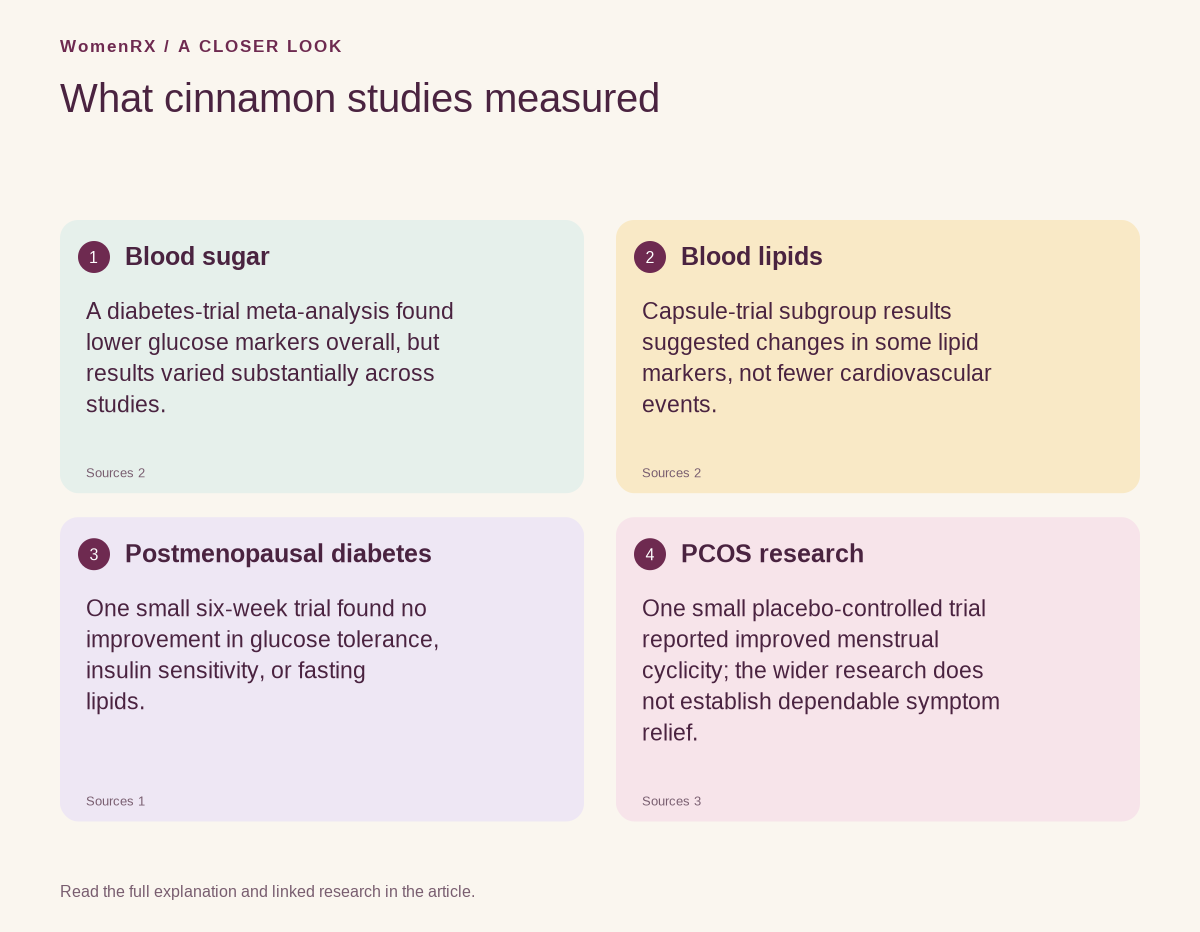
What cinnamon studies measured
Blood sugar: A diabetes-trial meta-analysis found lower glucose markers overall, but results varied substantially across studies.2
Blood lipids: Capsule-trial subgroup results suggested changes in some lipid markers, not fewer cardiovascular events.2
Postmenopausal diabetes: One small six-week trial found no improvement in glucose tolerance, insulin sensitivity, or fasting lipids.1
PCOS research: One small placebo-controlled trial reported improved menstrual cyclicity; the wider research does not establish dependable symptom relief.3
Read the figure as text
This map separates short-term blood-marker findings from limited PCOS research and outcomes the studies do not establish.- Blood sugar: A diabetes-trial meta-analysis found lower glucose markers overall, but results varied substantially across studies.2
- Blood lipids: Capsule-trial subgroup results suggested changes in some lipid markers, not fewer cardiovascular events.2
- Postmenopausal diabetes: One small six-week trial found no improvement in glucose tolerance, insulin sensitivity, or fasting lipids.1
- PCOS research: One small placebo-controlled trial reported improved menstrual cyclicity; the wider research does not establish dependable symptom relief.3
More questions, answered
Does cinnamon supplementation prevent diabetes?
The type 2 diabetes review analyzed short-term blood sugar and related markers in people who already had diabetes. Those results don’t establish that cinnamon prevents diabetes or delays its onset. 2
Does cinnamon reliably help with PCOS or irregular periods?
A small trial reported improved menstrual cyclicity compared with placebo, but that finding alone doesn’t establish a reliable treatment effect. The PCOS review included limited, mixed evidence and called for more clinical research. 3
Sources you can check
- Cinnamon supplementation does not improve glycemic control in postmenopausal type 2 diabetes patients.Vanschoonbeek K, Thomassen BJ, Senden JM, Wodzig WK, van Loon LJ. · The Journal of nutrition · 2006Return to first citation
- Effects of cinnamon supplementation on metabolic biomarkers in individuals with type 2 diabetes: a systematic review and meta-analysis.de Moura SL, Gomes BGR, Guilarducci MJ, Coelho OGL, Guimarães NS, Gomes JMG. · Nutrition reviews · 2025Return to first citation
- Mechanistic and therapeutic insight into the effects of cinnamon in polycystic ovary syndrome: a systematic review.Maleki V, Faghfouri AH, Tabrizi FPF, Moludi J, Saleh-Ghadimi S, Jafari-Vayghan H, Qaisar SA. · Journal of ovarian research · 2021Return to first citation