Glycine Supplements: What Human Benefits Have Been Studied?
Three human glycine trials have reported sleep-related improvements, while broader health claims often draw on studies of ingredient combinations.
Sleep has the clearest direct human research signal: a 2026 scoping review identified three glycine supplement trials, each reporting improvement in at least one sleep-related outcome. Its summary doesn’t show whether the same benefit was repeated across trials or provide trial-level doses, durations, or sample sizes. Research cited for fatigue and healthy aging often tests combinations rather than glycine alone. 123
Glycine is an amino acid involved in several normal body processes. Supplement claims often stretch from sleep to energy, aging, or general health, but those outcomes don’t all have the same kind of human evidence. The clearest direct research signal is for sleep, and even there, the evidence is still preliminary.
Sleep: a direct test, with an open question
A 2026 scoping review identified three human trials of glycine supplements that measured sleep-related outcomes. All three reported improvement in at least one outcome. The review summary does not identify which outcomes improved in each trial. 2
It also does not provide individual trial sample sizes, doses, or durations, or results separately for women. That means the three positive findings can’t establish whether a particular sleep benefit was repeated across trials or support a dose comparison. 2
Researchers have proposed possible links between glycine and sleep regulation, including thermoregulation and signaling in the nervous system. Those are plausible research ideas, not proof that a glycine supplement improves sleep in everyday use. 2
Fatigue and sleep in a mixed-amino-acid study
One study is sometimes tempting to read as support for amino-acid supplements for fatigue and sleep. It began with 151 healthy participants, then a subset of 37 took a multi-amino-acid supplement for 30 days. The researchers reported improvements in fatigue and sleep for 81% of the trial cohort, and all women in the cohort reported improved fatigue. But this was a mixture of amino acids, not glycine alone, so the result can’t show that glycine caused those changes. The reported female finding was about fatigue, not a demonstrated glycine effect. 3
Aging, exercise, and other broader claims
Glycine is also discussed in research on aging and cellular processes. A review of glycine and N-acetylcysteine, or NAC, describes both clinical and preclinical findings for GlyNAC, including lifespan findings from animal models. GlyNAC combines the two ingredients. Effects from a combined supplement can’t be assigned to glycine alone, and animal lifespan findings aren’t human results. The review also notes that direct clinical trials of glycine combined with exercise in older adults are lacking. That leaves claims about glycine alone improving muscle function or healthy aging unproven by the evidence discussed in the review. 1
Collagen supplements are another possible source of confusion because collagen contains glycine. An observational human study of a three-amino-acid collagen composition reported improved skin features within three months and a 1.4-year reduction in biological age within six months. It did not test glycine by itself, so its findings don’t establish that a glycine supplement produces the same results. 4
Match the claim to what researchers tested
For sleep, researchers have tested glycine itself in humans. For fatigue, the study described here tested a multi-amino-acid formula. For aging-related claims, the cited research concerns GlyNAC or a collagen amino-acid composition. Those studies can raise useful questions, but they can’t answer what a glycine-only supplement would do. 1234
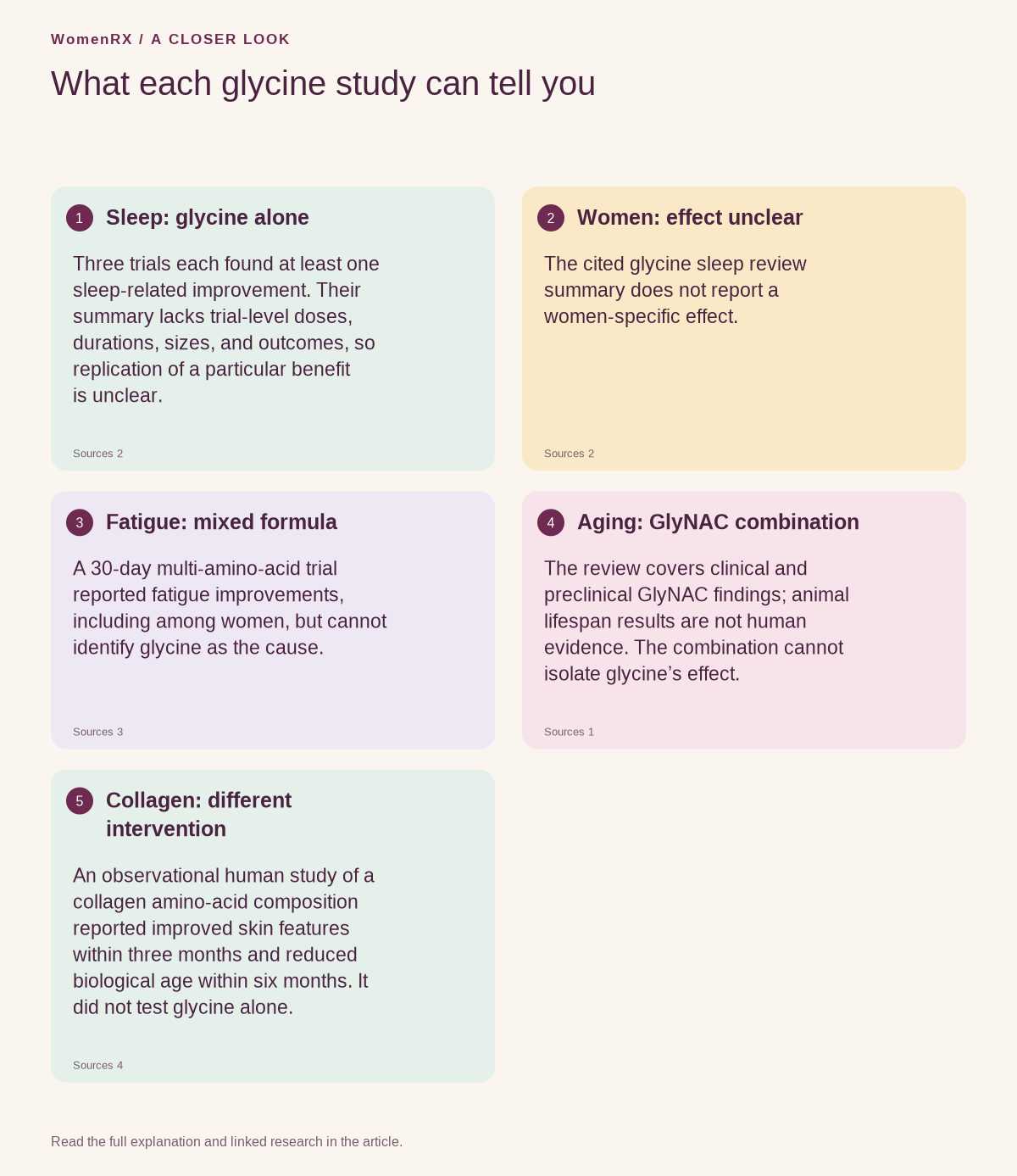
What each glycine study can tell you
Sleep: glycine alone: Three trials each found at least one sleep-related improvement. Their summary lacks trial-level doses, durations, sizes, and outcomes, so replication of a particular benefit is unclear.2
Women: effect unclear: The cited glycine sleep review summary does not report a women-specific effect.2
Fatigue: mixed formula: A 30-day multi-amino-acid trial reported fatigue improvements, including among women, but cannot identify glycine as the cause.3
Aging: GlyNAC combination: The review covers clinical and preclinical GlyNAC findings; animal lifespan results are not human evidence. The combination cannot isolate glycine’s effect.1
Collagen: different intervention: An observational human study of a collagen amino-acid composition reported improved skin features within three months and reduced biological age within six months. It did not test glycine alone.4
Read the figure as text
The ingredient tested determines which claim a human study can support.- Sleep: glycine alone: Three trials each found at least one sleep-related improvement. Their summary lacks trial-level doses, durations, sizes, and outcomes, so replication of a particular benefit is unclear.2
- Women: effect unclear: The cited glycine sleep review summary does not report a women-specific effect.2
- Fatigue: mixed formula: A 30-day multi-amino-acid trial reported fatigue improvements, including among women, but cannot identify glycine as the cause.3
- Aging: GlyNAC combination: The review covers clinical and preclinical GlyNAC findings; animal lifespan results are not human evidence. The combination cannot isolate glycine’s effect.1
- Collagen: different intervention: An observational human study of a collagen amino-acid composition reported improved skin features within three months and reduced biological age within six months. It did not test glycine alone.4
More questions, answered
Does research on collagen count as research on glycine supplements?
Not by itself. Collagen contains glycine, but a study of collagen or a collagen-derived amino-acid blend tests that formulation, not glycine alone. Its findings can’t establish that a glycine supplement has the same effect. 24
Have glycine sleep benefits been shown specifically in women?
The cited glycine sleep review summary does not report results separately for women. A separate mixed-amino-acid study reported fatigue improvements among its female participants, but it can’t show that glycine alone caused them. 23
Sources you can check
- Glycine and N-acetylcysteine supplementation, with or without exercise, in brain health and functional aging: implications for sarcopenia and frailty in older adults.Wang X, Hou R, Chen Z, Wang X, Wang H. · Frontiers in nutrition · 2026Return to first citation
- Glycine Bioavailability and Sleep-Related Outcomes Following Oral Glycine and Collagen Supplementation-A Scoping Review.Fan Z, Nelson JM, Wallace TC. · Journal of dietary supplements · 2026Return to first citation
- Diverse characteristics of the urinary excretion of amino acids in humans and the use of amino acid supplementation to reduce fatigue and sub-health in adults.Dunstan RH, Sparkes DL, Macdonald MM, De Jonge XJ, Dascombe BJ, Gottfries J, Gottfries CG, Roberts TK. · Nutrition journal · 2017Return to first citation
- A collagen amino acid composition supplementation reduces biological age in humans and increases health and lifespan in vivo.Dakhovnik A, Mantovani M, Knufinke M, Brügger V, Pramono I, Statzer C, Saravi B, Demidenko O, Budovskaya Y, Rümmelein CB, Chabloz S, Ewald CY. · npj aging · 2025Return to first citation