Glycine Supplements: What Side Effects Have Been Reported?
Digestive symptoms appeared in one short-term study, but the evidence leaves bigger questions about longer use and safety during pregnancy or breastfeeding.
Digestive symptoms were observed after bedtime ingestion of 9 g of glycine in an acute human study; investigators considered them possibly adverse but not serious. They observed no acute serious adverse events or next-day sleepiness carryover. That finding doesn’t establish a safe dose or tell us what happens with regular use. These glycine studies do not answer safety questions about pregnancy, breastfeeding, or differences by sex. 4
What the study observed
The clearest adverse-effect finding comes from an acute study of 9 g glycine ingested at bedtime. Digestive symptoms were observed after ingestion, which the investigators considered possibly adverse but not serious. The study found no acute serious adverse events or next-day sleepiness carryover. Changes in clinical tests and blood amino acids stayed within or near usual physiological ranges. The available report does not specify which digestive symptoms occurred or how many people had them, so it cannot tell you how likely a particular symptom is. 4
The amount matters when you interpret that result. The 9 g amount was three times the 3 g bedtime amount used in an earlier sleep study. That makes it a comparison between studied amounts, not a recommended dose, a safety limit, or a reason to assume that smaller amounts cannot cause symptoms. 4
Why the short studies leave room for caution
Another glycine study tested 3 g before bedtime in a randomized crossover trial during three nights of restricted sleep. Only seven healthy men were included in the analysis. The reported results focused on fatigue and performance, not an adverse-effect count. It would be a mistake to read the absence of a side-effect list as proof that none occurred. The study also cannot establish safety for women or for months of use. 3
The acute 9 g study gives a useful, narrower answer: digestive symptoms were observed, while acute serious events and next-day sleepiness carryover were not observed in that study. Its available report does not give participant sex counts, a symptom frequency, or longer-term outcomes. Neither study provides a basis for a list of conditions that make glycine unsafe or for claims about specific medication interactions. 43
If you’re pregnant or breastfeeding
Safety findings from these glycine studies do not answer whether supplemental glycine is safe during pregnancy or breastfeeding. If you’re pregnant or planning a pregnancy, bring the product and its ingredient list to your prenatal care team before starting it. MedlinePlus advises checking before using supplements during pregnancy because the decision depends on the risks and benefits in your circumstances. 42
If you’re breastfeeding, ask specifically about the supplement rather than assuming that findings in other adults apply to a nursing baby. MedlinePlus recommends checking with a health care provider when you have concerns about exposures while breastfeeding; that general guidance is not a finding that glycine passes into breast milk or causes harm. 1
A focused way to review your own use
If you’ve noticed a new digestive symptom, check when it began in relation to starting glycine and whether the product contains other ingredients. That won’t prove what caused it, but it gives a pharmacist or clinician a more useful question to work with than the product name alone. Bring the label, the amount you take, how often you take it, and how long you’ve used it. The published acute finding cannot predict what happens with a different amount or repeated use. 4
You can keep the conversation short and specific: “Could this product explain the digestive symptoms I’ve noticed?” “Does anything about my health circumstances or current medicines change your advice?” And, if you’re pregnant or breastfeeding, “What do we know about this product in my situation?” These are questions, not a claim that a glycine interaction or a pregnancy-related harm has been demonstrated.
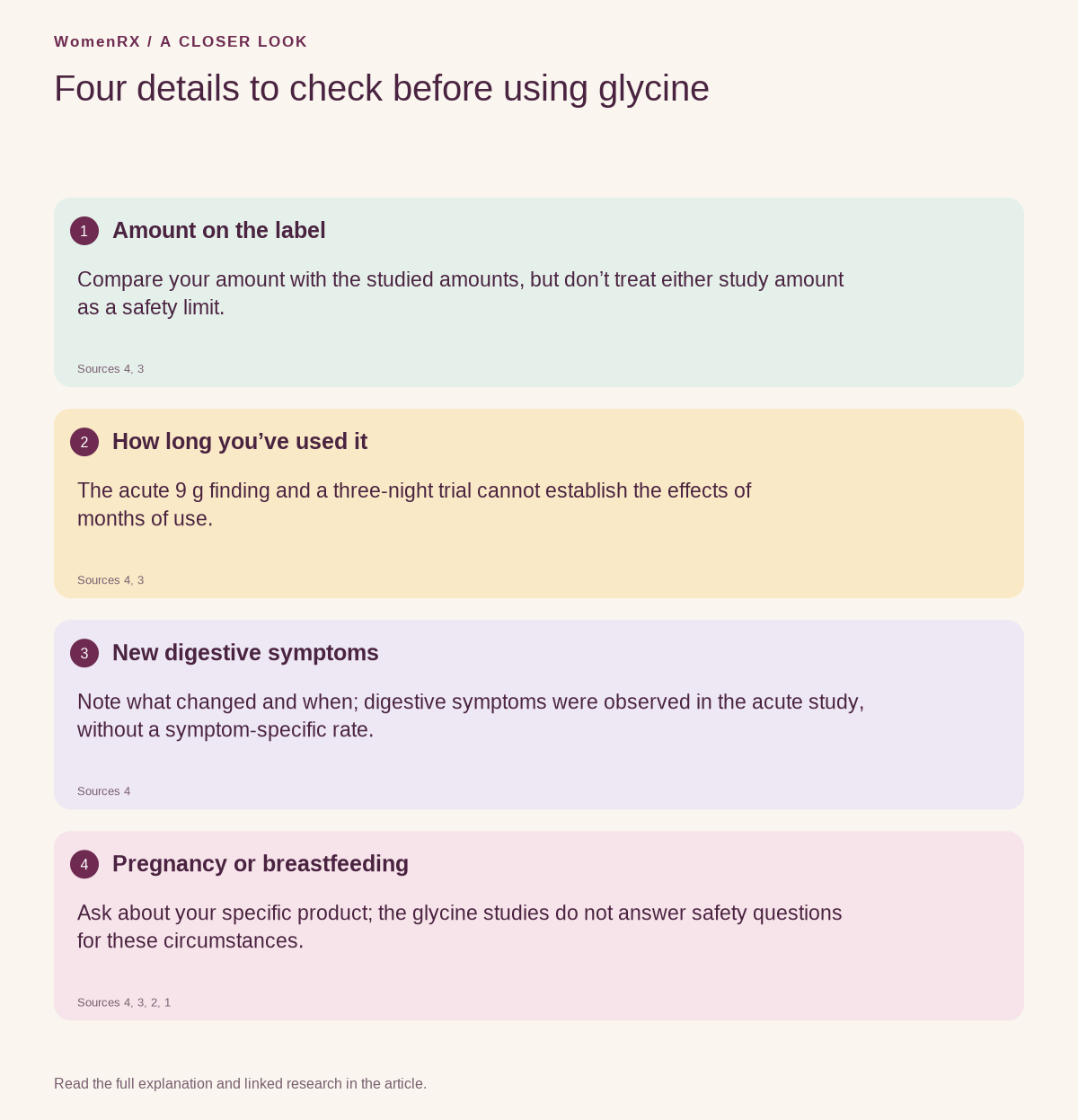
Four details to check before using glycine
Amount on the label: Compare your amount with the studied amounts, but don’t treat either study amount as a safety limit.43
How long you’ve used it: The acute 9 g finding and a three-night trial cannot establish the effects of months of use.43
New digestive symptoms: Note what changed and when; digestive symptoms were observed in the acute study, without a symptom-specific rate.4
Pregnancy or breastfeeding: Ask about your specific product; the glycine studies do not answer safety questions for these circumstances.4321
Read the figure as text
Use these details to put the short-term study finding in context or to frame a specific question about your product.- Amount on the label: Compare your amount with the studied amounts, but don’t treat either study amount as a safety limit.43
- How long you’ve used it: The acute 9 g finding and a three-night trial cannot establish the effects of months of use.43
- New digestive symptoms: Note what changed and when; digestive symptoms were observed in the acute study, without a symptom-specific rate.4
- Pregnancy or breastfeeding: Ask about your specific product; the glycine studies do not answer safety questions for these circumstances.4321
More questions, answered
Is 9 g of glycine a safe upper limit?
No. It was the amount reported in an acute study in which digestive symptoms were observed but no acute serious adverse events were observed. That result does not establish an upper limit or the safety of repeated use. 4
Does glycine cause next-day drowsiness?
Investigators did not observe next-day sleepiness carryover after bedtime ingestion of 9 g of glycine in the acute study. That is reassuring for that study’s circumstances, but it cannot rule out the experience for every person or pattern of use. 4
Sources you can check
- Breastfeeding | Benefits of Breastfeeding | MedlinePlusAccessed 2026-09-25Return to first citation
- Pregnancy and Medicines | MedlinePlusAccessed 2026-09-25Return to first citation
- The Effects of Glycine on Subjective Daytime Performance in Partially Sleep-Restricted Healthy VolunteersAccessed 2026-09-26Return to first citation
- Assessment of Acute Adverse Events of Glycine Ingestion at a High Dose in Human Volunteers (2006)Accessed 2026-09-26Return to first citation