Glycine Supplements: What Studied Doses Tell You
Short human studies give you doses to compare with a product label, but not a proven amount for everyday use.
One sleep study tested 3 grams before bed for three nights in seven analyzed healthy men; an acute safety study examined 9 grams and observed digestive symptoms that were not considered serious.56 A separate trial used higher, weight-based amounts in intensive-care patients.4 These findings don’t establish a long-term dose or side-effect rate for women choosing a supplement.
Glycine is an amino acid, but a number on a supplement label isn’t automatically a dose shown to help, or to be safe, in a study. The useful comparison is amount, purpose, person, and duration together. These studies address different purposes and durations, and only some identify who participated.
The doses answer different questions
In a randomized crossover study, seven healthy men were included in the analysis after taking either 3 grams of glycine or a placebo before bed during three consecutive nights of restricted sleep. Glycine improved performance on a vigilance test on the first and third days. A fatigue rating improved on the first day, but not the third. That’s a finding about a brief period of sleep restriction in men, not a dose recommendation for women with ongoing sleep trouble.5
An acute safety study looked at 9 grams taken at bedtime, three times the amount used in the earlier sleep research it referenced. Investigators observed digestive symptoms, which they considered possibly adverse but not serious. They reported no acute serious adverse events or next-day sleepiness carryover. Those short-term findings don’t tell you how often digestive symptoms occur, how women respond specifically, or what happens with continued use.6
A third randomized trial assigned 29 mechanically ventilated patients to placebo or glycine at 0.2 or 0.4 grams per kilogram of body weight per day, for no more than seven days. Glycine increased its measured concentration in blood and muscle. This was a study of critical illness, not an everyday supplement trial; its reported results don’t provide an adverse-effect summary or separate outcomes for women.4
Those weight-based amounts aren’t a higher rung on a dose ladder to try at home. They were tested for a different purpose, in patients receiving intensive care.4
What to compare on a product label
Start with the amount of glycine per serving, rather than treating the suggested serving as a research-backed target. If a product contains other active ingredients, its label also needs to be read as a combination product. Research on GlyNAC, for example, pairs glycine with N-acetylcysteine; it can’t tell you the effects or safety of glycine alone.3
Next, compare the duration you have in mind with the duration actually studied. Three nights, an acute assessment, and up to seven days of treatment cannot establish safety over months or years.564 Nor do these studies identify a usual side-effect rate for a woman taking a retail supplement. The 9-gram finding gives you one concrete possibility to watch for, digestive symptoms, without showing that they’re inevitable or that other effects cannot occur.6
When your circumstances change the decision
If you’re pregnant or planning a pregnancy, bring the glycine product and its full ingredient list to your prenatal care team before starting it. MedlinePlus advises checking before taking supplements during pregnancy; that guidance isn’t a glycine-specific safety finding.2 If you’re breastfeeding, raise questions about a new supplement with your care team as well. General breastfeeding guidance doesn’t tell us whether supplemental glycine changes breast milk or affects a baby.1
For other women, including those in perimenopause or postmenopause, the same distinction still matters: a study that didn’t report women’s results separately cannot establish a women-specific dose. If you take glycine and notice digestive symptoms, don’t assume the label’s serving is the right amount for you just because it resembles a studied dose.564
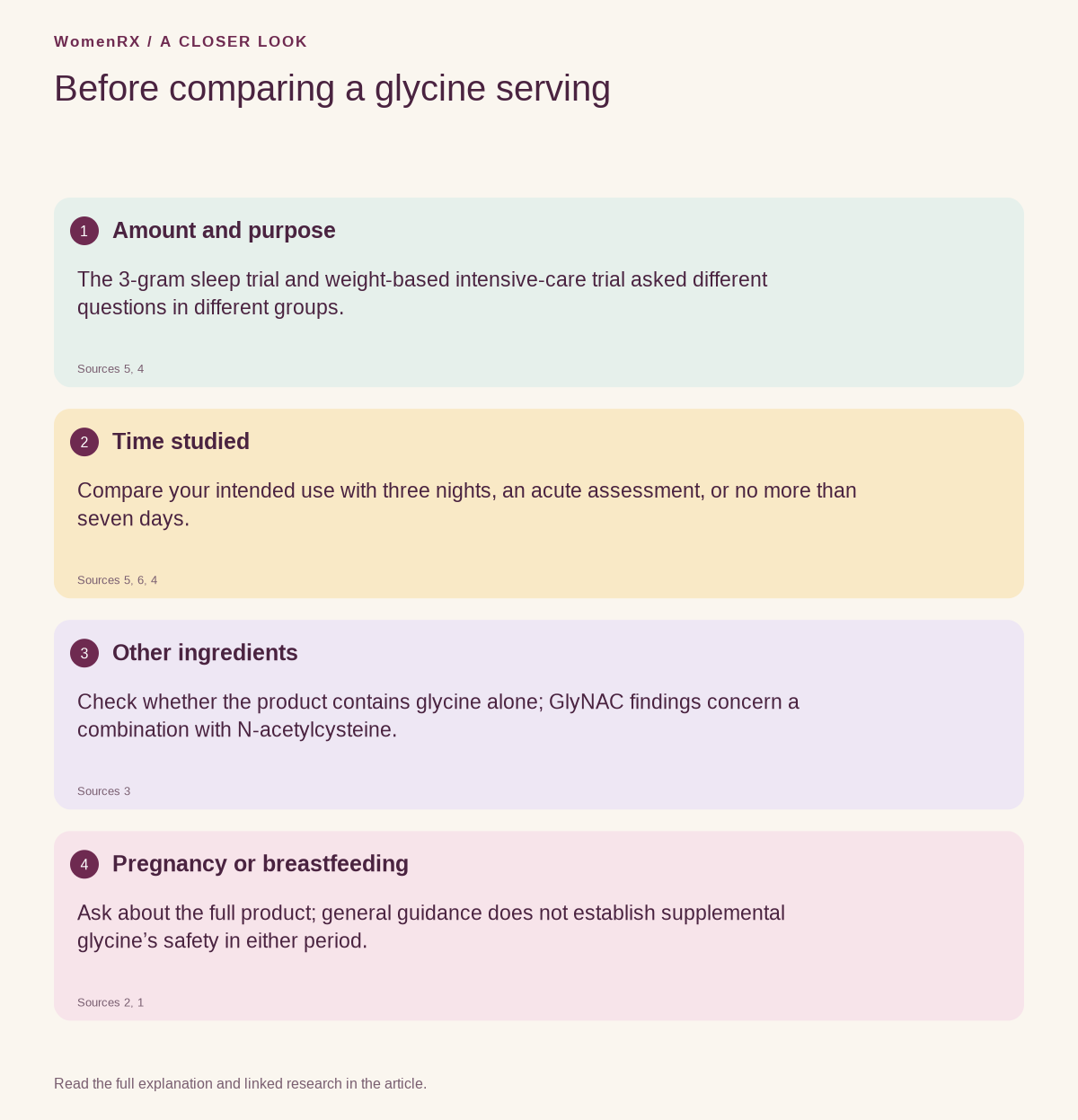
Before comparing a glycine serving
Amount and purpose: The 3-gram sleep trial and weight-based intensive-care trial asked different questions in different groups.54
Time studied: Compare your intended use with three nights, an acute assessment, or no more than seven days.564
Other ingredients: Check whether the product contains glycine alone; GlyNAC findings concern a combination with N-acetylcysteine.3
Pregnancy or breastfeeding: Ask about the full product; general guidance does not establish supplemental glycine’s safety in either period.21
Read the figure as text
Read a label against the conditions of a study, not just its dose.- Amount and purpose: The 3-gram sleep trial and weight-based intensive-care trial asked different questions in different groups.54
- Time studied: Compare your intended use with three nights, an acute assessment, or no more than seven days.564
- Other ingredients: Check whether the product contains glycine alone; GlyNAC findings concern a combination with N-acetylcysteine.3
- Pregnancy or breastfeeding: Ask about the full product; general guidance does not establish supplemental glycine’s safety in either period.21
Sources you can check
- Breastfeeding | Benefits of Breastfeeding | MedlinePlusAccessed 2026-09-25Return to first citation
- Pregnancy and Medicines | MedlinePlusAccessed 2026-09-25Return to first citation
- Targeted Supplementation and Nutritional Strategies for Healthy Aging: A Review of Physiological and Molecular Benefits.Kurtz JA, Singleton KM, Vasenina E, Jäger R, Gonzalez D, Schwarz A, Howard J, Antonio J. · Current nutrition reports · 2026Return to first citation
- The effect of enteral glycine on plasma glycine and muscle structure, size, and function in the critically ill: A randomized controlled trial.Ali Abdelhamid Y, Bongetti AJ, Caldow MK, Karahalios A, Wittholz K, Fetterplace K, Beach LJ, Haines KJ, Tascone B, De Souza DP, Elahee Doomun SN, Presneill J, Rooyackers O, Koopman... · Clinical nutrition (Edinburgh, Scotland) · 2025Return to first citation
- The Effects of Glycine on Subjective Daytime Performance in Partially Sleep-Restricted Healthy VolunteersAccessed 2026-09-26Return to first citation
- Assessment of Acute Adverse Events of Glycine Ingestion at a High Dose in Human Volunteers (2006)Accessed 2026-09-26Return to first citation