L-Theanine: What Study Doses and Safety Can Tell You
Human studies have tested a range of L-theanine amounts, but their protocols are not personal dosing recommendations.
L-theanine trials have tested single doses from about 50 to 500 mg, while reviews describe studies using repeated daily amounts for particular outcomes. That range doesn’t establish an ideal dose or prove long-term safety. When reading a product label, check the amount per serving and other active ingredients, and ask a pharmacist or clinician about use with your medicines, during pregnancy, or while breastfeeding. 13
A study dose isn’t a recommended dose
L-theanine supplements are often sold with a suggested serving, but the amount on a bottle shouldn’t be treated as a medically established target. Researchers have used different amounts, schedules, and outcomes, so a dose tested in one study may not apply to a different goal or person.
A 2026 systematic review of 31 randomized trials, involving 1,168 people in healthy and clinical populations, reported a 200 mg single dose in studies of attention. Its abstract also describes one study using 400 mg per day for eight weeks in people with psychotic anxiety. These are examples of research protocols, not recommendations for everyday use or for treating anxiety. 1
A separate review reports single doses from 50 mg to about 500 mg across cognitive studies. It describes 100-400 mg as a range used in some studies, while noting that evidence is insufficient to establish an optimal amount and that direct dose comparisons are limited and inconsistent. 3
Those findings don’t add up to a universal dose. The purpose of the study, whether the dose was taken once or repeatedly, and whether L-theanine was tested alone or with other ingredients all matter. For example, findings from L-theanine combined with caffeine can’t tell you what the same amount of L-theanine alone will do. 23
Read the whole serving, not just the front label
Before comparing products, find the amount of L-theanine in one serving and check how many capsules, tablets, or scoops make up that serving. Then read the full ingredient panel. A product may include caffeine or other active ingredients, which can make it different from the standalone L-theanine used in a trial.
Product formulations can also differ. A review of supplement research notes variation in composition, purity, and formulation, all of which can make results harder to apply from one product to another. A label’s milligram amount tells you what the manufacturer declares; it doesn’t by itself show that the product matches a particular research preparation. 2
A practical label check is to ask: What is the L-theanine amount per serving? What else is in the serving? Does the study being discussed use L-theanine alone or a combination? Was it a one-time dose or repeated use? These questions help keep a research number in context without turning it into a personal instruction.
What safety findings do, and don’t, show
The 31-trial review reported no serious adverse events and assessed safety using dropouts and their reported reasons. Another review describes L-theanine as generally well tolerated in clinical trials. These are reassuring observations, but they don’t prove that every product, amount, or duration is safe for everyone. 13
Longer-term human safety information is limited, and reviews call for more research on optimal dosing and interactions with other bioactive substances. The available evidence therefore can’t provide a complete interaction list or settle safety for ongoing use. If you take medicines or other supplements, bring the product label and your full list to a pharmacist or clinician rather than assuming that “natural” means interaction-free. 34
Pregnancy, breastfeeding, and women-specific findings
The cited human trial findings don’t establish whether L-theanine results differ by sex or whether supplements are safe during pregnancy or breastfeeding. 13 If you’re considering a product during either of those times, ask your clinician or pharmacist to review the exact product and your situation.
Useful questions for a pharmacist or clinician
Bring the label, including the amount per serving and all added ingredients. You might ask:
- Is there a known concern with this product and my medicines or other supplements?
- Does the evidence for the reason I’m considering it apply to my situation?
- Is there a reason to avoid it during pregnancy or breastfeeding?
- Does this combination product add ingredients that change the safety or evidence question?
The goal isn’t to match a study dose on your own. It’s to make sure the product, the research behind its claims, and your circumstances are being considered together.
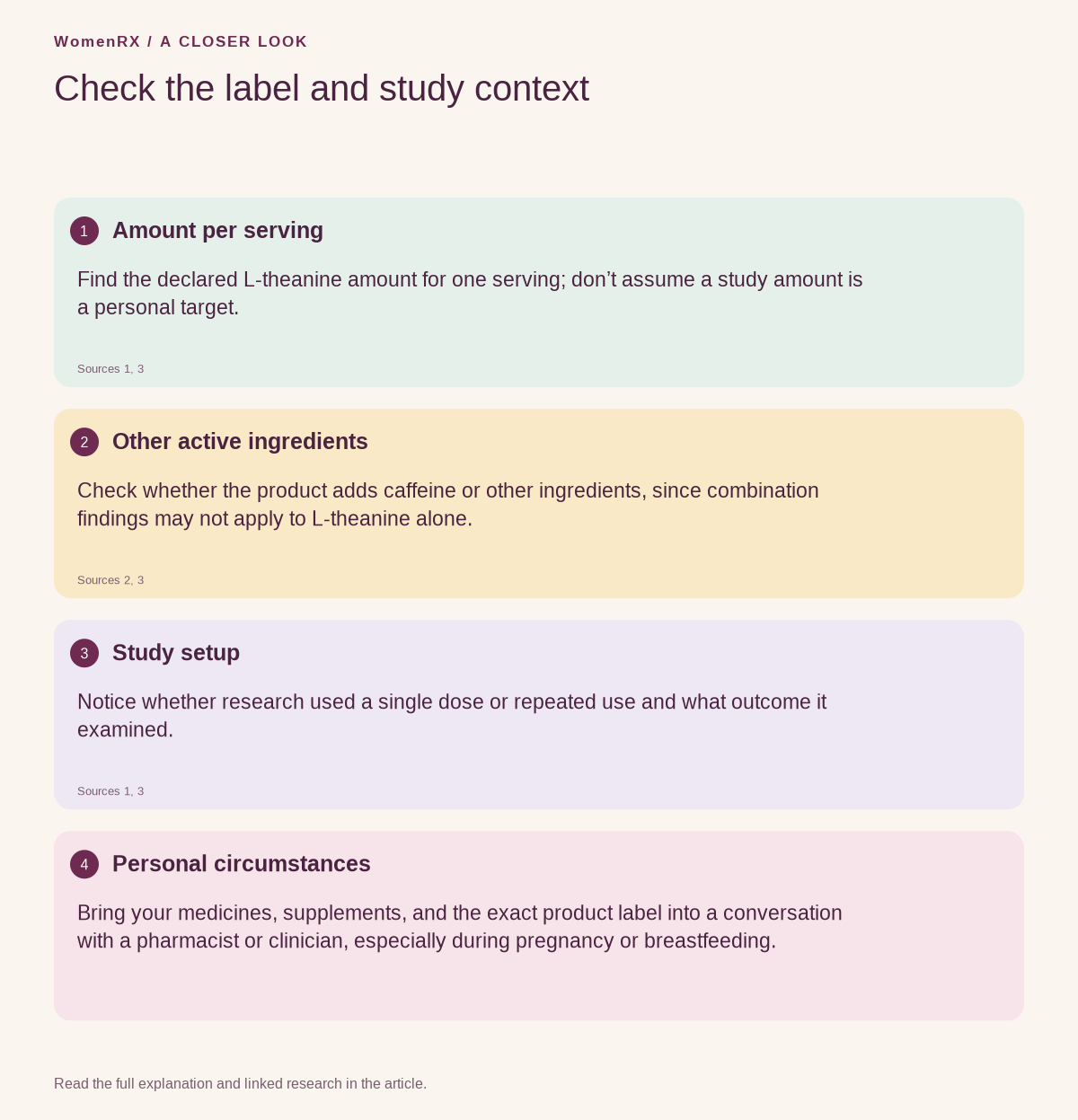
Check the label and study context
Amount per serving: Find the declared L-theanine amount for one serving; don’t assume a study amount is a personal target.13
Other active ingredients: Check whether the product adds caffeine or other ingredients, since combination findings may not apply to L-theanine alone.23
Study setup: Notice whether research used a single dose or repeated use and what outcome it examined.13
Personal circumstances: Bring your medicines, supplements, and the exact product label into a conversation with a pharmacist or clinician, especially during pregnancy or breastfeeding.
Read the figure as text
Use these checks to keep a product label, a research dose, and your own circumstances separate.- Amount per serving: Find the declared L-theanine amount for one serving; don’t assume a study amount is a personal target.13
- Other active ingredients: Check whether the product adds caffeine or other ingredients, since combination findings may not apply to L-theanine alone.23
- Study setup: Notice whether research used a single dose or repeated use and what outcome it examined.13
- Personal circumstances: Bring your medicines, supplements, and the exact product label into a conversation with a pharmacist or clinician, especially during pregnancy or breastfeeding.
More questions, answered
Does a dose used in a study mean that amount is safe for me?
No. A study amount describes what researchers tested under a particular protocol. It doesn’t establish a personal dose or guarantee safety for every person, product, or duration. 13
Sources you can check
- Cognitive and affective effects of L-Theanine: a systematic review and meta-analysis of 31 randomized trials.Gerolymos C, Saddier E, Boyer L, Fond G. · Molecular psychiatry · 2026Return to first citation
- Efficiency of Different Supplements in Alleviating Symptoms of ADHD with or Without the Use of Stimulants: A Systematic Review.Al Shahab S, Al Balushi R, Qambar A, Abdulla R, Qader M, Abdulla S, Jahrami H. · Nutrients · 2025Return to first citation
- Effects of L-theanine on cognition, mood and sleep: evidence from human trials.Cotter J, Kilpatrick HE. · Frontiers in nutrition · 2026Return to first citation
- The Emerging Role of Citrulline and Theanine in Health and Disease: A Comprehensive Review.Lv X, Chen C, Liang Y, Song Y, Liu J, Chen W, Li H. · Nutrients · 2025Return to first citation