Alpha-Lipoic Acid: Compare Study Doses and Safety Checks
Alpha-lipoic acid studies have used different daily amounts, but the right label check starts with the product and your health situation, not a research number.
Studies have used 600 mg daily for four weeks in people with diabetic nerve problems and 400 to 1,200 mg daily in a four-year observational study of adults without diabetes. Neither establishes a personal dose or proves that products are interchangeable. Check the amount per serving and added ingredients, then review blood-sugar medicines and relevant health conditions before use. 12

Alpha-lipoic acid is also called thioctic acid. If you’re comparing bottles, a familiar study dose may catch your eye. It’s more useful to ask what was studied, in whom, and whether your product and circumstances match. 12
Why the study amounts don’t give you a dose
In one four-week study, 205 people with diabetic polyneuropathy received 600 mg daily of Thiolepta, an alpha-lipoic acid preparation. In a different study, researchers looked back at records from 322 adults with normal or mildly elevated glucose who had taken an alpha-lipoic acid food supplement for four years. Those adults were in groups taking 400, 600, 800, or 1,200 mg daily. The studies involved different health questions, products, timeframes, and designs. Matching a bottle to one of their numbers does not establish that it will have the same effects. 12
The four-year study reported changes in glucose and lipid measures in its higher-dose groups, but it was observational, not a trial assigning people at random to doses. Its results shouldn’t be read as proof that a higher dose will improve those measures for you. The four-week study’s abstract reports favorable nerve-symptom results but doesn’t provide enough design detail to treat its regimen as a general supplement recommendation. 12
Read the serving, not just the front of the bottle
Find the amount of alpha-lipoic acid per serving, then check how many capsules or tablets make up that serving. For example, a label that lists two capsules per serving is describing the combined amount in two capsules, not necessarily the amount in one. Also read the full ingredient list. If other active ingredients are included, a study of an alpha-lipoic acid preparation cannot tell you the effects or safety of that combination. These studies did not compare retail formulations head to head. 12
Check medicines and conditions before use
The four-year study recorded nausea, vomiting, dizziness, rash, low blood sugar, and low blood pressure. Reported adverse events did not differ among its four dose groups, but that does not mean every amount is equally safe in other people or with other medicines. The study excluded people taking drugs that could affect glucose metabolism. If you use a blood-sugar medicine, ask a pharmacist or clinician to review the exact supplement and your medication list rather than assuming the study tested that combination. The research does not verify an interaction with a particular named drug. 13
The same study excluded people with diabetes, abnormal thyroid function, or certain liver or kidney impairments. That doesn’t establish that alpha-lipoic acid is harmful with those conditions; it means this study cannot settle the dose or safety question for them. If any applies to you, it’s worth raising specifically when you review the product. 1
What the findings mean for women
Women participated in both studies: 134 of the 205 people in the four-week study were women, and the four-year study included men and women in similar numbers across its dose groups. Neither reports results separately for women, so neither establishes a women-specific dose. 12
The four-year study excluded women who were pregnant or breastfeeding, as well as women who could become pregnant and were not using adequate contraception. Its findings therefore cannot answer whether a particular amount is safe during pregnancy or breastfeeding. If that’s your situation, get advice tailored to you before using the supplement. 1
A useful question to bring with the label is: “Given this amount per serving, these other ingredients, my medicines, and my health conditions, is there a reason I should avoid this product?” That keeps the decision focused on the bottle you actually have, rather than a dose used in a different setting.
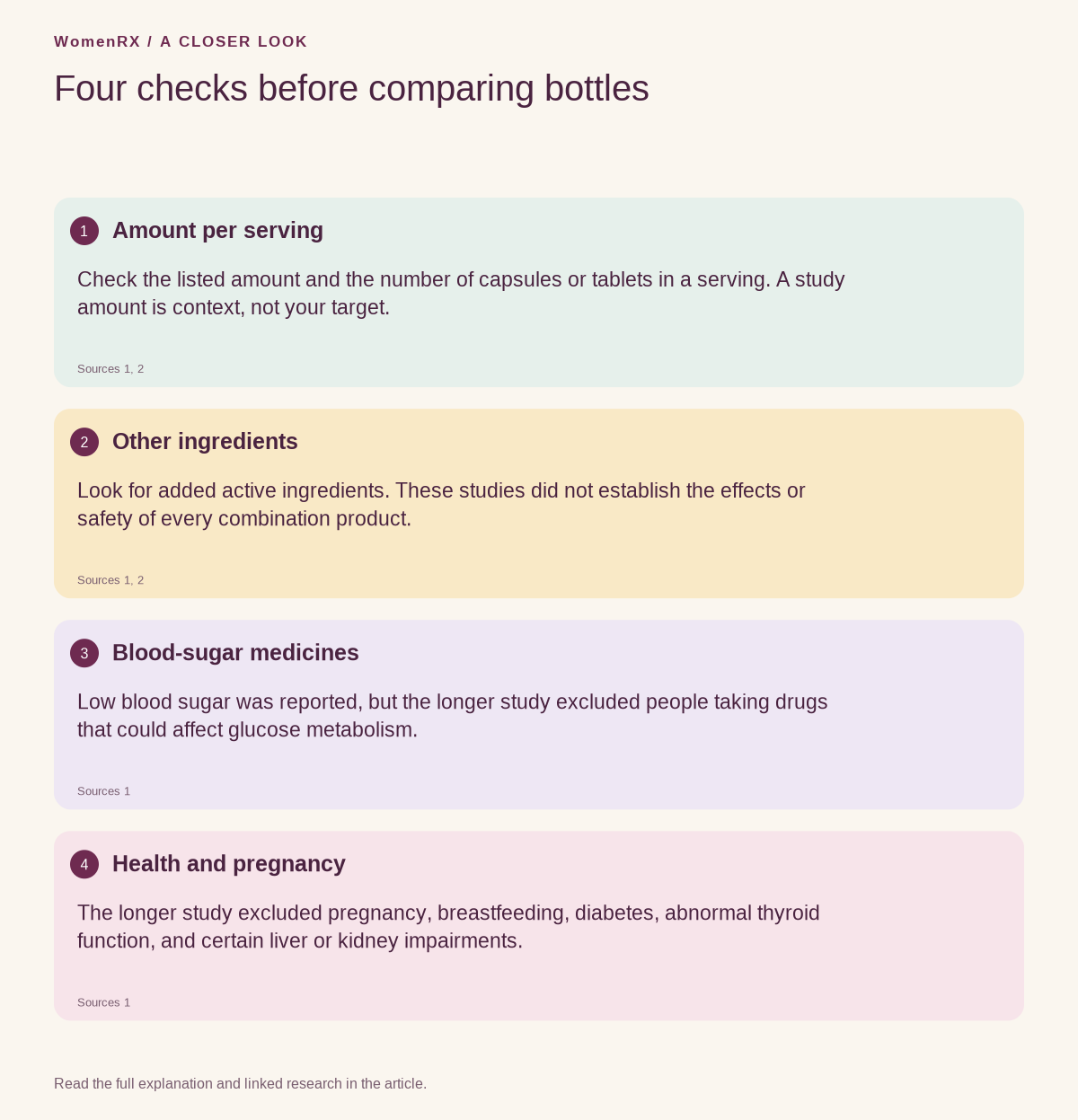
Four checks before comparing bottles
Amount per serving: Check the listed amount and the number of capsules or tablets in a serving. A study amount is context, not your target.12
Other ingredients: Look for added active ingredients. These studies did not establish the effects or safety of every combination product.12
Blood-sugar medicines: Low blood sugar was reported, but the longer study excluded people taking drugs that could affect glucose metabolism.1
Health and pregnancy: The longer study excluded pregnancy, breastfeeding, diabetes, abnormal thyroid function, and certain liver or kidney impairments.1
Read the figure as text
Use the label and your own health details to put a study amount in context; this is not a dosing score.- Amount per serving: Check the listed amount and the number of capsules or tablets in a serving. A study amount is context, not your target.12
- Other ingredients: Look for added active ingredients. These studies did not establish the effects or safety of every combination product.12
- Blood-sugar medicines: Low blood sugar was reported, but the longer study excluded people taking drugs that could affect glucose metabolism.1
- Health and pregnancy: The longer study excluded pregnancy, breastfeeding, diabetes, abnormal thyroid function, and certain liver or kidney impairments.1
Sources you can check
- Safety and Efficacy of Alpha Lipoic Acid During 4 Years of Observation: A Retrospective, Clinical Trial in Healthy Subjects in Primary Prevention.Derosa G, D'Angelo A, Preti P, Maffioli P. · Drug design, development and therapy · 2020Return to first citation
- [Efficacy of thiolepta in diabetic polyneuropathy: results of the study ETIKA].Strokov IA, Fokina AS, Golovacheva VA, Kochetov AG. · Zhurnal nevrologii i psikhiatrii imeni S.S. Korsakova · 2013Return to first citation
- Nutritional supplements and their effect on glucose control.Lee T, Dugoua JJ. · Advances in experimental medicine and biology · 2012Return to first citation