Alpha-Lipoic Acid After 40: What Midlife Evidence Shows
Being over 40 or going through menopause doesn’t, by itself, make alpha-lipoic acid more useful; the evidence depends on the condition you’re considering it for.
There’s no menopause-specific benefit established in the clinical findings discussed here. For fatty liver disease, a meta-analysis of randomized trials found no significant improvement in the outcomes it measured, including in its age subgroup analyses. For diabetic nerve symptoms, a review found some short-term symptom improvement, but not convincing evidence that alpha-lipoic acid repairs nerves or changes the long-term course. Neither finding shows that menopause changes the effect. 1 2

The short answer: midlife hasn’t been shown to change the effect
Alpha-lipoic acid (ALA) is sometimes considered for concerns such as diabetic nerve symptoms or fatty liver disease. But evidence about those conditions isn’t the same as evidence that ALA works differently during perimenopause or after menopause. The studies summarized here don’t establish a menopause-specific benefit, so age 40 or menopause alone isn’t a reason to start it.
That distinction matters: a study may include adults of different ages without reporting whether participants were perimenopausal or postmenopausal, or whether results differed by menopause status. ALA’s effects on a particular condition also can’t be assumed to apply to another one.
If you’re considering it for fatty liver disease
A 2026 meta-analysis pooled seven randomized trials involving 414 people with nonalcoholic fatty liver disease. Overall, ALA did not significantly improve the measured liver enzymes, cholesterol and other blood fats, blood-sugar measures, or obesity measures compared with placebo. The authors also reported no benefit in subgroup analyses by participant age. That is relevant to age, but it does not tell us whether menopause changes the result: menopause-specific outcomes aren’t reported in the summary. 1
A broader review found mixed results across human studies and described the evidence as limited by small samples, short follow-up, and varied study quality. Because it included different kinds of research, including animal and laboratory studies, those promising signals shouldn’t be treated as proof that ALA improves fatty liver disease in people. The randomized-trial meta-analysis offers a more focused check of clinical outcomes and found no significant benefit. 1 3
If you’re considering it for diabetic nerve symptoms
A review of alpha-lipoic acid for diabetic peripheral neuropathy found that several trials reported short-term symptom improvement. That is a narrower claim than restoring damaged nerves or preventing the condition from progressing. The review describes long-term evidence as limited: a major long-term trial had a borderline result on its main combined measure and did not significantly improve nerve-conduction measures. The review did not establish a menopause-specific effect. 2
So if nerve symptoms are the concern, the useful question is whether ALA has evidence for that condition and outcome, not whether it is marketed for “midlife.” The findings here concern adults with diabetes and nerve problems; they don’t show that ALA helps nerve symptoms unrelated to diabetes, or that it works better after menopause. 2
A practical way to weigh the decision
Start with the concern you want to address. For fatty liver disease, the randomized-trial synthesis did not find significant improvements in the outcomes it measured. For diabetic nerve symptoms, there is a signal for short-term symptom relief, but less support for lasting nerve-function benefits. Neither body of evidence identifies menopause as a reason to expect a different result. 1 2
This leaves an evidence gap, not proof that menopause can never matter. The studies summarized here don’t provide menopause-specific comparisons. Until that distinction is tested and reported, it’s more useful to judge ALA by the condition and outcome than by the fact that you’re over 40.
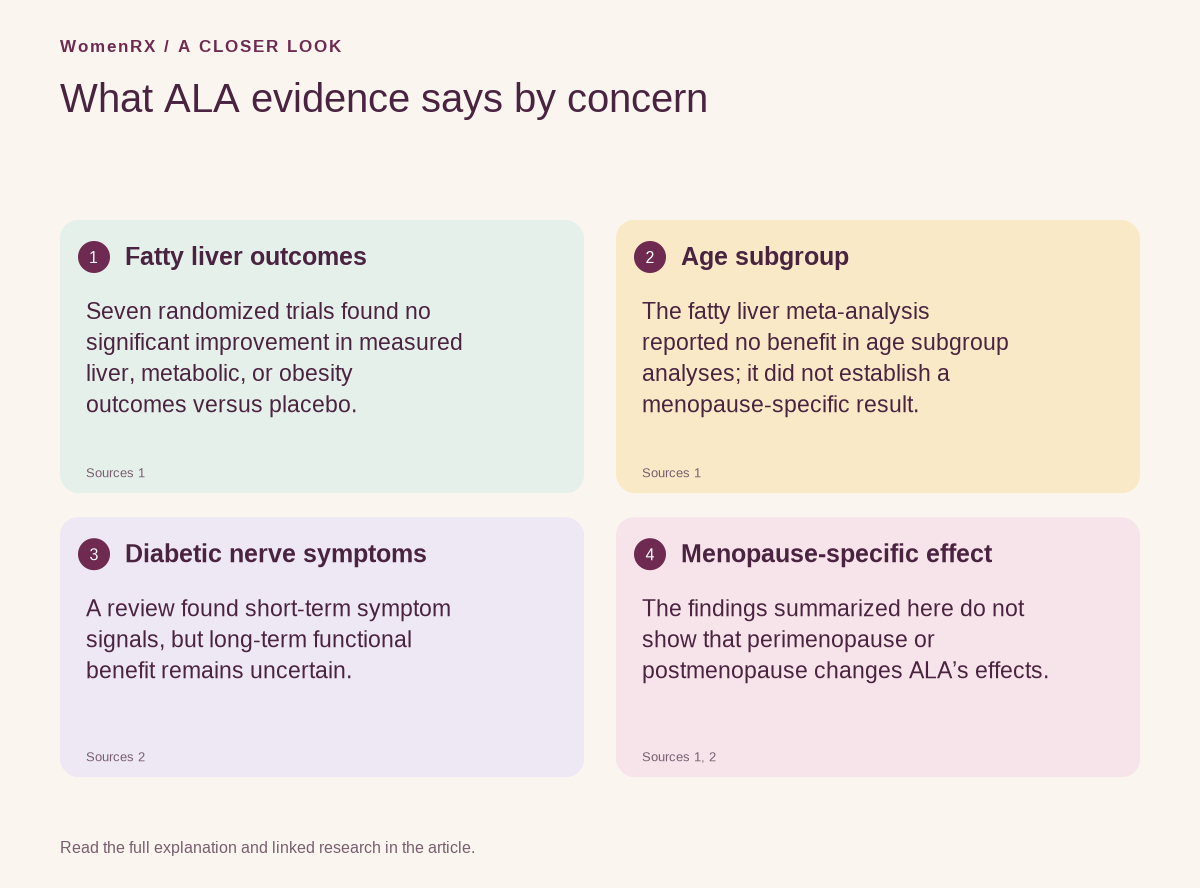
What ALA evidence says by concern
Fatty liver outcomes: Seven randomized trials found no significant improvement in measured liver, metabolic, or obesity outcomes versus placebo.1
Age subgroup: The fatty liver meta-analysis reported no benefit in age subgroup analyses; it did not establish a menopause-specific result.1
Diabetic nerve symptoms: A review found short-term symptom signals, but long-term functional benefit remains uncertain.2
Menopause-specific effect: The findings summarized here do not show that perimenopause or postmenopause changes ALA’s effects.12
Read the figure as text
The findings differ by condition, and neither evidence stream establishes a menopause-specific effect.- Fatty liver outcomes: Seven randomized trials found no significant improvement in measured liver, metabolic, or obesity outcomes versus placebo.1
- Age subgroup: The fatty liver meta-analysis reported no benefit in age subgroup analyses; it did not establish a menopause-specific result.1
- Diabetic nerve symptoms: A review found short-term symptom signals, but long-term functional benefit remains uncertain.2
- Menopause-specific effect: The findings summarized here do not show that perimenopause or postmenopause changes ALA’s effects.12
Sources you can check
- Effects of alpha-lipoic acid supplementation on patients with nonalcoholic fatty liver disease: a systematic review and meta-analysis of randomized clinical trials.Li T, Liu H, Zeng J. · BMC endocrine disorders · 2026Return to first citation
- Alpha-Lipoic Acid and Benfotiamine in Diabetic Peripheral Neuropathy: A Critical Review of Mechanistic Rationale and Clinical Evidence Within a Nutritional Therapeutic Framework.Ciubotaru A, Grosu C, Alexa D, Cucu LE, Schreiner TG, Bistriceanu CE, Maştaleru A, Azoicāi D, Vamanu A, Patrascu A, Cuciureanu DI, Ignat EB. · Nutrients · 2026Return to first citation
- Effects of alpha-lipoic acid in non-alcoholic fatty liver disease (NAFLD): a systematic review of literature.Saeed TN, Al-Hussainy AF, Sanghvi G, Roopashree R, Kashyap A, Anand DA, Panigrahi R, Aminov Z, Taher SG, Alwan M, Jawad M, Mushtaq H. · Journal of diabetes and metabolic disorders · 2026Return to first citation