Alpha-Lipoic Acid: Safety Questions Before You Try It
Small studies offer a few specific safety findings, but they don’t settle whether alpha-lipoic acid is safe for routine use.
In a 12-week trial involving people with type 2 diabetes and painful neuropathy, researchers found no significant safety differences between treatment groups. Dizziness and swelling were reported in the group taking alpha-lipoic acid with pregabalin, but weren’t established as alpha-lipoic-acid side effects. Insulin and some diabetes medicines can cause low blood glucose; the cited studies don’t establish whether alpha-lipoic acid adds to that risk. 1 2
What the safety findings actually tell you
Alpha-lipoic acid, also called ALA or thioctic acid, has been studied for specific health conditions. That research can offer clues about tolerability in the people and treatment settings studied, but it doesn’t establish a general safety profile for routine supplement use.
In a 12-week trial of people with type 2 diabetes and painful nerve damage, researchers found no significant safety differences among the treatment groups. Dizziness and swelling were reported as common reactions in the group taking ALA with pregabalin. The researchers described the combination’s safety profile as consistent with pregabalin, so those reactions weren’t shown to be caused by ALA. 2
A review of eight studies involving 165 people with schizophrenia found no significant differences from placebo in adverse events or stopping treatment. The authors noted that the findings were limited by small study sizes and imprecision. These results add some information about use in a specific setting, but don’t provide a complete side-effect picture for ALA alone or for longer-term use by the general public. 3
Separate low-glucose risks from ALA questions
Insulin and some other diabetes medicines can lower blood glucose. For many people with diabetes, a reading below 70 mg/dL is considered low, though the right threshold can differ from person to person. 1
These studies don’t establish whether ALA itself lowers blood glucose or changes the risk of low glucose when used with diabetes medicine. If you take insulin or another glucose-lowering medicine, have your prescriber or pharmacist review ALA alongside your treatment and monitoring plan. Don’t change prescribed diabetes medicine on your own. 1 2 3
Match the evidence to your reason for taking it
A study of ALA for painful diabetic neuropathy, for example, answers a different question from whether ALA is useful and safe as a general wellness supplement. Before trying it, consider what you want it to do and whether research in that particular condition applies to you. The 12-week neuropathy trial provides limited information about safety in its study setting, not proof that ALA is right for other purposes or for everyone with diabetes. 2
Pregnancy and breastfeeding are separate questions
The available review notes gaps in research involving vulnerable populations; it doesn’t establish whether ALA is safe during pregnancy or breastfeeding. That uncertainty doesn’t, by itself, answer safety questions for women who aren’t pregnant or breastfeeding. Safety outside those life stages still depends on the reason for use, other health conditions, and medicines, and isn’t settled by the limited studies described here. 4
A focused review before you start
Bring the product information to a prescriber or pharmacist and explain why you’re considering ALA. Be sure to mention diabetes, any insulin or other glucose-lowering medicine, and pregnancy or breastfeeding if either applies. Ask whether the research for your intended use actually applies to you, and what the available evidence does and doesn’t say about glucose and side effects.
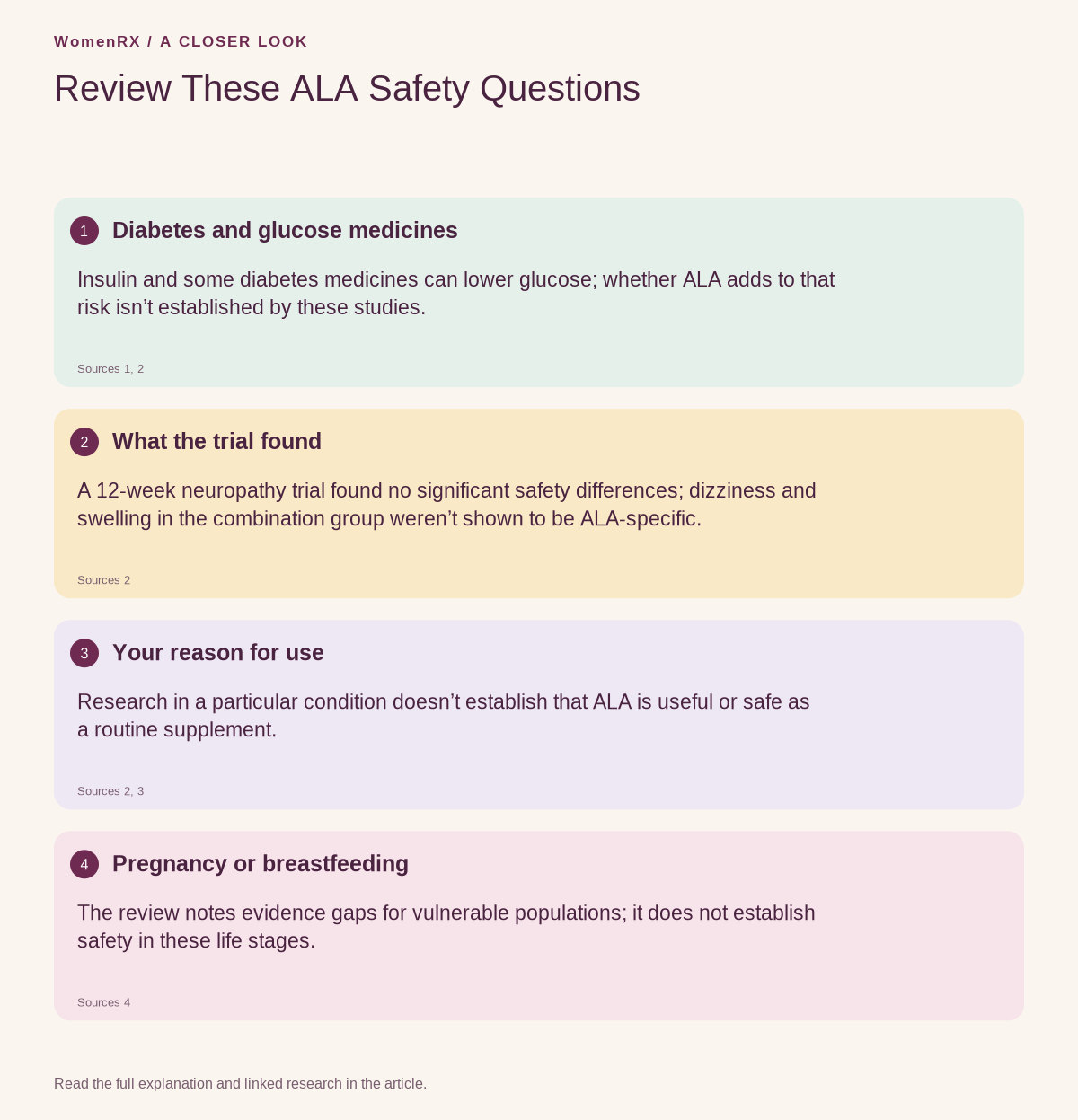
Review These ALA Safety Questions
Diabetes and glucose medicines: Insulin and some diabetes medicines can lower glucose; whether ALA adds to that risk isn’t established by these studies.12
What the trial found: A 12-week neuropathy trial found no significant safety differences; dizziness and swelling in the combination group weren’t shown to be ALA-specific.2
Your reason for use: Research in a particular condition doesn’t establish that ALA is useful or safe as a routine supplement.23
Pregnancy or breastfeeding: The review notes evidence gaps for vulnerable populations; it does not establish safety in these life stages.4
Read the figure as text
Use these distinctions to make a medication review specific to your health, medicines, and reason for considering ALA.- Diabetes and glucose medicines: Insulin and some diabetes medicines can lower glucose; whether ALA adds to that risk isn’t established by these studies.12
- What the trial found: A 12-week neuropathy trial found no significant safety differences; dizziness and swelling in the combination group weren’t shown to be ALA-specific.2
- Your reason for use: Research in a particular condition doesn’t establish that ALA is useful or safe as a routine supplement.23
- Pregnancy or breastfeeding: The review notes evidence gaps for vulnerable populations; it does not establish safety in these life stages.4
More questions, answered
Does research in people with diabetes prove ALA is safe for everyday use?
No. A 12-week trial in people with type 2 diabetes and painful neuropathy found no significant safety differences among treatment groups. Dizziness and swelling were reported in the group taking ALA with pregabalin, but the study didn’t establish these as ALA-specific effects or prove safety for routine use. 2
Does the evidence show whether ALA interacts with diabetes medicine?
The cited safety findings don’t establish whether ALA changes the risk of low blood glucose when combined with diabetes medicine. Insulin and some other diabetes medicines can lower blood glucose, so include ALA in a medication review if you use them. 1 2
Sources you can check
- Hypoglycemia: MedlinePlusAccessed 2026-09-25Return to first citation
- Efficacy and Safety of Pregabalin and Alpha-Lipoic Acid Combination in Patients With Painful Diabetic Peripheral Neuropathy: A Randomized, Open-Label, Non-Inferiority, Phase IV Clinical Trial and Subgroup Analysis (OPTIMUM Study).Oh TJ, Kim SS, Lee SH, Kwon HS, Kim ES, Rhee EJ, Yoo HJ, Jang HN, Lee WJ, Kim ES, Kim SY, Koh G, Hong EG, Park TS, Won JC. · Diabetes, obesity & metabolism · 2026Return to first citation
- Efficacy and Safety of Alpha-Lipoic Acid as an Adjunctive Therapy in Schizophrenia: A Systematic Review and Meta-Analysis.Tudella GCN, Pereira MAOM, Klostermann AU, Gonzalez JVP, Gonçalves OR, Donato KO, Nantes LAO, da Silva AMP, Forte ARCC, Patrocínio MLV, de Queiroz Oliveira T, Vasconcelos SMM. · Journal of clinical psychopharmacology · 2026Return to first citation
- Therapeutic applications of alpha-lipoic acid: A review of clinical and preclinical evidence (1998-2024).Carnib BL, Souza EV, Floresta LRS, Lage TM, Pedro IDR, Muniz FC, Silva ACA, Oliveira JM. · Biomedicine & pharmacotherapy = Biomedecine & pharmacotherapie · 2025Return to first citation