Alpha-Lipoic Acid: What Has It Been Shown to Help?
Alpha-lipoic acid has shown some promise for short-term diabetic nerve symptoms, but that’s different from lowering blood sugar or repairing nerves.
Alpha-lipoic acid (ALA, also called thioctic acid) has shown short-term symptom improvement in trials of diabetic peripheral neuropathy, though lasting benefits for nerve function remain uncertain. Trials combining ALA with pregabalin answer a different question from whether ALA works alone. The cited studies do not establish ALA as a blood-sugar treatment or answer pregnancy and breastfeeding safety questions. 267
Nerve symptoms are the most relevant use studied
Diabetic peripheral neuropathy can cause pain, tingling, and numbness. High blood glucose can damage nerves over time; managing blood glucose can help prevent nerve problems or keep them from worsening. Treating pain that’s already present is a separate goal. 12
A review of clinical studies reports that ALA improved short-term diabetic neuropathy symptoms across several randomized trials. But feeling less pain or tingling does not establish that a damaged nerve has recovered. The review found very limited, inconclusive evidence for long-term functional stabilization and no demonstrated structural nerve regeneration. 6
That distinction is useful when you see a broad claim that ALA “helps nerves.” Ask which outcome was measured: how symptoms felt, how nerves functioned, or whether damage was prevented. The answer can change what a result means for you.
ALA alone and ALA plus pregabalin are different tests
A 12-week randomized trial assigned 151 people with type 2 diabetes and painful neuropathy to ALA alone, pregabalin alone, or both. The ALA-alone group received 480 mg per day; the reported passages do not specify its route. The trial’s main comparison found that pregabalin alone was not inferior to the combination for pain relief. An exploratory analysis suggested a possible combination benefit in a subgroup with shorter-duration neuropathy, but the researchers said that finding needs verification. Neither result shows that ALA alone works as well as pregabalin. 2
A smaller, double-blind crossover trial compared oral ALA, pregabalin, and their combination for six weeks each in 55 people with peripheral neuropathies. Twenty had diabetic neuropathy; the others had small-fiber or other neuropathies. Pain ratings were lower during ALA than at baseline, but pregabalin performed better than ALA, and adding ALA to pregabalin showed no additional pain benefit. Because the trial mixed several causes of neuropathy, its overall result should not be treated as a precise estimate for diabetic neuropathy alone. 3
Another 12-week trial might appear to conflict with those findings. It enrolled people with painful diabetic neuropathy who had not responded adequately to pregabalin titration. A lower-pregabalin-dose plus ALA regimen met the trial’s criterion for being non-inferior to a higher-pregabalin-dose regimen on its main pain outcome. That is a finding about two different regimens in a selected group, not proof that adding ALA to the same pregabalin regimen improves pain, or that ALA works by itself. The abstract does not specify the treatment route. 7
These trials used different participants and comparisons. Their reported doses describe what researchers tested, not a dose to copy from a study.
Blood sugar is a separate question
A result for diabetic nerve symptoms does not show that ALA improves glucose control. One randomized study measured fasting glucose while testing oral ALA supplements for unexplained pain in 210 adults whose glucose levels were normal. After two months, the researchers reported no glucose decrease among ALA-treated participants. Because these participants did not have diabetes, that result cannot settle whether ALA affects glucose in people who do. It also says nothing about gestational diabetes. 5
If blood sugar is your reason for considering ALA, don’t substitute a neuropathy pain finding for evidence about that goal. Glucose control remains relevant to preventing diabetic nerve problems or keeping them from worsening, whether or not a treatment eases pain. 1
Other kinds of pain need their own evidence
Diabetic neuropathy findings do not automatically apply to fibromyalgia or unexplained pain. In a small placebo-controlled fibromyalgia trial, ALA did not significantly improve overall pain compared with placebo. An exploratory analysis found a favorable difference for men but not women; that subgroup finding cannot establish a benefit for men or answer whether ALA helps women with diabetic neuropathy. 4
A separate trial reported lower pain scores with ALA among adults with several kinds of unexplained pain. Its mixed conditions and results do not establish a benefit for any one nerve-pain diagnosis. 5
What changes if you’re pregnant or breastfeeding?
The reported diabetic-neuropathy trial results do not break out outcomes for women, so they cannot tell us whether ALA works differently for women and men. They also do not answer whether ALA is safe during pregnancy or breastfeeding. In particular, a result from adults with type 2 diabetes should not be carried over to gestational diabetes. 237
For a decision today, match the claim to the study: short-term relief of diabetic nerve symptoms has some support; lasting nerve repair and blood-sugar benefits have not been established by these studies. If you’re comparing products or discussing ALA alongside a current pain treatment, check whether the claim comes from an ALA-alone study or a combination trial. These trials do not establish a specific medication-interaction claim. 23567
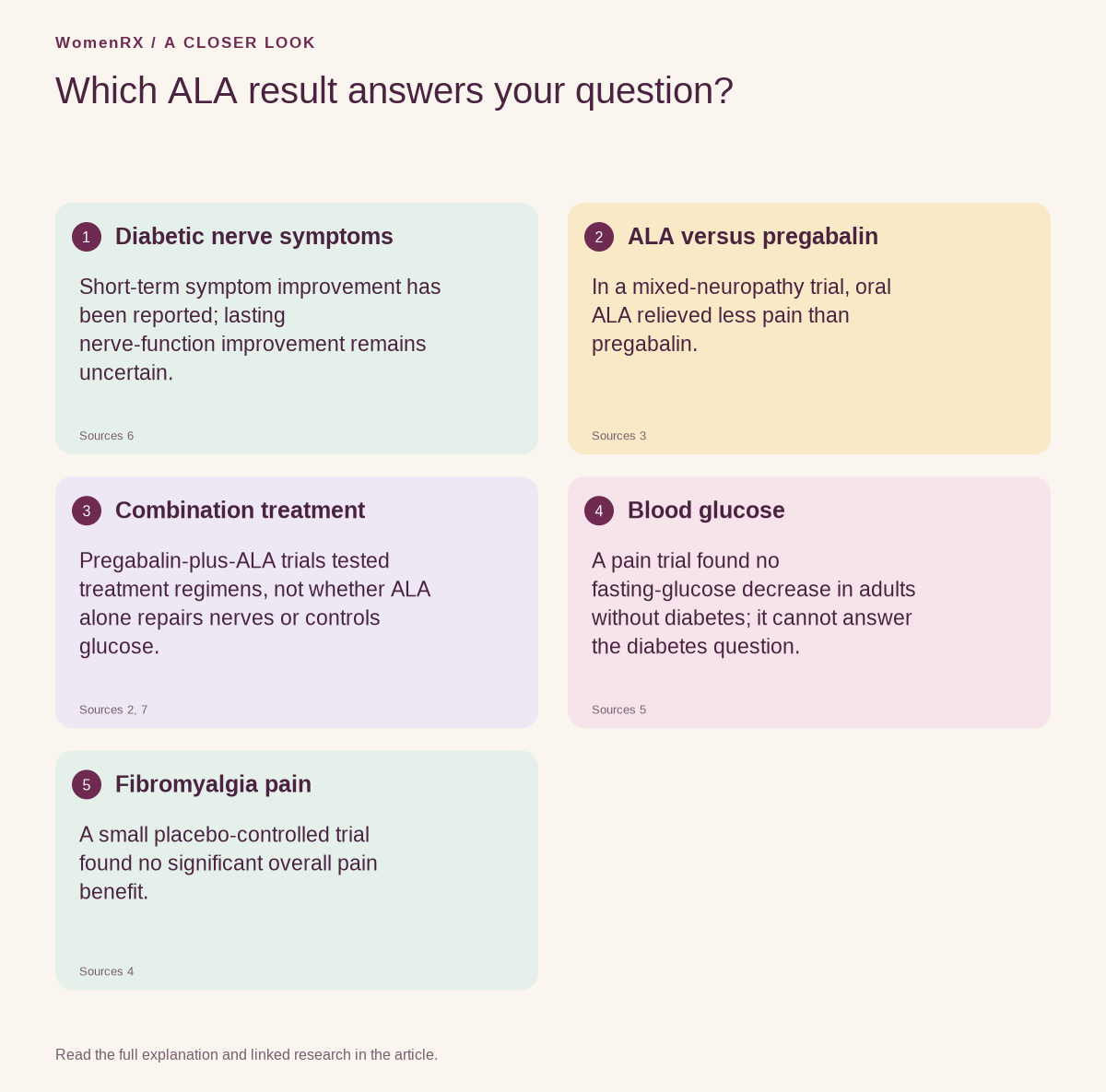
Which ALA result answers your question?
Diabetic nerve symptoms: Short-term symptom improvement has been reported; lasting nerve-function improvement remains uncertain.6
ALA versus pregabalin: In a mixed-neuropathy trial, oral ALA relieved less pain than pregabalin.3
Combination treatment: Pregabalin-plus-ALA trials tested treatment regimens, not whether ALA alone repairs nerves or controls glucose.27
Blood glucose: A pain trial found no fasting-glucose decrease in adults without diabetes; it cannot answer the diabetes question.5
Fibromyalgia pain: A small placebo-controlled trial found no significant overall pain benefit.4
Read the figure as text
The condition, outcome, and treatment comparison determine what each result can tell you.- Diabetic nerve symptoms: Short-term symptom improvement has been reported; lasting nerve-function improvement remains uncertain.6
- ALA versus pregabalin: In a mixed-neuropathy trial, oral ALA relieved less pain than pregabalin.3
- Combination treatment: Pregabalin-plus-ALA trials tested treatment regimens, not whether ALA alone repairs nerves or controls glucose.27
- Blood glucose: A pain trial found no fasting-glucose decrease in adults without diabetes; it cannot answer the diabetes question.5
- Fibromyalgia pain: A small placebo-controlled trial found no significant overall pain benefit.4
More questions, answered
Has ALA been shown to repair diabetic nerve damage?
No definitive nerve-regeneration or disease-modifying effect has been demonstrated. Short-term symptom improvement is better supported than lasting improvement in nerve function. 6
Sources you can check
- Diabetic Neuropathy | MedlinePlusAccessed 2026-09-25Return to first citation
- Efficacy and Safety of Pregabalin and Alpha-Lipoic Acid Combination in Patients With Painful Diabetic Peripheral Neuropathy: A Randomized, Open-Label, Non-Inferiority, Phase IV Clinical Trial and Subgroup Analysis (OPTIMUM Study).Oh TJ, Kim SS, Lee SH, Kwon HS, Kim ES, Rhee EJ, Yoo HJ, Jang HN, Lee WJ, Kim ES, Kim SY, Koh G, Hong EG, Park TS, Won JC. · Diabetes, obesity & metabolism · 2026Return to first citation
- Randomized, double-blind, controlled trial of a combination of alpha-lipoic acid and pregabalin for neuropathic pain: the PAIN-CARE trial.Gilron I, Robb S, Tu D, Holden RR, Jackson AC, Duggan S, Milev R. · Pain · 2024Return to first citation
- Double-blind, randomized, placebo-controlled crossover trial of alpha-lipoic acid for the treatment of fibromyalgia pain: the IMPALA trial.Gilron I, Robb S, Tu D, Holden R, Towheed T, Ziegler D, Wang L, Milev R, Gray C. · Pain · 2021Return to first citation
- Safety and efficacy of alpha-lipoic acid oral supplementation in the reduction of pain with unknown etiology: A monocentric, randomized, double-blind, placebo-controlled clinical trial.Esposito C, Ugo Garzarella E, Santarcangelo C, Di Minno A, Dacrema M, Sacchi R, Piccinocchi G, Piccinocchi R, Daglia M. · Biomedicine & pharmacotherapy = Biomedecine & pharmacotherapie · 2021Return to first citation
- Alpha-Lipoic Acid and Benfotiamine in Diabetic Peripheral Neuropathy: A Critical Review of Mechanistic Rationale and Clinical Evidence Within a Nutritional Therapeutic Framework.Ciubotaru A, Grosu C, Alexa D, Cucu LE, Schreiner TG, Bistriceanu CE, Maştaleru A, Azoicāi D, Vamanu A, Patrascu A, Cuciureanu DI, Ignat EB. · Nutrients · 2026Return to first citation
- Combination therapy with pregabalin and thioctic acid offers safer pain control in diabetic neuropathy: a multicenter, double-blind, non-inferiority trial.Zárate E, Velásquez-Reyes LV, Carlos Espindola-Reyes J, Bravo-Lamicq C, Ocampo-Gutiérrez de Velasco DA, Arias-Carrión O. · Brain communications · 2026Return to first citation