Alpha-Lipoic Acid and Weight: What the Trials Show
One 20-week trial found a modest weight difference, but other randomized results make alpha-lipoic acid a shaky bet for meaningful weight loss.
Alpha-lipoic acid (ALA) has shown a modest weight-loss signal, not a dependable result. In a 20-week trial of people with obesity or overweight plus certain health conditions, the group assigned the higher studied amount lost 2.1% more weight than placebo. An 8-week trial found a statistical difference but described no real weight reduction; other trials found no significant weight difference. The abstracts don’t show whether results differed for women or by menopause status. 4 3 2 7

Start with the size of the change
In a randomized, double-blind trial of 360 participants with obesity, or overweight plus certain health conditions, the group assigned 1,800 mg of ALA daily lost 2.1% more weight than the placebo group over 20 weeks. The reported 95% confidence interval was 1.4% to 2.8%. That’s a measurable difference, but a modest one. It’s a comparison between groups over five months, not a prediction of how much weight you would lose. 4
The other main oral weight trial gives a less encouraging picture. It enrolled 103 participants of Chinese Han ethnicity with a BMI of at least 25 and used a randomized crossover design, in which participants received ALA and placebo during different study periods. Weight and waist circumference differed statistically between treatments. Yet the authors also wrote that there was “no real weight reduction” in the ALA group. A statistically detectable difference isn’t necessarily a change you’d notice or value. 3
Neither trial establishes that a weight change lasts after ALA is stopped. And the abstracts don’t give enough information to say whether ALA consistently reduces fat mass rather than changing the number on the scale. 3 4
Weight, waist, and body fat answer different questions
A smaller waist can be worth studying, but it isn’t proof of overall weight loss. In a 12-week randomized trial of 67 people who had experienced a stroke, waist circumference differed between the ALA and placebo groups; weight and BMI did not significantly differ. That finding comes from people recovering from a particular health event, so it isn’t a direct estimate for people considering ALA for everyday weight management. 7
A three-month trial in children and adolescents with overweight or obesity also found no significant difference between ALA and placebo in its anthropometric measures. The final analysis included 64 participants. It adds to the mixed picture, but children’s results shouldn’t be treated as an answer for adult women. 2
Scale weight itself includes fat, muscle, bone, and water. That’s why a weight result, a waist measurement, and a direct body-fat measure shouldn’t be used as if they mean the same thing. 1 A trial of an ALA-containing patch reported changes in local arm skinfold and subcutaneous-fat measurements after two weeks, but not arm circumference. A patch applied to the arm is a different intervention from an oral supplement, and those local measurements don’t demonstrate overall weight loss. 6
What can a woman take from these results?
The abstracts of the two main oral weight trials report overall results, but not results broken out by sex or menopause status. They don’t establish whether women were represented across age groups or whether any average effect differed during perimenopause or after menopause. The abstract information also can’t tell us whether the full trial reports examined those questions. 3 4
Another 12-week trial reported reductions in weight, BMI, and waist circumference, but all 58 participants were men with chronic spinal cord injury. Its abstract doesn’t give the size of the weight change, and the result can’t answer what most women might expect. 5
If a product promises substantial or predictable weight loss from ALA, the randomized results don’t support that promise. The clearest finding was modest, the other main oral trial questioned the practical size of its result, and trials in different populations have not shown a consistent weight effect. These trials also do not show that ALA caused weight gain. They leave a more useful conclusion: you can’t count on oral ALA to produce a meaningful, lasting change in weight or body composition. 3 4 2 7
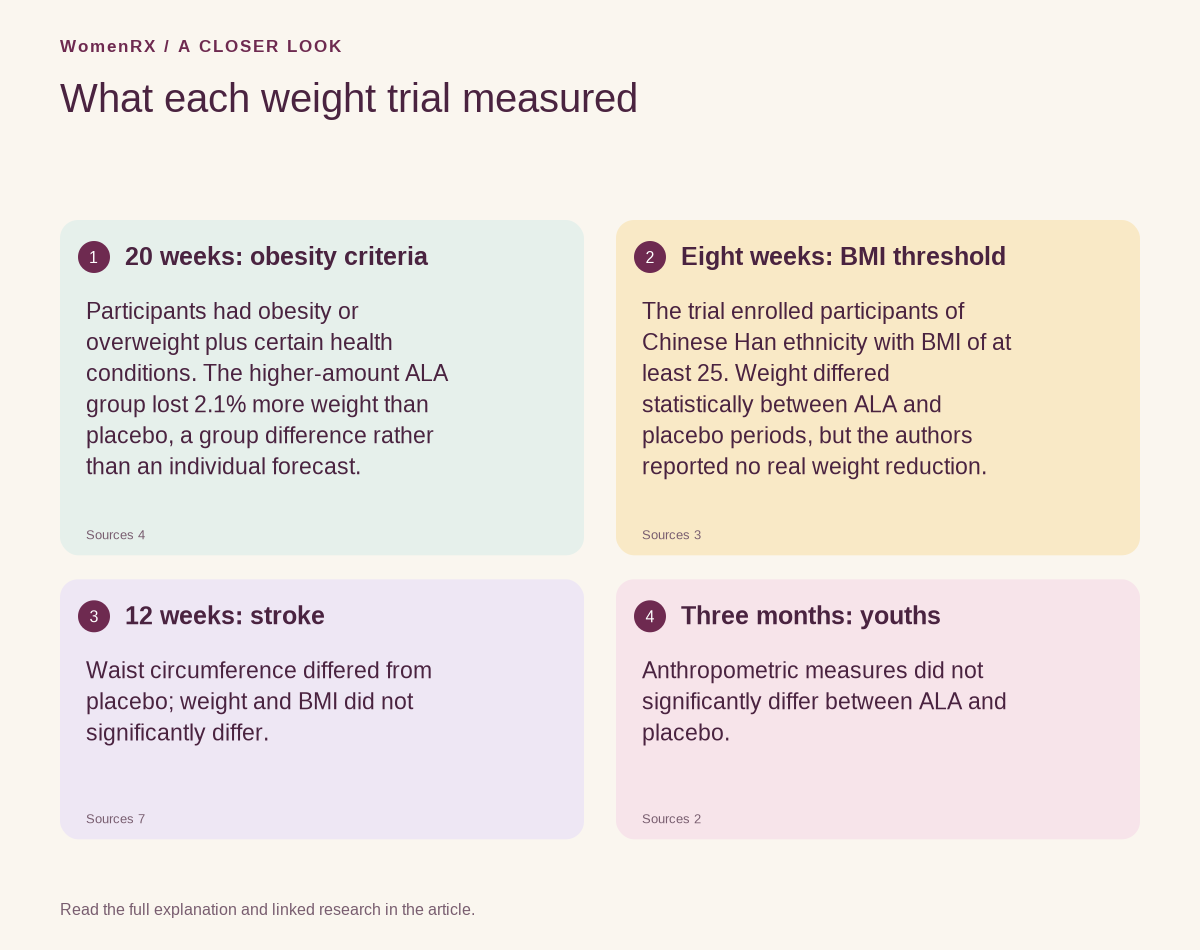
What each weight trial measured
20 weeks: obesity criteria: Participants had obesity or overweight plus certain health conditions. The higher-amount ALA group lost 2.1% more weight than placebo, a group difference rather than an individual forecast.4
Eight weeks: BMI threshold: The trial enrolled participants of Chinese Han ethnicity with BMI of at least 25. Weight differed statistically between ALA and placebo periods, but the authors reported no real weight reduction.3
12 weeks: stroke: Waist circumference differed from placebo; weight and BMI did not significantly differ.7
Three months: youths: Anthropometric measures did not significantly differ between ALA and placebo.2
Read the figure as text
Study length, comparison group, and outcome help put an apparent weight-loss result in context.- 20 weeks: obesity criteria: Participants had obesity or overweight plus certain health conditions. The higher-amount ALA group lost 2.1% more weight than placebo, a group difference rather than an individual forecast.4
- Eight weeks: BMI threshold: The trial enrolled participants of Chinese Han ethnicity with BMI of at least 25. Weight differed statistically between ALA and placebo periods, but the authors reported no real weight reduction.3
- 12 weeks: stroke: Waist circumference differed from placebo; weight and BMI did not significantly differ.7
- Three months: youths: Anthropometric measures did not significantly differ between ALA and placebo.2
Sources you can check
- Body Weight: MedlinePlusAccessed 2026-09-25Return to first citation
- Effect of Alpha-Lipoic Acid Supplementation on Endothelial Function and Cardiovascular Risk Factors in Overweight/Obese Youths: A Double-Blind, Placebo-Controlled Randomized Trial.Tromba L, Perla FM, Carbotta G, Chiesa C, Pacifico L. · Nutrients · 2019Return to first citation
- Effects of oral α-lipoic acid administration on body weight in overweight or obese subjects: a crossover randomized, double-blind, placebo-controlled trial.Li N, Yan W, Hu X, Huang Y, Wang F, Zhang W, Wang Q, Wang X, Sun K. · Clinical endocrinology · 2017Return to first citation
- Effects of alpha-lipoic Acid on body weight in obese subjects.Koh EH, Lee WJ, Lee SA, Kim EH, Cho EH, Jeong E, Kim DW, Kim MS, Park JY, Park KG, Lee HJ, Lee IK, Lim S, Jang HC, Lee KH, Lee KU. · The American journal of medicine · 2011Return to first citation
- The effect of alpha-lipoic acid (ALA) supplementation on cardiovascular risk factors in men with chronic spinal cord injury: a clinical trial.Mohammadi V, Khalili M, Eghtesadi S, Dehghani S, Jazayeri S, Aghababaee SK, Sabour H, Saberi H, Eghtesadi M, Gohari MR. · Spinal cord · 2015Return to first citation
- The effects of alpha-lipoic acid transdermal patch for local subcutaneous fat reduction: A randomized, placebo-controlled, clinical trial in overweight volunteers.Sooklert K, Thamakaison S, Nilyai S, Cherdchom S, Rojanathanes R, Sereemaspun A. · Contemporary clinical trials communications · 2024Return to first citation
- The effect of alpha-lipoic acid supplementation on anthropometric indices and food intake in patients who experienced stroke: A randomized, double-blind, placebo-controlled clinical trial.Mohammadi V, Khorvash F, Feizi A, Askari G. · Journal of research in medical sciences : the official journal of Isfahan University of Medical Sciences · 2017Return to first citation