Alpha-Lipoic Acid for Weight or Blood Sugar: What Studies Show
Alpha-lipoic acid showed small average differences in weight and glucose-related measures, but the results don’t establish it as a dependable weight-loss method or a replacement for diabetes care.
A 2026 review of 63 randomized trials found modest average differences favoring alpha-lipoic acid for body weight, fasting glucose, and HbA1c. A separate 12-week study involved men with type 2 diabetes and began with seven days of non-oral ALA treatment, so it doesn’t establish what women taking an oral supplement can expect. Neither finding is a reason to change diabetes treatment. 2 3
Alpha-lipoic acid (ALA), also called thioctic acid, has been studied for weight and blood-sugar-related outcomes. The results are worth understanding, but they don’t mean the supplement reliably produces noticeable weight loss or can replace diabetes treatment. The key distinction is between small average differences in research and a dependable result for an individual.
Weight and glucose are different goals
A 2026 systematic review and dose-response meta-analysis combined results from 63 randomized controlled trials of ALA and cardiometabolic risk factors. Its pooled body-weight result favored ALA by 0.64 kg compared with control. That’s a modest average difference, not a prediction that any one person will lose weight or maintain a change. 2
The same review reported fasting blood glucose 5.28 mg/dL lower and HbA1c 0.40 percentage points lower with ALA than with control. These are measures of glucose, not evidence that ALA prevents diabetes complications or works as a stand-alone treatment. 2
The review abstract doesn’t identify which diagnoses and trial durations contributed to each outcome or provide a separate estimate for women. A small, open, 12-week comparative study offers one more specific example: it enrolled 45 men with type 2 diabetes and erectile dysfunction and compared ALA with testosterone treatment. The ALA treatment began with seven days of parenteral, or non-oral, administration before oral treatment. HbA1c decreased in the ALA group, but the study had no placebo group for comparison. It therefore can’t establish the expected effect in women, people without diabetes, or someone considering an oral ALA supplement for general wellness. 2 3
For a weight goal, the pooled result is small and doesn’t establish ALA as a reliable weight-loss method. For a glucose goal, the review’s average differences may be relevant to a discussion about diabetes care, but they don’t show that ALA can replace prescribed treatment or predict an individual response. 2
What the findings mean for women
The review’s abstract gives overall pooled results but no estimate by sex; it doesn’t tell us whether the full review reports sex-stratified results. The separate 12-week study involved men, so it doesn’t fill that gap. Don’t assume that an overall average, or a result in men with diabetes, predicts the same effect for you. 2 3
If you’re pregnant, trying to become pregnant, or breastfeeding, these metabolic findings don’t answer whether ALA is appropriate. The reported human results don’t address pregnancy or breastfeeding outcomes. A maternal supplementation study in rats can’t establish safety or benefit for people. 2 4
Safety questions before you try ALA
The pooled weight and glucose outcomes don’t establish which combinations of ALA and diabetes medicines are safe, or whether glucose monitoring should change. If you use diabetes medicine, ask your prescriber or pharmacist whether ALA fits with your current treatment and whether you need a plan for monitoring or responding to changes. This is a practical safety question, not a claim that a particular ALA-drug interaction has been demonstrated. General NIH guidance notes that weight-loss supplements can interact with medicines and recommends discussing them, especially when you have diabetes. 1 2
Bring the product label and your medication list to that conversation. ALA’s pooled results are not a reason to stop or change prescribed diabetes treatment. The review assessed risk-factor measures; it did not test ALA as a replacement for diabetes care. 1 2
For weight change, compare the modest average result with what you’d consider a worthwhile and sustainable outcome. For blood sugar, the more useful question is whether adding ALA would fit safely into your existing care, not whether it can take the place of treatment that’s already managing your diabetes.
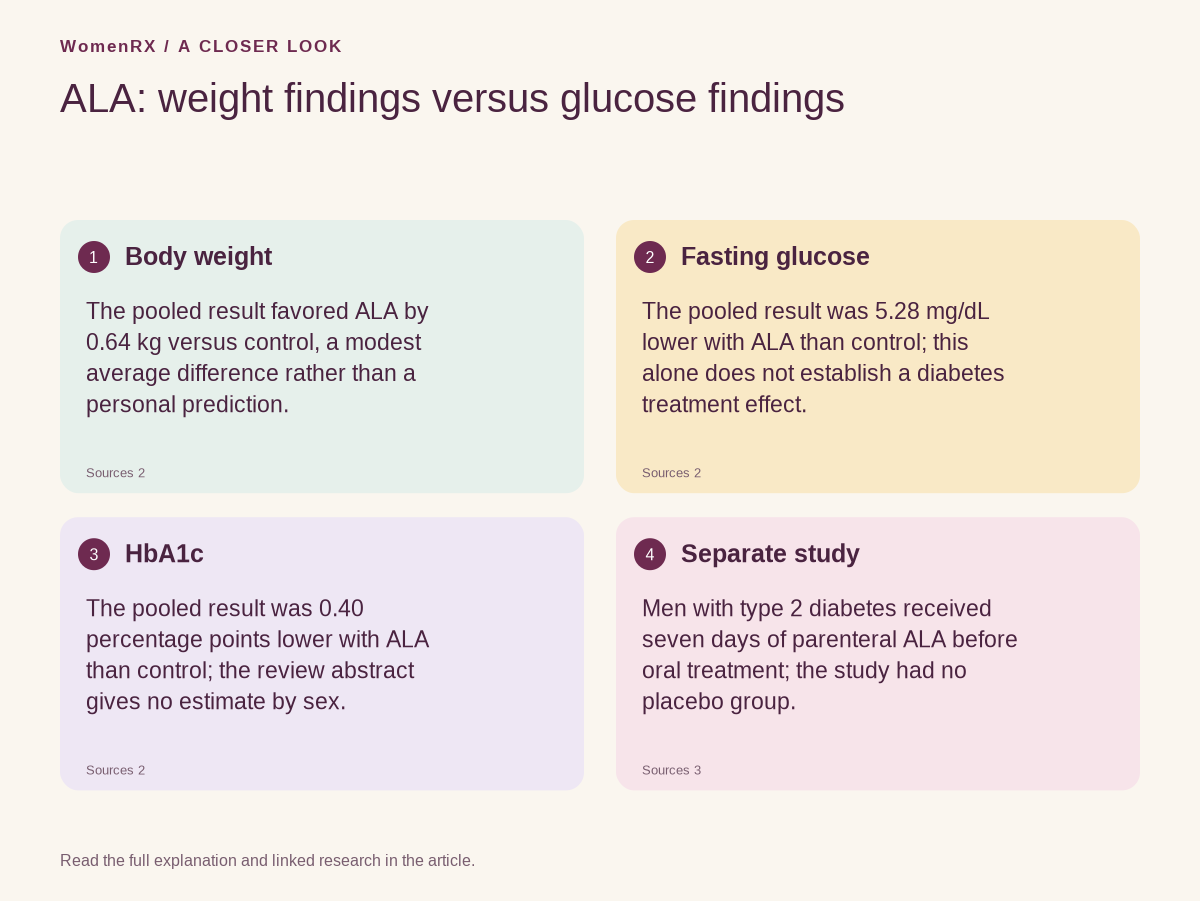
ALA: weight findings versus glucose findings
Body weight: The pooled result favored ALA by 0.64 kg versus control, a modest average difference rather than a personal prediction.2
Fasting glucose: The pooled result was 5.28 mg/dL lower with ALA than control; this alone does not establish a diabetes treatment effect.2
HbA1c: The pooled result was 0.40 percentage points lower with ALA than control; the review abstract gives no estimate by sex.2
Separate study: Men with type 2 diabetes received seven days of parenteral ALA before oral treatment; the study had no placebo group.3
Read the figure as text
These results concern different outcomes. The overall review reports pooled estimates, while a separate 12-week study involved men with type 2 diabetes.- Body weight: The pooled result favored ALA by 0.64 kg versus control, a modest average difference rather than a personal prediction.2
- Fasting glucose: The pooled result was 5.28 mg/dL lower with ALA than control; this alone does not establish a diabetes treatment effect.2
- HbA1c: The pooled result was 0.40 percentage points lower with ALA than control; the review abstract gives no estimate by sex.2
- Separate study: Men with type 2 diabetes received seven days of parenteral ALA before oral treatment; the study had no placebo group.3
More questions, answered
Does alpha-lipoic acid cause weight loss?
A 2026 review found an average body-weight difference of 0.64 kg favoring ALA over control. That’s a modest pooled result, not a guarantee of weight loss for an individual or proof that ALA is a reliable weight-loss method. 2
Should I change my diabetes medicine if I take ALA?
The pooled changes in glucose measures don’t show that ALA can replace diabetes treatment. Ask your prescriber or pharmacist whether it fits with your medicines and whether you need a plan for glucose monitoring. 1 2
Sources you can check
- Dietary Supplements for Weight Loss - Health Professional Fact SheetAccessed 2026-09-25Return to first citation
- Effects of alpha-lipoic acid supplementation on cardiometabolic risk factors: A systematic review and dose-response meta-analysis.Mohammadi S, Ashtary-Larky D, Alaghemand N, Alavi I, Erfanian-Salim M, Pirayvatlou PS, Ettehad Y, Borzabadi A, Mehrbod M, Asbaghi O. · Nutrition, metabolism, and cardiovascular diseases : NMCD · 2026Return to first citation
- Effect of transdermal testosterone or alpha-lipoic acid on erectile dysfunction and quality of life in patients with type 2 diabetes mellitus.Mitkov MD, Aleksandrova IY, Orbetzova MM. · Folia medica · 2013Return to first citation
- Influence of Maternal Alpha-Lipoic Acid Supplementation on Postpartum Body Weight and Metabolic Health in Rats with Obesity.Le TTK, Andreani GA, Mahmood S, Patel MS, Rideout TC. · Journal of dietary supplements · 2025Return to first citation