Berberine for Blood Sugar or Weight: What Trials Show
Some trials suggest modest improvements in glucose measures, but evidence for meaningful weight loss is much less convincing.
Berberine has shown signals of better glucose control in studies of people with type 2 diabetes or metabolic syndrome, but trials used varied products and had important quality limitations. Weight findings are less persuasive: pooled results show small changes in BMI and waist size, not proof of substantial, lasting weight loss. It can interact with medicines, so review it before starting. 3 4 1
Berberine is a plant-derived compound sold as a dietary supplement. The clinical picture is mixed: glucose measures have improved in some studies, while the weight findings are modest and don’t establish berberine as an obesity treatment. The details matter because the studies measured different outcomes in different groups, and supplements used in trials may not match products on store shelves.
Blood sugar: a signal, not a substitute for treatment
A systematic review of 46 randomized trials involving 4,158 people with type 2 diabetes reported pooled improvements in glucose-related measures. But the trials varied in products and regimens, and the review noted high heterogeneity, geographic concentration, and variable trial quality. Those limitations make the overall signal less certain than a consistent result from well-matched, high-quality studies would be. 3
A separate review of placebo-controlled trials in people with metabolic syndrome found that berberine was associated with an average fasting plasma glucose difference of −0.515 mmol/L compared with placebo (95% CI −0.847 to −0.183). That’s an average change in one measure, not evidence that berberine prevents diabetes complications or can replace prescribed treatment. The review assessed individual metabolic-syndrome components, not reversal of the syndrome as a whole. 4
One small pilot study in newly diagnosed type 2 diabetes reported lower HbA1c and glucose readings after three months of berberine. The results were changes within the berberine group; they don’t establish that berberine works as well as metformin. 3
Weight: waist and BMI aren’t the same as weight loss
In the metabolic-syndrome review, the pooled difference in waist circumference was −3.270 cm (95% CI −4.818 to −1.722), and the difference in BMI was −0.435 kg/m² (95% CI −0.856 to −0.013), compared with placebo. These are changes in waist size and BMI, not a reported amount of body weight lost. They don’t show how much weight an individual might lose, whether a change would be noticeable or sustained, or whether berberine is an effective obesity treatment. 4
It helps to keep the outcomes separate: evidence of a change in fasting glucose does not establish a weight-loss effect, and a small average change in BMI does not establish a meaningful improvement in health for every person. These small pooled changes do not establish berberine as an effective weight-loss treatment. 4
Medicine interactions deserve a real conversation
Berberine can affect how some medicines are handled in the body, and may add to glucose-lowering effects. The strongest concrete example in the interaction review was cyclosporine: in a human study of kidney-transplant recipients, berberine increased cyclosporine exposure (AUC) by 34.5%, and cyclosporine trough levels were 29.3% above control. That finding applies to this medicine and study population; it doesn’t tell us that every interaction will be the same. 1
The review also describes possible effects on drug-metabolizing enzymes and transporters. Much of the evidence for other specific medicine pairs is mechanistic rather than demonstrated in clinical interaction studies. Tell the person managing your medicines that you’re considering berberine, and include over-the-counter products and supplements in that conversation. Don’t change prescribed diabetes medicine to make room for a supplement. 1
Product and life-stage questions
Clinical studies used different berberine products and regimens, which makes results harder to compare and harder to apply to an individual retail product. A review of interactions also identifies product quality as a factor that can add uncertainty about actual exposure. A study result for one preparation therefore shouldn’t be assumed to apply to every supplement labeled berberine. 3 1
This evidence doesn’t establish whether effects differ by sex, so these findings shouldn’t be read as a women-specific estimate. A toxicology review of Berberis plants and their alkaloids flags embryonic-development concerns, but its summary doesn’t establish human risk from a berberine supplement. It also doesn’t address breastfeeding safety. 2
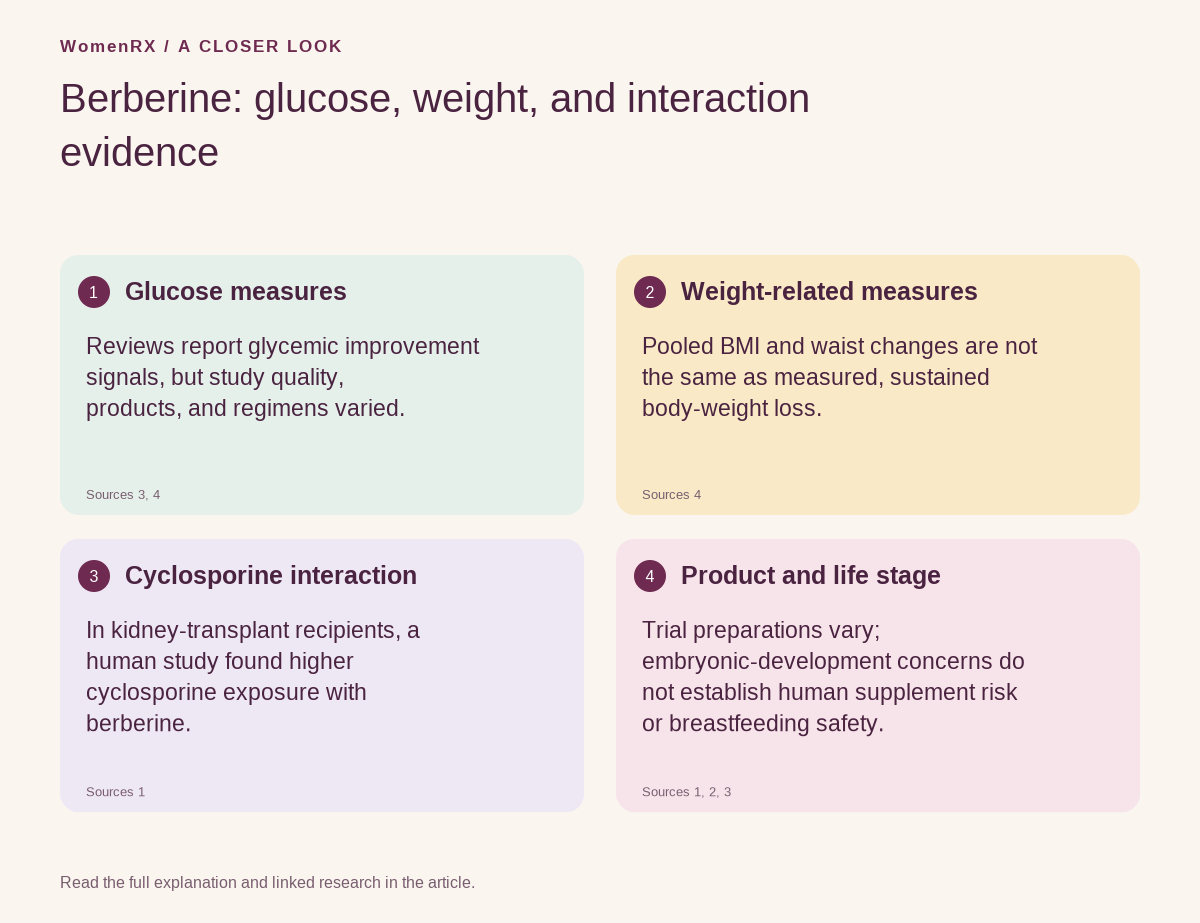
Berberine: glucose, weight, and interaction evidence
Glucose measures: Reviews report glycemic improvement signals, but study quality, products, and regimens varied.34
Weight-related measures: Pooled BMI and waist changes are not the same as measured, sustained body-weight loss.4
Cyclosporine interaction: In kidney-transplant recipients, a human study found higher cyclosporine exposure with berberine.1
Product and life stage: Trial preparations vary; embryonic-development concerns do not establish human supplement risk or breastfeeding safety.123
Read the figure as text
These findings come from different study populations and measure different outcomes; a glucose signal should not be read as proof of substantial weight loss.- Glucose measures: Reviews report glycemic improvement signals, but study quality, products, and regimens varied.34
- Weight-related measures: Pooled BMI and waist changes are not the same as measured, sustained body-weight loss.4
- Cyclosporine interaction: In kidney-transplant recipients, a human study found higher cyclosporine exposure with berberine.1
- Product and life stage: Trial preparations vary; embryonic-development concerns do not establish human supplement risk or breastfeeding safety.123
More questions, answered
Can berberine replace my diabetes medication?
No. The clinical findings don’t establish that berberine can replace prescribed diabetes treatment. One small pilot’s within-group improvement did not show that berberine was non-inferior to metformin, and the trial reviews describe important evidence limitations. Don’t change your prescribed medicine based on a supplement study. 3
What should I mention when asking about interactions?
Name berberine specifically and share the product label along with your prescription medicines, nonprescription medicines, and other supplements. A human interaction has been documented with cyclosporine in kidney-transplant recipients, while many other proposed interactions rely mainly on mechanistic evidence. 1
Sources you can check
- Berberine-Drug Interactions: Mechanisms, Clinical Relevance and Risk Stratification-A Narrative Review.Dumitru CN, Marcu T, Dumitru AO, Tudor SS, Ferțu ID, Elisei AM, Goroftei L. · Pharmaceuticals (Basel, Switzerland) · 2026Return to first citation
- Balancing efficacy and risk: A toxicological review and safety transformation of Berberis plants and their alkaloids.Ma J, Lan X, Luo X, Jing Y, Yin Y, Du H, Li Q, Fan G. · Phytomedicine : international journal of phytotherapy and phytopharmacology · 2026Return to first citation
- Defined Natural Products as Adjunctive Therapies: Evidence-Gated Polypharmacology Across Molecular Targets, Human Exposure, Clinical Signals, and Safety Boundaries.Seo Y, Woo J. · International journal of molecular sciences · 2026Return to first citation
- Efficacy and safety of berberine on the components of metabolic syndrome: a systematic review and meta-analysis of randomized placebo-controlled trials.Liu D, Zhao H, Zhang Y, Hu J, Xu H. · Frontiers in pharmacology · 2025Return to first citation