Berberine for Blood Sugar: What the Evidence Shows
Berberine has lowered several blood-sugar measures in trials of people with type 2 diabetes, but the results don’t establish who benefits most or whether it’s safe with your medicines.
In randomized-trial reviews of people with type 2 diabetes, berberine was associated with lower fasting and after-meal glucose. One review also reported lower HbA1c when berberine was combined with glucose-lowering medicines; another pooled review reported an HbA1c reduction across studies of berberine alone or in combination. These findings don’t predict an individual response or establish safety with every medicine. The reported pooled estimates don’t establish whether effects or risks differ for women. 1 2
What the blood-sugar results mean
Two reviews of randomized trials found lower blood-sugar measures among people with type 2 diabetes who took berberine, either alone or alongside glucose-lowering medicines. One review pooled 37 trials with 3,048 participants. Across the included studies, the average differences were about 0.82 mmol/L lower fasting glucose, 1.16 mmol/L lower glucose two hours after a meal, and 0.63 percentage points lower HbA1c. The review includes studies of berberine alone and alongside oral glucose-lowering medicines; those pooled estimates aren’t a promise of a particular change for you. 2
A later review of 50 trials, involving 4,150 participants, also found improvements in fasting and after-meal glucose. It reported lower fasting and after-meal glucose with berberine alone, and lower HbA1c along with fasting and after-meal glucose when berberine was combined with glucose-lowering medicines. Most studies in that review were conducted in China, and all included people with uncomplicated type 2 diabetes. Results from these trials don’t establish a benefit for people without diabetes or tell us how berberine compares with established treatment in broader groups. 1
HbA1c reflects longer-term blood-sugar control, while fasting and after-meal tests capture glucose at particular points. The reviews report improvements across these measures, but their findings don’t mean that every outcome improved in every treatment context. The pooled results also don’t tell you whether the supplement will help you, how long any effect lasts, or whether it prevents diabetes complications. 1 2
What the evidence says about women
The reported pooled estimates for people with type 2 diabetes don’t establish whether berberine’s effects or risks differ for women. The evidence also doesn’t establish safety during pregnancy or breastfeeding. A review of Berberis plants and their alkaloids flags potential concerns, including effects on embryonic development under specific conditions, but that is not proof of harm from a particular berberine product in a human pregnancy. 1 2 4
If you’re pregnant, breastfeeding, or planning a pregnancy, don’t start berberine on your own. Bring the product label and your medication list to a clinician or pharmacist who can review your situation.
Check medicines before adding it
The combination evidence deserves a careful reading. Trial reviews report that berberine was studied alongside glucose-lowering medicines, but that does not establish that every combination is safe or that the results apply to your treatment. One 12-week randomized trial tested a three-ingredient product containing berberine, hesperidin, and chromium with metformin. Because it tested a combination, its results can’t show what berberine alone did. 1 3
A review of Berberis plants and their alkaloids identifies possible interaction concerns involving drug-metabolizing enzymes and transport proteins, including CYP450 and P-glycoprotein. It does not establish which specific supplement-and-medicine combinations are safe. So a general statement that berberine “works with” a medicine, including metformin, isn’t enough to confirm that a particular product is appropriate for you. 4
Before considering berberine, use this medication check:
- List everything you take. Include prescriptions, over-the-counter medicines, vitamins, and other supplements.
- Name your diabetes treatment. Ask specifically about taking berberine with your current medicines and whether any monitoring or treatment changes would be needed.
- Bring the exact product. Supplement formulations vary; a reviewer needs to see the actual label, not just the word “berberine.”
- Don’t replace prescribed care. Trial findings do not show that berberine can stand in for diabetes treatment or follow-up.
The trial review did not find a statistically significant increase in hypoglycemia with berberine, but its estimate was imprecise: the confidence interval included both a possible reduction and a possible increase. That result can’t rule out risk for an individual, especially when combining supplements with prescribed glucose-lowering treatment. 2
A useful bottom line
There’s a signal of improvement in several blood-sugar outcomes in type 2 diabetes trials, but important decisions remain individual: what else you take, whether the product’s ingredients are clear, and whether pregnancy or breastfeeding is relevant. The evidence supports asking for a medicine-and-product review, not treating berberine as a proven, universally safe add-on.
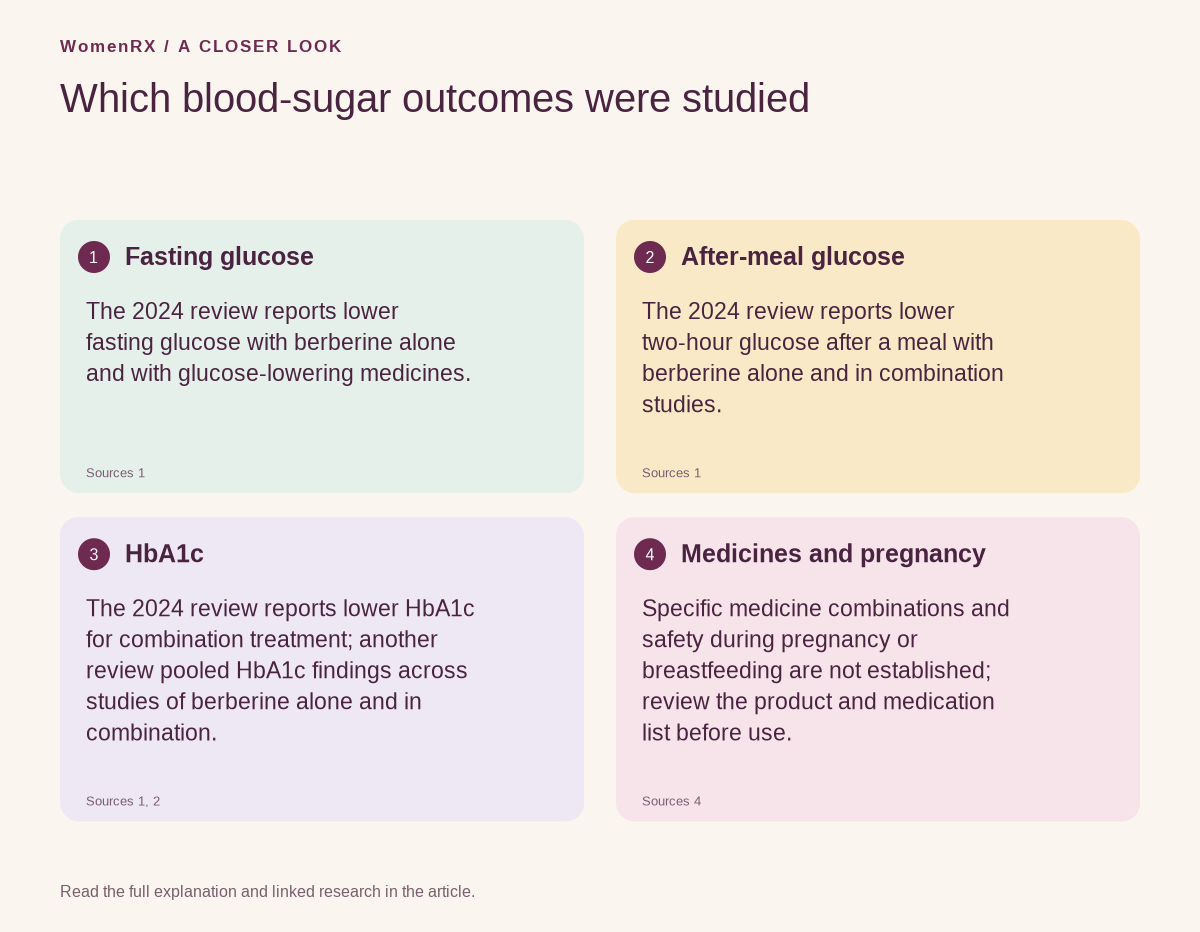
Which blood-sugar outcomes were studied
Fasting glucose: The 2024 review reports lower fasting glucose with berberine alone and with glucose-lowering medicines.1
After-meal glucose: The 2024 review reports lower two-hour glucose after a meal with berberine alone and in combination studies.1
HbA1c: The 2024 review reports lower HbA1c for combination treatment; another review pooled HbA1c findings across studies of berberine alone and in combination.12
Medicines and pregnancy: Specific medicine combinations and safety during pregnancy or breastfeeding are not established; review the product and medication list before use.4
Read the figure as text
The trials cover multiple glucose measures, but findings differ by whether berberine was studied alone or alongside glucose-lowering medicines.- Fasting glucose: The 2024 review reports lower fasting glucose with berberine alone and with glucose-lowering medicines.1
- After-meal glucose: The 2024 review reports lower two-hour glucose after a meal with berberine alone and in combination studies.1
- HbA1c: The 2024 review reports lower HbA1c for combination treatment; another review pooled HbA1c findings across studies of berberine alone and in combination.12
- Medicines and pregnancy: Specific medicine combinations and safety during pregnancy or breastfeeding are not established; review the product and medication list before use.4
More questions, answered
Does berberine work with metformin?
Some trials studied berberine alongside glucose-lowering medicines, and one randomized trial tested metformin with a product containing berberine plus two other ingredients. That doesn’t establish the safety or effect of berberine alone with metformin, or confirm that a specific product is right for you. 1 3
Do the studies show that berberine works differently for women?
The reported pooled estimates don’t establish whether effects or risks differ for women. They also don’t establish safety during pregnancy or breastfeeding. 1 2 4
Sources you can check
- Effects of administering berberine alone or in combination on type 2 diabetes mellitus: a systematic review and meta-analysis.Wang J, Bi C, Xi H, Wei F. · Frontiers in pharmacology · 2024Return to first citation
- Glucose-lowering effect of berberine on type 2 diabetes: A systematic review and meta-analysis.Xie W, Su F, Wang G, Peng Z, Xu Y, Zhang Y, Xu N, Hou K, Hu Z, Chen Y, Chen R. · Frontiers in pharmacology · 2022Return to first citation
- Effect of a New Formulation of Nutraceuticals as an Add-On to Metformin Monotherapy for Patients with Type 2 Diabetes and Suboptimal Glycemic Control: A Randomized Controlled Trial.Sartore G, Ragazzi E, Antonello G, Cosma C, Lapolla A. · Nutrients · 2021Return to first citation
- Balancing efficacy and risk: A toxicological review and safety transformation of Berberis plants and their alkaloids.Ma J, Lan X, Luo X, Jing Y, Yin Y, Du H, Li Q, Fan G. · Phytomedicine : international journal of phytotherapy and phytopharmacology · 2026Return to first citation