Berberine for Cholesterol: What the Evidence Shows
Berberine may lower some cholesterol and triglyceride measurements, but those changes aren’t proof that it prevents heart attacks or strokes.
A 2025 review of randomized, placebo-controlled trials found average reductions in LDL cholesterol, total cholesterol, and triglycerides with berberine, but no significant change in HDL. These are changes in blood-test measures, not evidence that berberine prevents heart attacks or strokes. Statins, by contrast, have evidence of lowering heart attack and stroke risk. 4 3
Berberine has shown promise on some lipid-panel numbers, but the evidence doesn’t establish it as a substitute for treatment proven to reduce cardiovascular events. If you’re considering it, the useful distinction is between changing a lab result and changing your chance of a heart attack or stroke.
What changed on the lipid panel
A 2025 systematic review and meta-analysis examined randomized, placebo-controlled trials of purified berberine for metabolic-syndrome components. On average, berberine was associated with lower LDL cholesterol by 0.495 mmol/L, total cholesterol by 0.451 mmol/L, and triglycerides by 0.367 mmol/L compared with placebo. The analysis did not find a significant effect on HDL cholesterol. These are pooled averages across trials, not a prediction of what one person’s next test will show. 4
The numbers also don’t tell you whether berberine prevents disease. The review assessed changes in metabolic measurements; those results alone can’t establish fewer heart attacks or strokes. 4
One smaller randomized trial tested a particular berberine-phospholipid product in 49 overweight adults with impaired fasting glucose, including 28 women. After two months, the trial reported differences between the supplement and placebo groups for total cholesterol and triglycerides. It did not break out women-specific lipid results, so it can’t show whether the effects were the same for women as for men. And because it tested a specific formulation in a small group, it shouldn’t be treated as evidence that every berberine product will have the same results. 5
A better lab result isn’t the same as prevention
LDL cholesterol is one part of cardiovascular risk. A lipid panel also measures other fats and lipoproteins, and the appropriate treatment depends on more than a single number. Age, blood pressure, family history, and other health factors can matter when interpreting cholesterol results. 1
Statins have a different kind of evidence: they lower LDL and have been shown to reduce heart attack and stroke risk in people with high LDL. That makes them a more established option when medication is recommended. 3 MedlinePlus lists examples of situations in which cholesterol medicines may be recommended, including a prior heart attack or stroke, LDL of 190 mg/dL or higher, or certain combinations of age, diabetes, LDL level, and cardiovascular risk. 2
So if berberine lowers a cholesterol number, that still doesn’t tell you that it offers the same protection as a prescribed lipid-lowering medicine. Don’t stop or replace prescribed treatment on the strength of a supplement’s effect on a lab measure. 2 3
What women should take from the research
The evidence doesn’t establish a cholesterol-lowering effect specific to women. The small trial included women, but its reported lipid results were overall results rather than women-only results. The pooled review results also don’t show whether effects differ by sex. 4 5
Risk can change with age. MedlinePlus notes that women’s risk of high cholesterol rises after menopause. That’s a reason to interpret cholesterol results in the context of your overall risk and life stage, not a reason to assume berberine works differently in women. 1
Safety: what to check before trying it
The 2025 review found no significant difference in reported safety outcomes between berberine and placebo, but it also called for more rigorous trials. A separate, small trial of one berberine-phospholipid product reported no adverse events over two months. Neither finding settles longer-term safety or establishes safety for every product, health condition, or combination of medicines. 4 5
These studies don’t identify specific interactions between berberine and named medicines or conditions. That isn’t proof that there are no interactions. Before adding it, show your prescriber or pharmacist the exact product label and your full list of prescriptions, over-the-counter medicines, supplements, and existing health conditions. Ask them to check for interactions and whether it fits your health situation. If you take a statin or another cholesterol medicine, don’t change it on your own. 2 3
A practical way to weigh the choice is to ask: What is my overall cardiovascular risk? What treatment is recommended for that risk? And is there evidence that berberine improves an outcome I care about, beyond changing a lab value? For berberine, the current evidence supports possible changes in some lipid measures, not proven prevention of heart attacks or strokes.
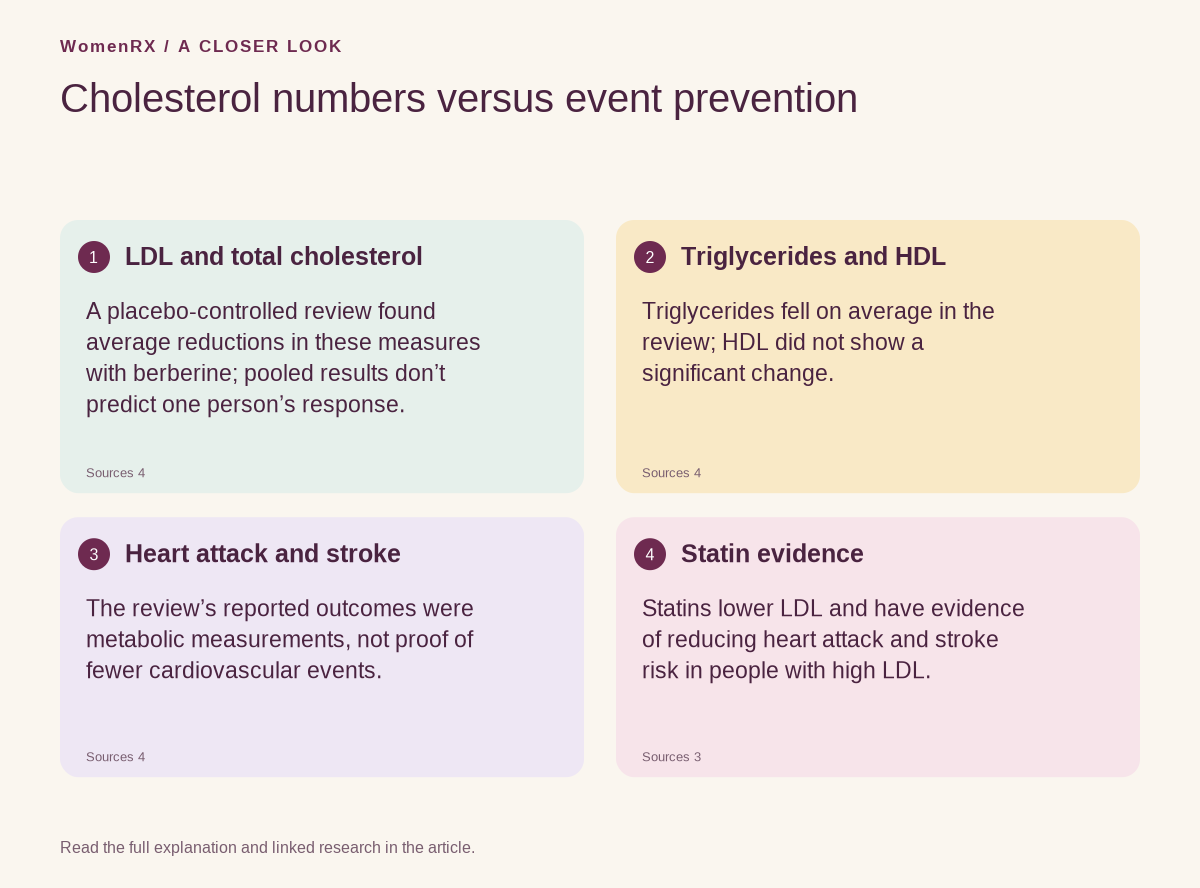
Cholesterol numbers versus event prevention
LDL and total cholesterol: A placebo-controlled review found average reductions in these measures with berberine; pooled results don’t predict one person’s response.4
Triglycerides and HDL: Triglycerides fell on average in the review; HDL did not show a significant change.4
Heart attack and stroke: The review’s reported outcomes were metabolic measurements, not proof of fewer cardiovascular events.4
Statin evidence: Statins lower LDL and have evidence of reducing heart attack and stroke risk in people with high LDL.3
Read the figure as text
Berberine’s reported lipid changes and statins’ reported event-risk evidence answer different questions.- LDL and total cholesterol: A placebo-controlled review found average reductions in these measures with berberine; pooled results don’t predict one person’s response.4
- Triglycerides and HDL: Triglycerides fell on average in the review; HDL did not show a significant change.4
- Heart attack and stroke: The review’s reported outcomes were metabolic measurements, not proof of fewer cardiovascular events.4
- Statin evidence: Statins lower LDL and have evidence of reducing heart attack and stroke risk in people with high LDL.3
More questions, answered
Does berberine raise HDL cholesterol?
The 2025 meta-analysis did not find a significant effect on HDL cholesterol. That doesn’t mean every individual or every product will have the same result; it means the pooled trial evidence did not show a clear average increase. 4
Can I take berberine instead of my statin?
This evidence does not show that berberine prevents heart attacks or strokes. Statins have evidence of reducing those risks, so don’t stop or replace a prescribed statin based on berberine’s reported changes in cholesterol measurements. 3 4
Sources you can check
- Cholesterol Levels: What You Need to Know: MedlinePlusAccessed 2026-09-25Return to first citation
- Cholesterol Medicines: MedlinePlusAccessed 2026-09-25Return to first citation
- Statins: MedlinePlusAccessed 2026-09-25Return to first citation
- Efficacy and safety of berberine on the components of metabolic syndrome: a systematic review and meta-analysis of randomized placebo-controlled trials.Liu D, Zhao H, Zhang Y, Hu J, Xu H. · Frontiers in pharmacology · 2025Return to first citation
- Berberine phospholipid exerts a positive effect on the glycemic profile of overweight subjects with impaired fasting blood glucose (IFG): a randomized double-blind placebo-controlled clinical trial.Rondanelli M, Gasparri C, Petrangolini G, Allegrini P, Avenoso D, Fazia T, Bernardinelli L, Peroni G, Patelli Z, Mansueto F, Tartara A, Cavioni A, Riva A. · European review for medical and pharmacological sciences · 2023Return to first citation