Can Supplements Lower Cholesterol? What the Evidence Shows
Some products lower LDL cholesterol in studies, but the ingredient, product form, and your prescribed treatment all matter.
Plant sterol supplements have randomized-trial evidence for lowering LDL cholesterol. Some soy products and garlic supplements have reported small cholesterol effects, but that doesn’t establish how they compare with sterols. Curcumin findings come from varied formulations and populations. A lower LDL result alone doesn’t prove a supplement prevents heart attacks or strokes. Check any product against your prescriptions before adding it. 1 4 6 7
If you’re considering a supplement because your LDL is still high, start with the outcome that matters. LDL is the cholesterol measure most of these products have been studied against. But a study showing a change in LDL doesn’t necessarily tell you whether a particular bottle will help you, or whether taking it prevents a heart attack or stroke. Prescribed statins have evidence for reducing those events in people with high LDL. 4 6
Plant sterols have direct LDL evidence
Plant sterols and stanols are ingredients found in some cholesterol-lowering products. In a review of 28 randomized trials involving 1,777 adults, phytosterol supplementation lowered LDL cholesterol and apolipoprotein B, another blood measure related to cholesterol-carrying particles. The pooled finding doesn’t tell you what LDL change to expect from a particular product. MedlinePlus notes that sterol and stanol supplements can reduce cholesterol when taken with meals. 1 6
That makes them a reasonable option to discuss, not a replacement for a prescribed medicine. The trial review assessed blood measurements rather than showing that sterol supplements prevent cardiovascular events. Its discussion also describes conflicting research on blood phytosterol levels and coronary disease; those associations don’t answer whether taking a supplement changes your risk of a heart attack. 6
Food and capsule aren’t always interchangeable
Soy: Some soy products have a small cholesterol-lowering effect, but MedlinePlus reports more benefit from eating soy foods than from taking soy supplements. If you enjoy soy foods, that distinction is useful: a result for food doesn’t establish the same result for an extract in a capsule. 1
Garlic: Garlic supplements may lower cholesterol, though MedlinePlus describes the effect as small compared with cholesterol medicines. That’s a reason to keep expectations modest if your treatment plan calls for a substantial LDL reduction. 1
Curcumin: A review of 104 randomized trials in adults with metabolic syndrome or related conditions reported lower LDL with Curcuma longa supplementation. The trials primarily tested standardized or absorption-enhanced turmeric and curcumin products, not the spice used in cooking. Results varied across formulations, doses, and study lengths, so the pooled finding doesn’t predict what an ordinary turmeric product will do. 7
Niacin: It’s a B vitamin, but niacin used to treat cholesterol belongs in a different conversation from adding a food ingredient. MedlinePlus says it can lower LDL and triglycerides and raise HDL, while warning that high doses can cause serious side effects. Being able to buy it without a prescription doesn’t make it a casual add-on to cholesterol treatment. 3
What changes for women?
Cholesterol levels tend to rise with age, and women’s risk of high total cholesterol rises after menopause. That doesn’t mean every supplement has a menopause-specific effect. A review of randomized trials in menopausal women found a modest average LDL reduction across plant-derived supplements, but it combined different products and formulations and had limited dose-specific information. It can’t identify one best supplement for a woman after menopause. 2 5
For plant sterols and curcumin, the available findings don’t show whether effects differ by sex. And pooled results across varied products don’t give a dependable LDL change to expect from any one product. 6 7
Pregnancy planning changes the medication discussion more directly. MedlinePlus says statins should not be taken during pregnancy or breastfeeding. If you’re planning a pregnancy, pregnant, or breastfeeding, talk through your existing cholesterol treatment before changing it or substituting a supplement. The studies discussed above don’t establish pregnancy safety for those products. 4 5 6 7
Check the combination, not just the front label
Supplements can have side effects and interact with medicines. This research doesn’t establish a specific interaction between each proposed supplement and each cholesterol drug, so a broad claim that a combination is either safe or dangerous would be misleading. Take the complete product label and the names of your prescriptions to a pharmacist or the person managing your treatment. Ask whether the particular ingredients raise a concern with the particular medicine you take. 1
If you take a statin, don’t stop it on your own to test a supplement. Statins lower LDL and have evidence for reducing heart attack and stroke risk in people with high LDL. A useful next question is what LDL change your treatment is meant to achieve, then whether an added product has evidence for that outcome and how you’ll assess its effect. 3 4
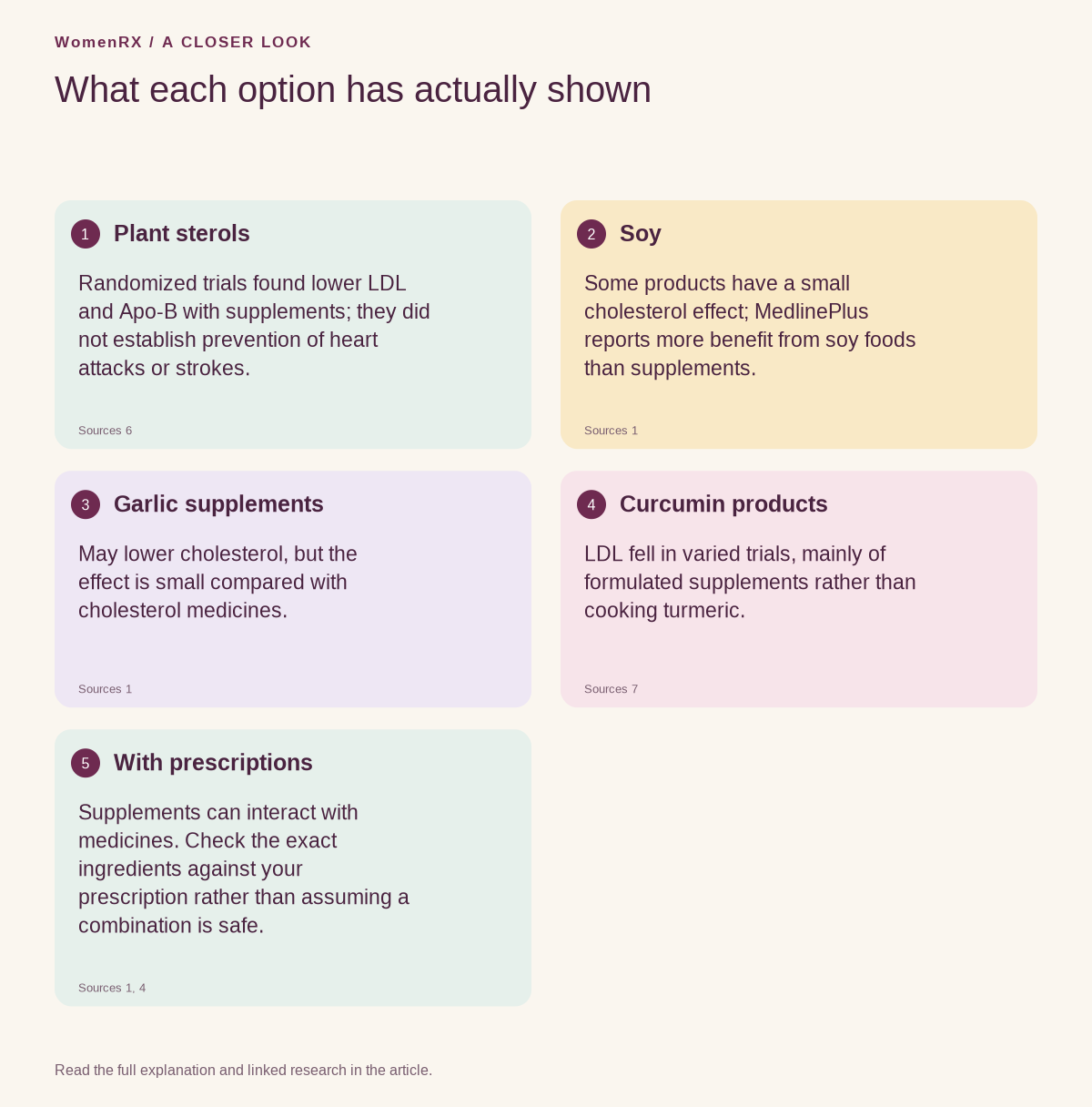
What each option has actually shown
Plant sterols: Randomized trials found lower LDL and Apo-B with supplements; they did not establish prevention of heart attacks or strokes.6
Soy: Some products have a small cholesterol effect; MedlinePlus reports more benefit from soy foods than supplements.1
Garlic supplements: May lower cholesterol, but the effect is small compared with cholesterol medicines.1
Curcumin products: LDL fell in varied trials, mainly of formulated supplements rather than cooking turmeric.7
With prescriptions: Supplements can interact with medicines. Check the exact ingredients against your prescription rather than assuming a combination is safe.14
Read the figure as text
The studied outcome and product form help you judge what a finding says. The exact medicine-and-product combination also matters.- Plant sterols: Randomized trials found lower LDL and Apo-B with supplements; they did not establish prevention of heart attacks or strokes.6
- Soy: Some products have a small cholesterol effect; MedlinePlus reports more benefit from soy foods than supplements.1
- Garlic supplements: May lower cholesterol, but the effect is small compared with cholesterol medicines.1
- Curcumin products: LDL fell in varied trials, mainly of formulated supplements rather than cooking turmeric.7
- With prescriptions: Supplements can interact with medicines. Check the exact ingredients against your prescription rather than assuming a combination is safe.14
More questions, answered
Does a lower LDL result mean a supplement protects my heart?
Not necessarily. The phytosterol trial review measured lipids and apolipoproteins; it did not establish that taking phytosterol supplements prevents heart attacks or strokes. That distinction matters when comparing a supplement with a prescribed treatment. 4 6
Sources you can check
- How to Lower Cholesterol: MedlinePlusAccessed 2026-09-25Return to first citation
- Cholesterol | MedlinePlusAccessed 2026-09-25Return to first citation
- Cholesterol Medicines: MedlinePlusAccessed 2026-09-25Return to first citation
- Statins: MedlinePlusAccessed 2026-09-25Return to first citation
- Effects of Plant-Derived Dietary Supplements on Lipid Profiles in Menopausal Women: An Updated Systematic Review and Meta-Analysis of Randomized Placebo-Controlled Trials.Park SH, Oh MR, Lee J, Choi HK, Hwang JT. · Phytotherapy research : PTR · 2025Return to first citation
- Effects of phytosterol supplementation on lipid profiles and apolipoproteins: A meta-analysis of randomized controlled trials.Zhang YF, Qiao W, Feng H, Jiang K, Yang J, Zhou T, Zhang Y. · Medicine · 2024Return to first citation
- Clinical Potential of Curcuma longa Linn. as Nutraceutical/Dietary Supplement for Metabolic Syndrome: Systematic Review and Meta-Analysis of Randomized Controlled Trials.Kehinde SA, Qaisrani ZN, Pattanayaiying R, Lay BB, Phyo KY, Lin WP, San MM, Awaeloh N, Aunsorn S, Kitkangplu R, Chusri S. · Foods (Basel, Switzerland) · 2025Return to first citation