Heart-Health Supplements: Which Outcomes Have Actually Improved?
Fish oil, plant sterols, and CoQ10 have very different evidence, and a better lab result isn’t the same as fewer heart attacks.
If you’re choosing a supplement to prevent heart disease, look for trials that counted heart attacks, strokes, or deaths, not just changes in cholesterol. Common omega-3 supplements haven’t consistently reduced major cardiovascular events in large trials. Plant sterols can lower cholesterol, but that doesn’t establish fewer events. CoQ10 has shown an outcome benefit in a trial of people who already had moderate to severe heart failure, which is a different question. 379
First, decide which result you’re looking for
A lower cholesterol or triglyceride number may be useful, but it isn’t itself a heart attack prevented. That distinction matters when a bottle promises “heart health.” If your goal is to change a risk factor, ask whether that particular supplement has changed it in people like you. If your goal is fewer heart attacks, strokes, hospitalizations, or deaths, look for a trial that measured those events. The answer can differ by formulation and by whether participants already had cardiovascular disease. 369
Fish oil: the formulation and the outcome both matter
The strongest reason not to treat all omega-3 products alike comes from trials that reached different results. In VITAL, 25,871 adults without a previous heart attack or stroke took an omega-3 supplement or placebo. After a median 5.3 years, there was no statistically significant reduction in the trial’s combined outcome of heart attack, stroke, and cardiovascular death, although total heart attacks were lower in the omega-3 group. In ASCEND, 15,480 adults with diabetes but no known cardiovascular disease took the same omega-3 formulation or placebo. After an average 7.4 years, the supplement did not significantly reduce the trial’s primary serious vascular-event outcome, although cardiovascular deaths were lower. Those secondary findings deserve attention, but they don’t turn either trial’s primary result into a clear prevention win. 3
A separate trial illustrates why an improved blood test isn’t enough: among 12,536 people with diabetes or a high risk of diabetes and cardiovascular events, an EPA-plus-DHA supplement lowered triglycerides over about six years but did not reduce heart attack, stroke, or cardiovascular death versus placebo. 3
There is an important outcome finding for a specific prescription omega-3 product. In REDUCE-IT, 8,179 people who had cardiovascular disease, or diabetes plus another risk factor, had elevated triglycerides despite taking statins. Over a median 4.9 years, prescription icosapent ethyl, an EPA-only product, reduced a combined cardiovascular-event outcome by 25% relative to placebo. That result cannot be transferred to an over-the-counter fish oil capsule: the product, participants, and treatment context matter. Another trial, STRENGTH, found no significant reduction in its combined cardiovascular outcome with a different prescription EPA-plus-DHA product in high-risk participants; atrial fibrillation occurred more often in its omega-3 group. 3
If you’re comparing labels, “fish oil” is not the amount of EPA and DHA. Products vary in which omega-3s they contain and how much. But matching an ingredient name on a supplement label still doesn’t make it equivalent to a prescription product tested in an outcomes trial. 3
Plant sterols: a cholesterol question, not an event claim
Plant sterol and stanol supplements taken with meals can lower cholesterol. That gives them a clearer role in a conversation about a lab result than in a claim about preventing heart attacks or strokes. 7
The details of an individual trial can also temper expectations. In a six-week study of 26 people already taking statins, the plant-sterol supplement group did not have a reduction in LDL cholesterol; LDL fell in the placebo group. The researchers measured blood and other intermediate markers, not heart attacks or strokes. This small trial doesn’t erase other evidence that sterols can lower cholesterol, but neither a favorable marker study nor a general cholesterol-lowering claim establishes fewer cardiovascular events from a supplement. 67
If your LDL cholesterol is high, the practical comparison isn’t simply sterols versus doing nothing. Lifestyle changes and, for some people, cholesterol-lowering medicines are established parts of care. A supplement’s possible effect on a number should be considered in that wider plan, rather than treated as a replacement for a medicine prescribed to reduce risk. 17
CoQ10: an established heart-failure question, not general prevention
Coenzyme Q10 has a different evidence story. In Q-SYMBIO, 420 people with moderate to severe chronic heart failure were randomized to CoQ10 or placebo in addition to standard treatment. At two years, the trial’s combined major-adverse-cardiovascular-event outcome occurred in 15% of the CoQ10 group and 26% of the placebo group. The combined outcome included events such as worsening-heart-failure hospitalization and cardiovascular death. Short-term measures at 16 weeks did not improve significantly. 98
That’s a meaningful result in a particular group, not evidence that CoQ10 prevents a first heart attack in someone without heart failure. A European analysis of the trial was predominantly male, and the outcome results described here don’t establish a separate effect for women. If you have heart failure, the relevant question is whether CoQ10 adds anything to your existing treatment, not whether it can stand in for it. 89
What changes the decision for you?
For prevention, start with your actual risk and the outcome you want to improve. Heart disease is the leading cause of death in US women, and risk rises after menopause, but those facts don’t show that any of these supplements works differently in women. The omega-3 trials included women; the results summarized above don’t provide a women-specific answer. 23
Also check what else you take before adding a product. Supplements can have side effects and interact with medicines, and a multi-ingredient “heart” product may make it harder to tell what you’re taking. That general warning doesn’t identify a particular drug-supplement pairing, so don’t assume a product is interaction-free. Bringing the exact label alongside your medication list makes that question concrete. 75
Pregnancy is a separate decision. DHA and EPA are discussed in pregnancy guidance for fetal development and preterm-birth outcomes, not as a strategy to prevent the pregnant person’s future heart disease. Fish-oil products also differ from cod liver oil, which contains vitamin A; excessive preformed vitamin A during pregnancy can cause birth defects. 34
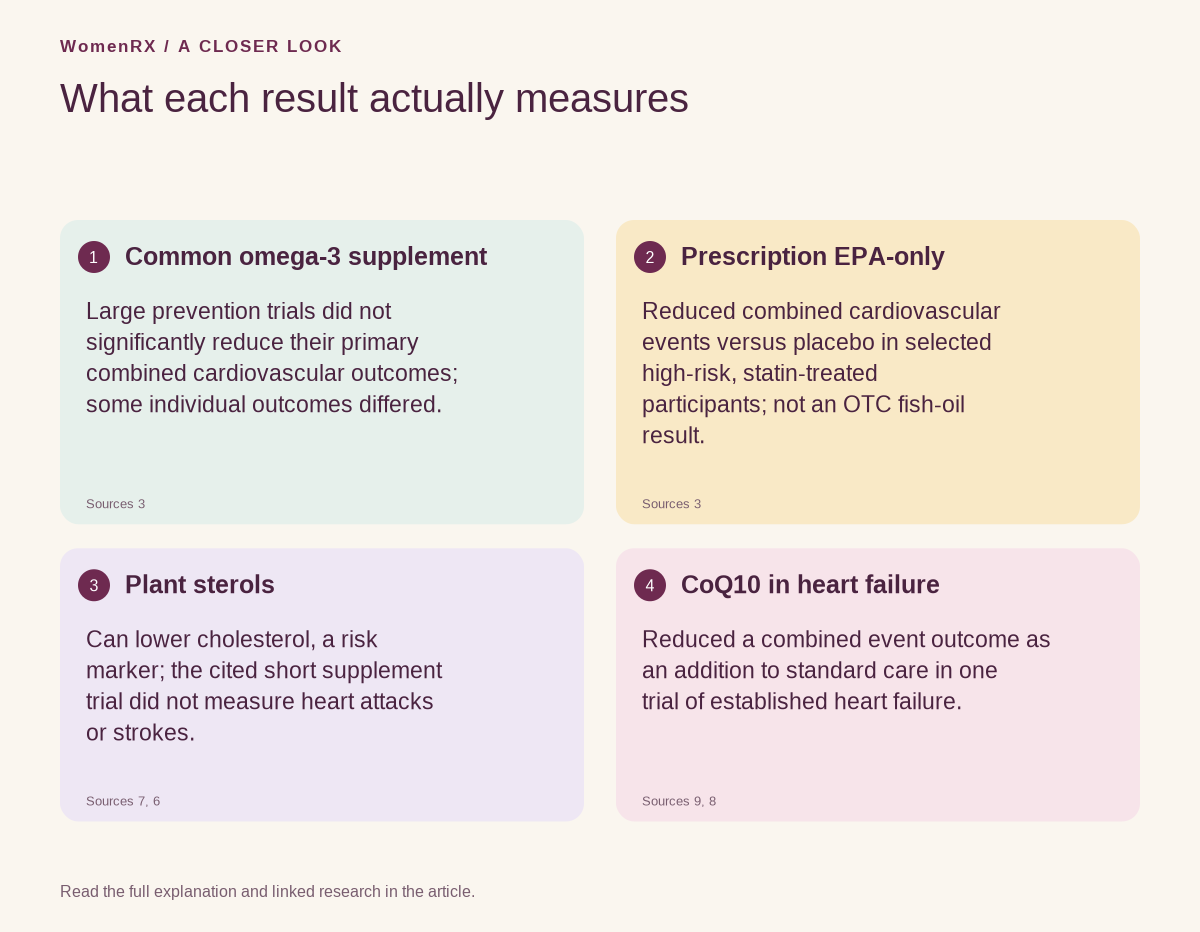
What each result actually measures
Common omega-3 supplement: Large prevention trials did not significantly reduce their primary combined cardiovascular outcomes; some individual outcomes differed.3
Prescription EPA-only: Reduced combined cardiovascular events versus placebo in selected high-risk, statin-treated participants; not an OTC fish-oil result.3
Plant sterols: Can lower cholesterol, a risk marker; the cited short supplement trial did not measure heart attacks or strokes.76
CoQ10 in heart failure: Reduced a combined event outcome as an addition to standard care in one trial of established heart failure.98
Read the figure as text
The same “heart-health” label can sit on products studied for very different outcomes.- Common omega-3 supplement: Large prevention trials did not significantly reduce their primary combined cardiovascular outcomes; some individual outcomes differed.3
- Prescription EPA-only: Reduced combined cardiovascular events versus placebo in selected high-risk, statin-treated participants; not an OTC fish-oil result.3
- Plant sterols: Can lower cholesterol, a risk marker; the cited short supplement trial did not measure heart attacks or strokes.76
- CoQ10 in heart failure: Reduced a combined event outcome as an addition to standard care in one trial of established heart failure.98
More questions, answered
Does lowering triglycerides with fish oil mean my heart risk is lower?
Not necessarily. In one trial involving people with diabetes or high diabetes risk and high cardiovascular risk, an EPA-plus-DHA supplement lowered triglycerides but did not reduce heart attack, stroke, or cardiovascular death compared with placebo over about six years. 3
Is prescription EPA the same as an omega-3 supplement?
No. The cardiovascular-event benefit in REDUCE-IT was found with prescription EPA-only icosapent ethyl added to statin treatment in people meeting specific risk and triglyceride criteria. That finding doesn’t establish the same benefit for retail fish oil products. 3
Sources you can check
- Cardiovascular disease - NHSAccessed 2026-09-25Return to first citation
- Heart Disease in Women | MedlinePlusAccessed 2026-09-25Return to first citation
- Omega-3 Fatty Acids - Health Professional Fact SheetAccessed 2026-09-25Return to first citation
- Dietary Supplements and Life Stages: Pregnancy - Health Professional Fact SheetAccessed 2026-09-25Return to first citation
- Online Marketing of Alternative Medicine for Heart Failure: An Assessment of Amazon.com.Vinsdata N, Heidel RE, Hauptman PJ. · The American journal of medicine · 2025Return to first citation
- Impact of a Plant Sterol Food Supplement on Eryptotic and Associated Cardiometabolic Parameters: A Randomized Placebo-Controlled Trial in Statin-Treated Patients.Miedes D, Ortega-Luna R, Broseta S, Martínez-Hervás S, Álvarez-Ribelles Á, Collado-Díaz V, Cilla A, Alegría A. · Foods (Basel, Switzerland) · 2024Return to first citation
- How to Lower Cholesterol: MedlinePlusAccessed 2026-09-25Return to first citation
- Effect of coenzyme Q10 in Europeans with chronic heart failure: A sub-group analysis of the Q-SYMBIO randomized double-blind trial.Mortensen AL, Rosenfeldt F, Filipiak KJ. · Cardiology journal · 2019Return to first citation
- The effect of coenzyme Q10 on morbidity and mortality in chronic heart failure: results from Q-SYMBIO: a randomized double-blind trial.Mortensen SA, Rosenfeldt F, Kumar A, Dolliner P, Filipiak KJ, Pella D, Alehagen U, Steurer G, Littarru GP, Q-SYMBIO Study Investigators. · JACC. Heart failure · 2014Return to first citation