Omega-3 for Heart Health: Food, Supplements, and the Evidence
Eating seafood and taking an omega-3 pill aren’t equivalent heart-health choices, and prescription EPA has evidence that over-the-counter products don’t.
For most people, over-the-counter omega-3 supplements haven’t clearly reduced the major combined risk of heart attack, stroke, and cardiovascular death in large trials. Seafood is linked with better outcomes in observational studies, but that doesn’t prove omega-3 alone is the reason. A specific prescription EPA medicine reduced cardiovascular events in a high-risk group; that result doesn’t apply to every fish-oil product. 1 3
Three choices, three different kinds of evidence
“Omega-3” can mean seafood, an over-the-counter (OTC) fish-oil supplement, or a prescription medicine. These aren’t interchangeable. They differ in what they contain and, crucially, in the people and outcomes studied.
Seafood: a food choice, not a proven supplement effect
People who eat more fish and seafood often have better health outcomes in observational studies. But those studies can’t show that omega-3 itself caused the difference. Seafood eaters may also eat less of other foods, and fish contains more than omega-3. The overall eating pattern and other differences between people could matter too. 1
That makes seafood and a capsule different questions. Eating fish as part of your diet may be a reasonable food choice, but the association between seafood and health doesn’t prove an OTC supplement will prevent a heart attack or stroke.
OTC supplements: promising ideas, mostly neutral main outcomes
Large trials testing common omega-3 supplements have not shown a clear reduction in their main combined cardiovascular outcomes. In VITAL, a 1-gram daily EPA-and-DHA supplement did not significantly reduce the combined rate of heart attack, stroke, and cardiovascular death over a median 5.3 years. In ASCEND, the same formulation did not significantly reduce the main serious vascular-event outcome over a mean 7.4 years. 1
There were some favorable findings for individual outcomes in those trials, including fewer heart attacks in VITAL and fewer cardiovascular deaths in ASCEND. Those findings can be worth studying, but they don’t change the fact that the main combined outcomes were not significantly reduced. They also don’t show that any OTC product reliably prevents cardiovascular disease. 1
So if you’re considering fish oil specifically to lower your chance of a heart attack or stroke, the evidence doesn’t support assuming that a typical supplement will do that. A change in omega-3 levels or another measurement is not the same as showing fewer serious cardiovascular events.
Prescription EPA: a specific treatment for a specific setting
REDUCE-IT studied icosapent ethyl, a prescription form of EPA, in people at elevated cardiovascular risk. The trial found fewer cardiovascular events with this treatment. Its results are about that particular medicine and the people studied, not about fish oil in general or every product that contains EPA. 1 3
The distinction matters because another large trial, STRENGTH, tested a high-dose prescription product containing both EPA and DHA in high-risk patients receiving usual treatment. It did not significantly reduce its combined cardiovascular outcome. A higher rate of atrial fibrillation was also reported in the omega-3 group. Different results across products are a reason not to treat “high-dose omega-3” as one proven category. 1
In a 2026 review of high-dose trials, only icosapent ethyl was independently associated with fewer cardiovascular events among the blinded, placebo-controlled outcome trials included. The review also noted that the role of other formulations and the patients most likely to benefit still needs clarification. 2
A practical way to think about the choice
- Want to include fish in your diet? Think of it as a food choice. Observational links between seafood and health don’t establish that a supplement has the same effect. 1
- Considering an OTC capsule for prevention? Don’t count on it to lower your risk of a major cardiovascular event. The main combined outcomes in large trials were not significantly reduced. 1
- Have high cardiovascular risk and elevated triglycerides? Ask about the evidence for the specific prescription medicine icosapent ethyl, rather than assuming OTC fish oil is equivalent. The benefit shown in REDUCE-IT was for a selected high-risk group and that medicine. 1 3
Omega-3 products also shouldn’t replace other treatment for cardiovascular risk. The trials of prescription EPA evaluated it alongside usual care, not as a substitute for it. 1 3
What the research says about women
The cardiovascular findings don’t give a dependable women-only estimate. Some trials included both men and women, and one recent review included trials in which the proportion of men ranged from 31% to 85%; the reported results don’t establish that women benefit more, less, or the same as men. 1 2
Pregnancy is a separate context. This comparison doesn’t establish which fish to choose or how much to eat during pregnancy; those questions need pregnancy-specific dietary guidance rather than a cardiovascular-supplement trial.
The useful distinction is not “omega-3 works” versus “omega-3 doesn’t work.” It’s whether the question is about seafood as food, a general supplement for prevention, or a specific prescription EPA medicine for a selected high-risk situation.
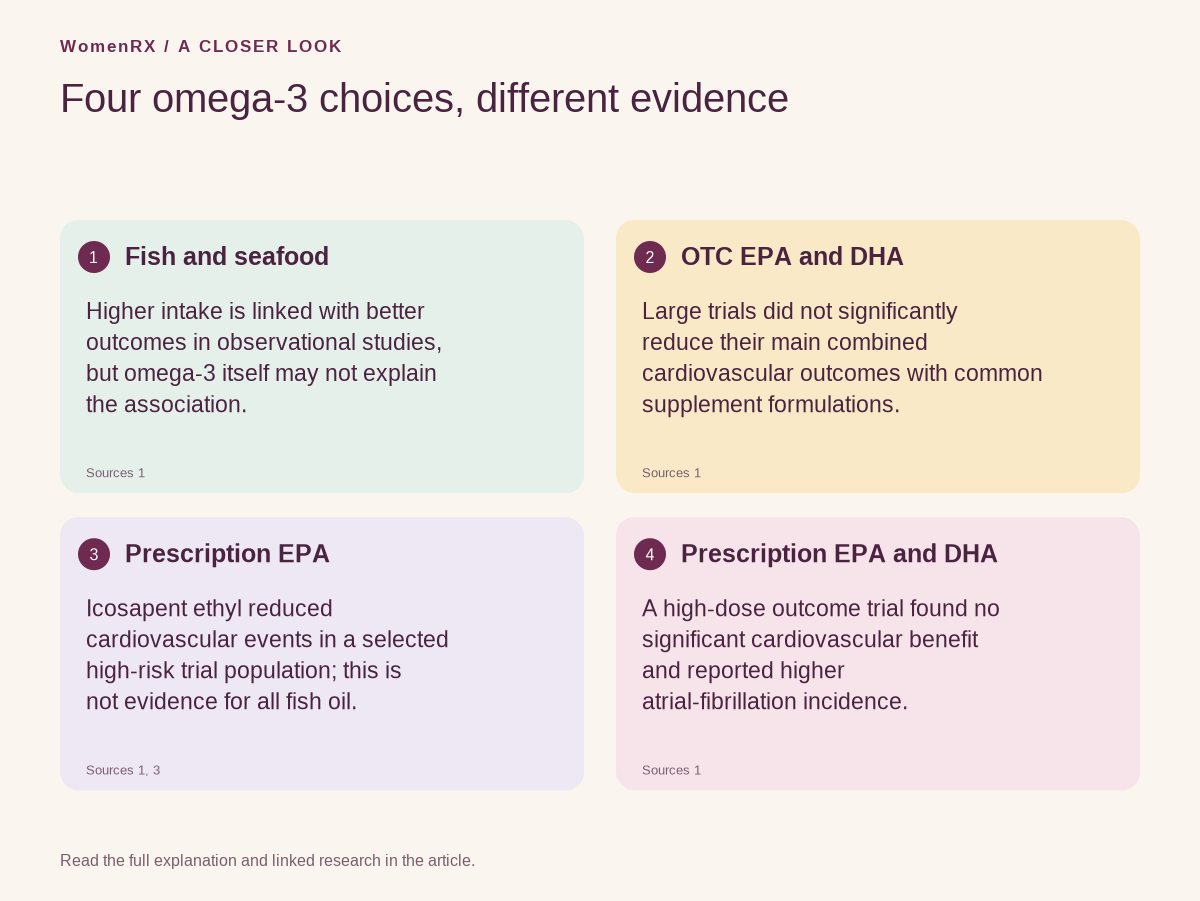
Four omega-3 choices, different evidence
Fish and seafood: Higher intake is linked with better outcomes in observational studies, but omega-3 itself may not explain the association.1
OTC EPA and DHA: Large trials did not significantly reduce their main combined cardiovascular outcomes with common supplement formulations.1
Prescription EPA: Icosapent ethyl reduced cardiovascular events in a selected high-risk trial population; this is not evidence for all fish oil.13
Prescription EPA and DHA: A high-dose outcome trial found no significant cardiovascular benefit and reported higher atrial-fibrillation incidence.1
Read the figure as text
The cardiovascular evidence depends on whether omega-3 comes from food, an OTC supplement, or a particular prescription formulation.- Fish and seafood: Higher intake is linked with better outcomes in observational studies, but omega-3 itself may not explain the association.1
- OTC EPA and DHA: Large trials did not significantly reduce their main combined cardiovascular outcomes with common supplement formulations.1
- Prescription EPA: Icosapent ethyl reduced cardiovascular events in a selected high-risk trial population; this is not evidence for all fish oil.13
- Prescription EPA and DHA: A high-dose outcome trial found no significant cardiovascular benefit and reported higher atrial-fibrillation incidence.1
More questions, answered
Do omega-3 heart-trial results show the same effect in women?
The trial summaries and review results don’t provide a dependable women-only estimate. Because the findings combine results from mixed-sex populations, they can’t establish whether the effect is the same in women and men. 1 2
Sources you can check
- Omega-3 Fatty Acids - Health Professional Fact SheetAccessed 2026-09-25Return to first citation
- Formulation-Specific Cardiovascular Outcomes with High-Dose Eicosapentaenoic Acid: A Systematic Review and Meta-analysis.Faheem MA, Azeem B, Ali T, Asim R, Muhammad TS, Dogar ME, Naveed MA. · American journal of cardiovascular drugs : drugs, devices, and other interventions · 2026Return to first citation
- Meta Analysis of DHA and EPA Supplementation on Cardiovascular Outcomes and Atrial Fibrillation Risk.Shayan SK, Abbood RS, Al-Taie SF, Nataj PG, Khamdamjonovna MM, Aminnezhad S, Boushehri YG, Sindorovich JJ, Sinehsepehr A, Zare F, Pakmehr SA, Abdollahi E, Vahedinezhad M. · Pharmacology research & perspectives · 2026Return to first citation