Omega-3 Labels: Compare EPA and DHA, Not Fish Oil Total
The milligrams of fish oil on the front label aren’t the same as the EPA and DHA you get in a serving.
To compare fish-oil or algae-oil supplements, check the Supplement Facts panel for the EPA and DHA amounts per serving; don’t use total oil weight as a substitute. There’s no established daily EPA or DHA intake recommendation for adults, pregnancy, or lactation in the guidance cited here. The general intake figures for women refer to ALA, a different omega-3, not DHA or EPA. 1
Start with the Supplement Facts panel
A bottle might highlight “1,000 mg fish oil,” but that number describes the oil, not necessarily the amount of EPA and DHA in it. Look for the serving size, then find EPA and DHA separately in the Supplement Facts panel. Add those two amounts if you want to compare the serving’s combined EPA and DHA with another product. Don’t assume two products with the same total oil weight provide the same amounts of either fatty acid. Formulations vary widely. 1
For example, NIH’s Office of Dietary Supplements describes a typical fish-oil supplement providing about 1,000 mg of fish oil with 180 mg EPA and 120 mg DHA. That’s one example, not a standard formula or a dose to aim for. The same reference notes that algal-oil products usually provide around 100-300 mg DHA, and some also contain EPA. Read each label rather than treating fish oil and algae oil as interchangeable. 1
The general intake numbers are for ALA
For women ages 19 and older, the Adequate Intake (AI) for omega-3 is 1.1 grams per day. It rises to 1.4 grams during pregnancy and is 1.3 grams during lactation. Those numbers can look like recommendations for fish oil, but they apply to ALA, not EPA or DHA. ALA is found in foods such as flaxseed, chia seeds, walnuts, and some plant oils. The Institute of Medicine did not establish specific intake recommendations for EPA or DHA. 1
That distinction matters if you’re trying to decide whether a supplement meets a general daily target: these ALA figures don’t tell you how much EPA or DHA to take, and they aren’t a reason to match an EPA-and-DHA supplement to the same gram amount. The guidance here doesn’t establish a universal daily EPA or DHA target for women.
Pregnancy and lactation are separate contexts
Pregnancy and lactation have different ALA AIs, but those figures still aren’t DHA targets. If you’re pregnant or breastfeeding and considering a product for DHA, look at the actual DHA amount, not just the front-label fish-oil weight. Don’t infer a pregnancy or lactation dose from the ALA AI. The available guidance here does not specify a separate EPA or DHA intake recommendation for either stage. 1
Study amounts are not automatically personal recommendations, either. For example, one randomized trial gave participants 2.4 grams of fish oil daily during late pregnancy and found no significant reduction in ADHD or autism-spectrum-disorder risk in children at age 10. That result concerns one product, dose, study period, and set of outcomes; it doesn’t establish a general DHA target or show that every omega-3 outcome is unaffected. 2
If a pregnancy or lactation goal is driving your choice, bring the product label to your prenatal or postpartum care visit. Ask whether the goal is specifically DHA, EPA, or both, and whether the product’s amounts fit that goal. That’s more useful than choosing by the largest number on the front of the bottle.
A quick label comparison
- Serving size: Check how many capsules or how much liquid makes one serving. Compare products on the same serving basis.
- EPA: Note the EPA amount listed in Supplement Facts.
- DHA: Note the DHA amount separately. For an algae product, check whether it also includes EPA.
- Total oil: Treat “fish oil” or “algal oil” weight as the weight of the oil, not the amount of EPA plus DHA.
A label can tell you what a serving contains. It can’t, by itself, tell you whether that amount is right for a particular health goal. The right comparison depends on the goal, and a dose used in one study shouldn’t be carried over as a universal recommendation.
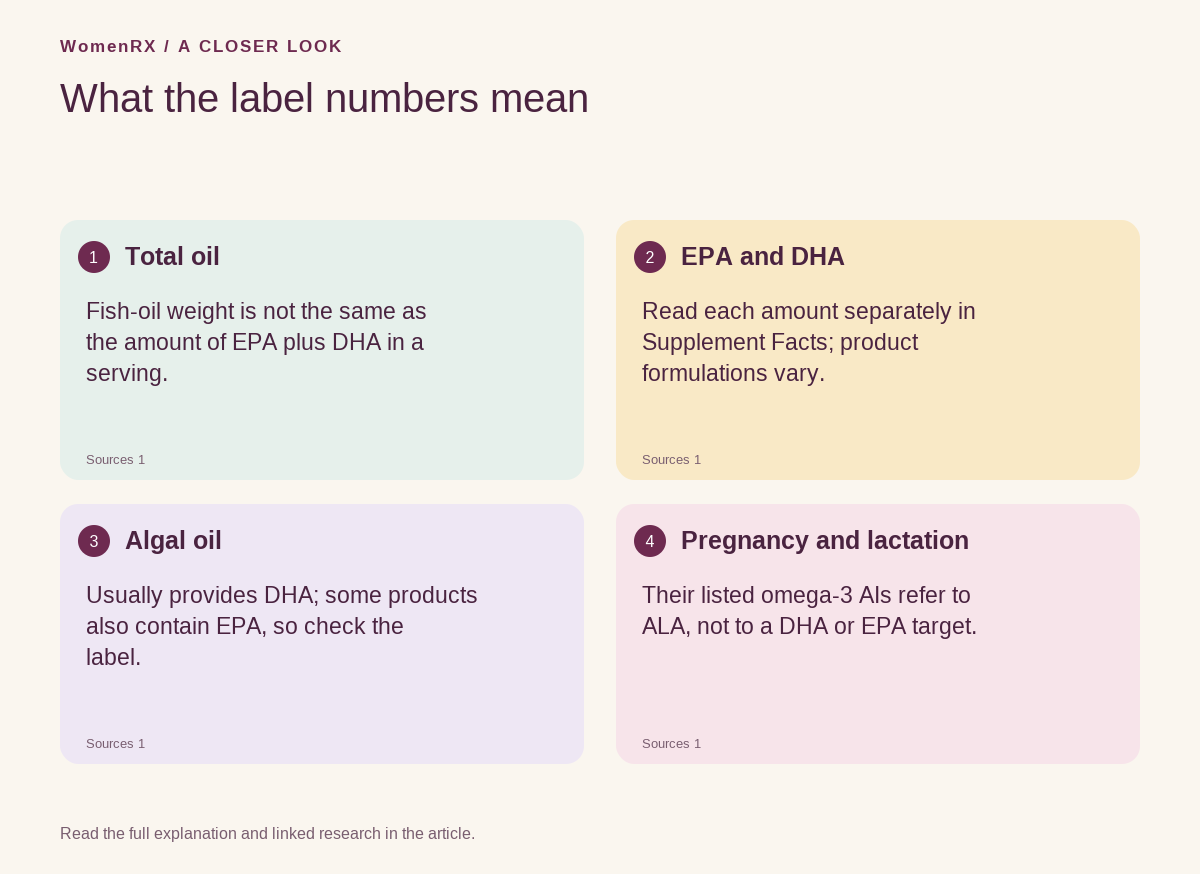
What the label numbers mean
Total oil: Fish-oil weight is not the same as the amount of EPA plus DHA in a serving.1
EPA and DHA: Read each amount separately in Supplement Facts; product formulations vary.1
Algal oil: Usually provides DHA; some products also contain EPA, so check the label.1
Pregnancy and lactation: Their listed omega-3 AIs refer to ALA, not to a DHA or EPA target.1
Read the figure as text
Compare the serving’s EPA and DHA with the total oil weight, then keep ALA intake guidance distinct from EPA and DHA.- Total oil: Fish-oil weight is not the same as the amount of EPA plus DHA in a serving.1
- EPA and DHA: Read each amount separately in Supplement Facts; product formulations vary.1
- Algal oil: Usually provides DHA; some products also contain EPA, so check the label.1
- Pregnancy and lactation: Their listed omega-3 AIs refer to ALA, not to a DHA or EPA target.1
More questions, answered
Does the omega-3 AI for pregnancy mean I should take 1.4 grams of DHA?
No. The 1.4-gram pregnancy AI is for ALA, not DHA. The guidance cited here does not establish a specific EPA or DHA intake recommendation for pregnancy. 1
Are fish oil and algae oil equivalent?
Not necessarily. Product formulations and EPA and DHA amounts vary. Algal-oil supplements usually provide DHA, and some also provide EPA, so compare the amounts on each product’s Supplement Facts panel. 1
Sources you can check
- Omega-3 Fatty Acids - Health Professional Fact SheetAccessed 2026-09-25Return to first citation
- Fish oil-derived fatty acids during pregnancy and risk of neurodevelopmental disorders in children at age 10 - A randomized controlled trial.Rosenberg JB, Sevelsted A, Jepsen JRM, Vinding R, Mohammadzadeh P, Hernández Lorca M, Horner D, Sørensen ME, Fagerlund B, Bilenberg N, Pantelis C, Glenthøj BY, Chawes B, Stokholm J... · Translational psychiatry · 2026Return to first citation