Should You Take Fish Oil With a Meal?
Meal fat matters for ethyl ester absorption, while comfort and product directions can help shape your routine.
There isn’t one meal-timing rule for every fish oil. If your label identifies the oil as an ethyl ester, taking it with a meal containing fat fits what’s known about its absorption. 2 For other forms, the effect of meal timing is less clear. Follow your product’s directions, and if they allow flexibility, you can try taking it with food to see whether that feels better.
Start with the form, not a universal rule
Omega-3 dietary supplements come in different chemical forms, including natural triglycerides, re-esterified triglycerides, free fatty acids, phospholipids, and ethyl esters. The form can affect bioavailability, so check whether the label names it. The label is also the place to compare how much EPA and DHA the product provides; the amount of fish oil alone doesn’t tell you those amounts. 1
One form has a clearer connection to meal timing: a 2026 review reports that ethyl ester omega-3s depend on pancreatic enzyme activity and lipid intake at each meal for absorption. If your label identifies an ethyl ester, taking it with a meal that contains fat is a sensible way to align with that finding. That evidence concerns absorption, not proof of better health outcomes. 2
For other forms, the effect of taking them with food rather than on an empty stomach is less clear. NIH’s Office of Dietary Supplements reports that triglyceride, re-esterified triglyceride, and free-fatty-acid forms have somewhat higher bioavailability than ethyl esters, while consumption of all the forms it discusses can raise blood EPA and DHA levels. That comparison doesn’t tell us whether taking a particular non-ethyl-ester product on an empty stomach works just as well as taking it with food. 1
If reflux or fishy burps are the main issue
If a capsule leaves you with reflux or a fishy aftertaste, taking it with a meal is something you can try for comfort. It isn’t a guaranteed fix, and the formulation evidence above doesn’t tell us whether food reduces either symptom.
If the product’s own directions don’t require a particular timing, you can compare how you feel taking it with a regular meal versus at another time, without changing the intended dose. Keep the routine consistent enough to notice whether there’s a difference. If symptoms persist or are troublesome, don’t assume timing is the only possible explanation; consider whether the supplement is right for you and discuss the symptoms with your care team.
A quick label check
Before choosing a routine, look for three things: the product’s own directions, the named omega-3 form, and the amounts of EPA and DHA. Formulations vary, and the NIH fact sheet recommends checking labels for the types and amounts of omega-3s. If the form is listed as ethyl ester, meal fat is relevant to absorption; if the form isn’t clear, don’t guess based on the words “fish oil” alone. 1 2
Pregnancy and breastfeeding call for a separate product check
Meal timing doesn’t determine whether a particular omega-3 product is appropriate during pregnancy or breastfeeding. Check whether the supplement is fish oil or cod liver oil: cod liver oil also provides vitamins A and D, so those amounts matter when you’re considering it alongside a prenatal vitamin or other supplements. 1
The NIH fact sheet notes that intake recommendations for EPA and DHA specifically have not been established, including for pregnancy and lactation; its listed pregnancy and lactation values are for ALA, a different omega-3. That doesn’t answer whether you personally need an EPA/DHA supplement. If you’re pregnant or breastfeeding, review the exact product with your prenatal care team rather than assuming any fish oil or cod liver oil is interchangeable. 1
A practical rule: follow the product’s own directions; if it’s an ethyl ester, take it with a meal containing fat. For other forms, if the directions allow flexibility, you can try a meal-time routine for comfort. Don’t change the intended dose just to experiment with timing.
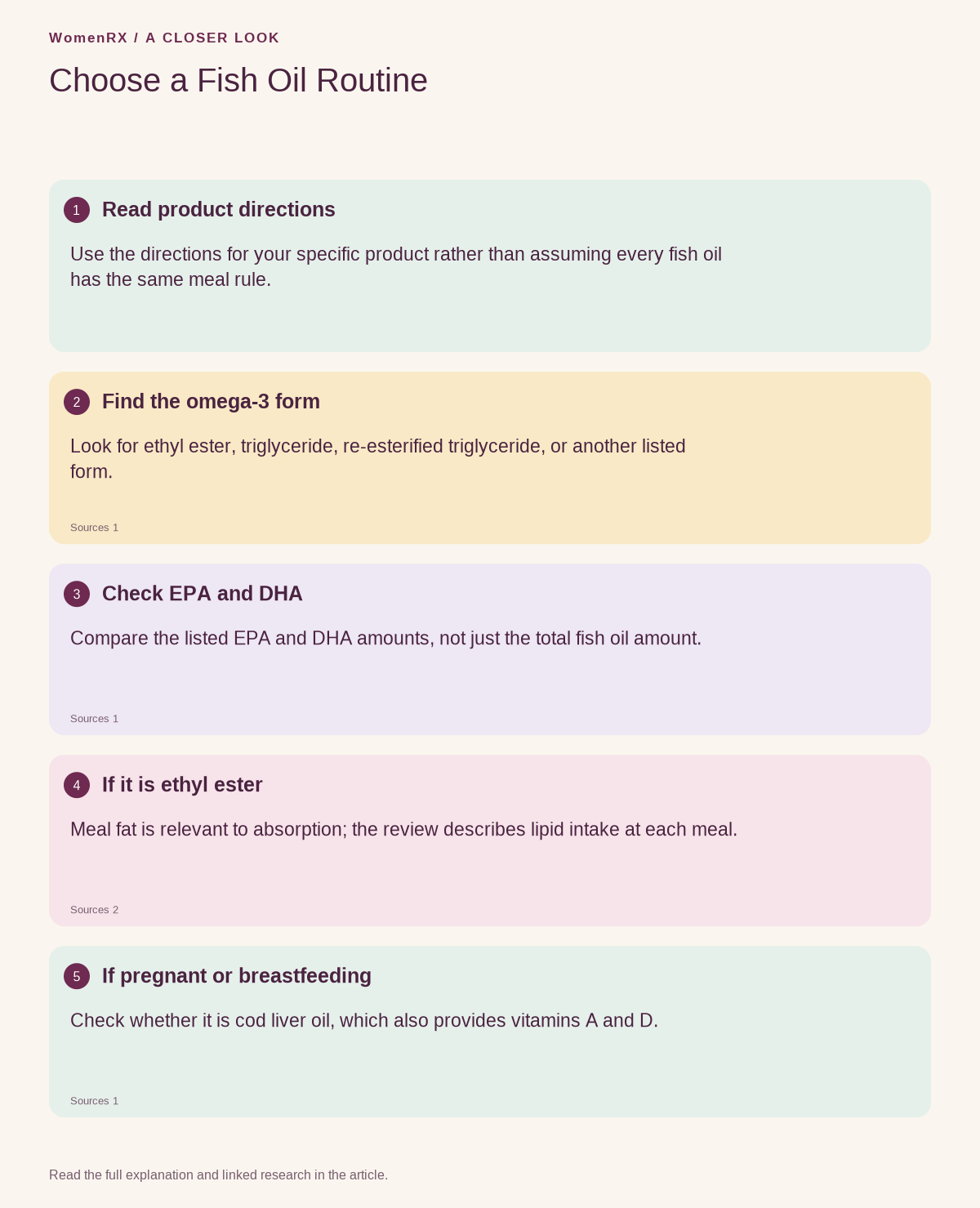
Choose a Fish Oil Routine
Read product directions: Use the directions for your specific product rather than assuming every fish oil has the same meal rule.
Find the omega-3 form: Look for ethyl ester, triglyceride, re-esterified triglyceride, or another listed form.1
Check EPA and DHA: Compare the listed EPA and DHA amounts, not just the total fish oil amount.1
If it is ethyl ester: Meal fat is relevant to absorption; the review describes lipid intake at each meal.2
If pregnant or breastfeeding: Check whether it is cod liver oil, which also provides vitamins A and D.1
Read the figure as text
Check the product and its form first; a review links meal fat to ethyl ester absorption.- Read product directions: Use the directions for your specific product rather than assuming every fish oil has the same meal rule.
- Find the omega-3 form: Look for ethyl ester, triglyceride, re-esterified triglyceride, or another listed form.1
- Check EPA and DHA: Compare the listed EPA and DHA amounts, not just the total fish oil amount.1
- If it is ethyl ester: Meal fat is relevant to absorption; the review describes lipid intake at each meal.2
- If pregnant or breastfeeding: Check whether it is cod liver oil, which also provides vitamins A and D.1
More questions, answered
Is cod liver oil the same as fish oil during pregnancy?
They aren’t interchangeable by label: cod liver oil also supplies vitamins A and D. Check the amounts alongside any prenatal supplements, and review the specific product with your prenatal care team. 1
Sources you can check
- Omega-3 Fatty Acids - Health Professional Fact SheetAccessed 2026-09-25Return to first citation
- Digestion, absorption and deposition of n-3 polyunsaturated fatty acids in tissues: is the chemical form of supply relevant?Alvear I, Duarte L, Farias C, Videla LA, Muñoz Y, Valenzuela R. · Critical reviews in food science and nutrition · 2026Return to first citation