Fish Oil Safety Starts With the EPA and DHA Label
Two fish-oil bottles can list very different EPA and DHA amounts per serving, even when both promise omega-3s.
Compare EPA and DHA per serving, not just the fish-oil amount on the front. Stomach symptoms are common concerns; bleeding evidence is more reassuring than the phrase “blood thinner” suggests, though your medications still matter. Higher-dose omega-3 trials have also raised an atrial-fibrillation concern. If you’re pregnant or breastfeeding, lower-mercury fish provides nutrients a capsule doesn’t. 1367
First, read the smaller numbers
“1,000 mg fish oil” doesn’t mean 1,000 mg of EPA and DHA. The NIH Office of Dietary Supplements gives an example of a 1,000 mg fish-oil supplement containing 180 mg EPA and 120 mg DHA. That’s 300 mg of EPA plus DHA, and other formulations vary widely. When comparing two products, find the EPA and DHA amounts on each label and check the serving size they refer to. 1
Here’s a real comparison, using manufacturer listings checked September 26, 2026. A serving of NOW Omega-3 Fish Oil Molecularly Distilled Softgels is two capsules: 2,000 mg fish oil concentrate, with 360 mg EPA and 240 mg DHA, or 600 mg EPA plus DHA. A serving of Nordic Naturals Ultimate Omega Lemon Soft Gels is also two capsules. Its package lists 1,280 mg total omega-3s, while its Supplement Facts list 650 mg EPA and 450 mg DHA, or 1,100 mg EPA plus DHA. Fish-oil weight, total omega-3s and EPA plus DHA are three different figures; Nordic’s listed total omega-3s should not be read as its EPA-plus-DHA amount. 89
At the listed one-time bottle prices, NOW’s 100 capsules provided 50 servings for $12.99, or about $0.26 per serving and $0.43 per 1,000 mg of listed EPA plus DHA. Nordic’s 60 capsules provided 30 servings for $29.95, or about $1.00 per serving and $0.91 per 1,000 mg of listed EPA plus DHA. Those are price-comparison units, not suggested amounts to take. Prices can change, and neither calculation tells you which product will improve a health outcome. 89
This distinction matters because omega-3 names a family of fats, not one interchangeable ingredient. Fish and fish oil provide EPA and DHA. Algal-oil supplements usually provide DHA, and some provide EPA as well. ALA is found in plant foods such as flaxseed and some vegetable oils. The body converts ALA to EPA and then DHA only to a limited extent, so a flaxseed product and a fish-oil capsule aren’t two ways of getting the same listed EPA and DHA amount. 1
Food, supplements and prescriptions aren’t interchangeable
Fish provides EPA and DHA along with protein and other nutrients that an omega-3 capsule doesn’t provide. A supplement label lets you compare its declared EPA and DHA per serving. If you’re comparing supplements, also look at what else is in the formulation: cod liver oil, for example, provides vitamins A and D in addition to omega-3s. Labels identify stated ingredients and amounts, not independently verified contents. NOW reports contaminant testing and links a historical testing letter; Nordic describes third-party testing and offers a certificate-of-analysis lookup. Neither disclosure, by itself, verifies the contents of a particular bottle or establishes a health advantage. 1689
If you might become pregnant, are pregnant or are breastfeeding, seafood choice matters as much as omega-3 content. FDA/EPA advice recommends two to three four-ounce servings each week from its lower-mercury “Best Choices” fish, such as salmon, sardines or trout. Alternatively, it advises one serving from “Good Choices” and no other fish that week. During pregnancy, choose cooked fish. Fish supplies nutrients beyond DHA, while a fish-oil or algal-oil supplement can be assessed for DHA by reading its label. A capsule isn’t a direct substitute for everything in a fish meal, and these food recommendations aren’t a supplement dose or a promise that supplements prevent pregnancy complications. 16
A prescription omega-3 product is also not simply a stronger bottle of store-bought fish oil. A review comparing prescription omega-3-acid ethyl esters with dietary supplements described differences in formulation and product standards, while noting that it lacked head-to-head clinical trials. Its account of a prescription indication was published in 2007, so it shouldn’t be used to identify today’s available products or indications. If a prescription product has been recommended for a specific medical goal, compare it with a supplement by its exact formulation and purpose, not by the shared words “omega-3.” 2
Likewise, taking an over-the-counter capsule for general heart protection isn’t a conclusion the label can justify. Research on omega-3s has examined different foods, formulations, populations and outcomes; the NIH fact sheet notes that several supplement trials using 1 g daily did not significantly affect their primary cardiovascular outcomes. More fish oil on the front label isn’t, by itself, evidence of more benefit. 1
Side effects and bleeding: what the studies actually tested
Unpleasant taste, heartburn, nausea, diarrhea and other gastrointestinal discomfort are typically mild reported side effects of omega-3 supplements. They may matter more to your day-to-day decision than a claim on the front of the bottle. 7
Bleeding deserves a closer look, particularly if you take a medicine intended to reduce clotting. An analysis of eight studies of fish-oil-enriched medical nutrition found no increased bleeding or significant change in measured clotting tests among more than 600 people receiving the products. Some participants used antithrombotic drugs. But these were selected patients using medical nutrition products, not a test of every fish-oil capsule with every medicine. 3
A separate randomized trial in adults aged 50 or older compared a daily fish-oil product containing 465 mg EPA and 375 mg DHA with placebo over a median of 5.3 years. Gastrointestinal bleeding was reported in 2.6% of the omega-3 group versus 2.7% of the placebo group; easy bruising was reported in 24.8% versus 25.1%. Women made up 49.2% of participants, but those figures weren’t reported separately for women. They’re useful context, not a personal risk estimate for someone taking a particular medication. 4
Medication details still matter. Fish oil may prolong clotting time with warfarin, although most research at the amounts studied did not find a significant change in anticoagulant status; prescription omega-3 labeling calls for periodic INR monitoring when used with anticoagulants. A 2010 cardiovascular review also discussed aspirin and clopidogrel, reporting that anticipated bleeding complications had not materialized in the evidence it considered. Neither finding establishes safety for every product and medication combination. If you take one of these medicines, bring the product’s EPA and DHA amounts to the person managing that treatment rather than treating “fish oil” as a single dose or formulation. 57
Bleeding isn’t the only question at higher intakes. The NIH fact sheet describes two large trials in which 4 g daily of omega-3s over years slightly increased atrial fibrillation risk among people with cardiovascular disease or high cardiovascular risk. That finding isn’t a risk estimate for every lower-dose supplement, but it is a reason not to assume that more EPA and DHA is automatically safer or better. 7
A heavier period after starting fish oil is a different question from gastrointestinal bleeding or easy bruising. Those trial outcomes don’t tell us whether omega-3 supplements change menstrual flow. If bleeding has changed, don’t assume the supplement is the cause or rule it out on the basis of these studies. 34
The most useful purchase check is therefore specific: What type of omega-3 does this provide, how much EPA and DHA does the stated serving contain, and what am I taking it for? Then consider what evidence you have about that product’s quality and whether a medication or health goal changes the decision. 127
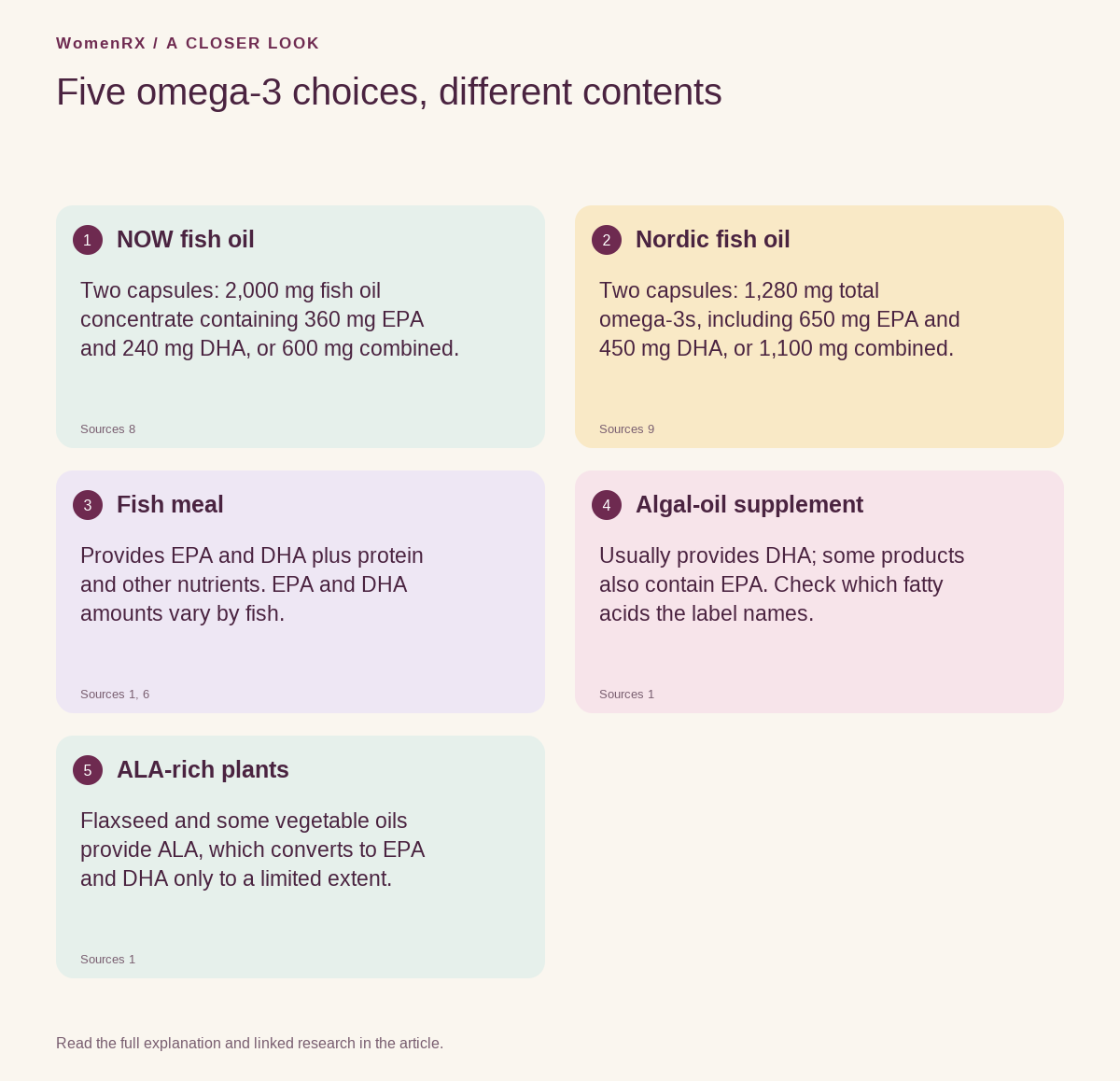
Five omega-3 choices, different contents
NOW fish oil: Two capsules: 2,000 mg fish oil concentrate containing 360 mg EPA and 240 mg DHA, or 600 mg combined.8
Nordic fish oil: Two capsules: 1,280 mg total omega-3s, including 650 mg EPA and 450 mg DHA, or 1,100 mg combined.9
Fish meal: Provides EPA and DHA plus protein and other nutrients. EPA and DHA amounts vary by fish.16
Algal-oil supplement: Usually provides DHA; some products also contain EPA. Check which fatty acids the label names.1
ALA-rich plants: Flaxseed and some vegetable oils provide ALA, which converts to EPA and DHA only to a limited extent.1
Read the figure as text
The two capsule examples use listed two-capsule servings. Compare their EPA and DHA with what food and other omega-3 sources provide.- NOW fish oil: Two capsules: 2,000 mg fish oil concentrate containing 360 mg EPA and 240 mg DHA, or 600 mg combined.8
- Nordic fish oil: Two capsules: 1,280 mg total omega-3s, including 650 mg EPA and 450 mg DHA, or 1,100 mg combined.9
- Fish meal: Provides EPA and DHA plus protein and other nutrients. EPA and DHA amounts vary by fish.16
- Algal-oil supplement: Usually provides DHA; some products also contain EPA. Check which fatty acids the label names.1
- ALA-rich plants: Flaxseed and some vegetable oils provide ALA, which converts to EPA and DHA only to a limited extent.1
More questions, answered
Does “1,000 mg fish oil” mean 1,000 mg omega-3?
No. The NIH gives an example of a 1,000 mg fish-oil supplement with 180 mg EPA and 120 mg DHA. Check the EPA and DHA lines and the serving size; formulations vary. 1
Is plant-based ALA the same as the omega-3s in algal oil?
No. ALA is found in foods such as flaxseed and some vegetable oils. Algal-oil supplements usually provide DHA, and some also provide EPA. The body converts ALA to EPA and DHA only to a limited extent, so check which fatty acids a product lists rather than relying on “plant-based omega-3” alone. 1
Sources you can check
- Omega-3 Fatty Acids - Health Professional Fact SheetAccessed 2026-09-25Return to first citation
- Differentiating prescription omega-3-acid ethyl esters (P-OM3) from dietary-supplement omega-3 fatty acids.Brunton S, Collins N. · Current medical research and opinion · 2007Return to first citation
- Fish oil LC-PUFAs do not affect blood coagulation parameters and bleeding manifestations: Analysis of 8 clinical studies with selected patient groups on omega-3-enriched medical nutrition.Jeansen S, Witkamp RF, Garthoff JA, van Helvoort A, Calder PC. · Clinical nutrition (Edinburgh, Scotland) · 2018Return to first citation
- Effect of Long-term Supplementation With Marine Omega-3 Fatty Acids vs Placebo on Risk of Depression or Clinically Relevant Depressive Symptoms and on Change in Mood Scores: A Randomized Clinical Trial.Okereke OI, Vyas CM, Mischoulon D, Chang G, Cook NR, Weinberg A, Bubes V, Copeland T, Friedenberg G, Lee IM, Buring JE, Reynolds CF, Manson JE. · JAMA · 2021Return to first citation
- Omega-3 Fatty acids for cardiovascular disease prevention.Defilippis AP, Blaha MJ, Jacobson TA. · Current treatment options in cardiovascular medicine · 2010Return to first citation
- Questions & Answers from the FDA/EPA Advice about Eating Fish for Those Who Might Become or Are Pregnant or Breastfeeding and Children Ages 1 to 11 Years | FDAAccessed 2026-09-25Return to first citation
- NIH ODS Omega-3 Fatty Acids: safety and interactionsAccessed 2026-09-26Return to first citation
- NOW Omega-3 Fish Oil, Molecularly Distilled Softgels: current product factsAccessed 2026-09-26Return to first citation
- Nordic Naturals Ultimate Omega lemon soft gels: current product factsAccessed 2026-09-26Return to first citation