How Long Do Omega-3 Supplements Take to Work?
Blood omega-3 levels can change within weeks, but that doesn’t tell you when, or whether, a health benefit will be noticeable.
There’s no single timeline for omega-3 supplements. In a trial of healthy adults, blood fatty-acid markers changed after four weeks, while a triglyceride trial in people with type 2 diabetes measured its main outcome after 12 weeks. Those are different outcomes in different groups, not a general promise of when you’ll feel a difference. 3 4
First, define what “working” means
Omega-3 supplements can contain EPA, DHA, or both. The result you’re hoping for might be a higher level of these fatty acids in blood, a change in a health marker such as triglycerides, or a noticeable change in symptoms. Those are not interchangeable measures, and a study’s measurement date is not proof that a benefit begins then.
That distinction matters because blood levels can respond to intake without demonstrating that a person feels better or has a lower risk of illness. One randomized study in healthy adults found changes in blood omega-3 profiles after four weeks, but it found no change in the cardiovascular biomarkers it assessed. 3
Blood levels: a change was measured at four weeks
In that study, healthy adults took a long-chain omega-3-rich canola oil or corn-oil placebo daily. The active oil provided one of three amounts of long-chain omega-3 fatty acids: 285, 570, or 1,140 milligrams a day. Researchers found differences in some blood omega-3 measures after four weeks; red blood cell EPA and DHA were assessed again at 16 weeks. The study tested an alternative oil, not a typical fish-oil product, and it did not show that the blood changes produced a noticeable health benefit. 3
So four weeks is a useful example of when researchers measured a change in blood markers, not a universal deadline for fish oil to “kick in.” The product, amount of EPA and DHA, starting diet, and outcome being measured all affect what a study can tell you.
Triglycerides: a 12-week study in a specific group
A randomized trial followed 309 Chinese adults with type 2 diabetes and high triglycerides for 12 weeks. Participants received 4 grams of fish oil or corn oil daily; the reported summary does not specify the fish oil’s separate EPA and DHA amounts. Average triglycerides fell more in the fish-oil group than in the corn-oil group over that study period. This finding applies to that group and regimen; it does not establish a timeline for people taking an over-the-counter product for a different reason. 4
The practical takeaway is to match the assessment to the goal. A blood fatty-acid test, a triglyceride measurement, and a change you notice in daily life answer different questions. The trial’s 12-week endpoint tells you when the researchers compared triglycerides, not when every person should expect a response.
Symptoms and other health goals: don’t borrow another study’s clock
A small, three-week trial in people with non-severe burns compared fish oil providing 1.5 grams of EPA daily plus 600 milligrams of DHA daily with corn oil plus the same 600 milligrams of DHA daily. In other words, the comparison tested added EPA alongside DHA, not omega-3s against no omega-3s. The fish-oil group had larger reductions in CRP and ESR, markers of inflammation, and improved glucose-related measures; hospital stay did not differ significantly between groups. The participants were receiving medical care for burns, and the study excluded pregnant and lactating women. It cannot set a timeline for everyday fish-oil use or for a different health goal. 2
For cognition, one trial assessed older adults with memory complaints at three and 12 months. The intervention combined fish oil providing 1.1 grams of DHA and 0.4 grams of EPA daily with 500 milligrams of cocoa flavanols daily, so it cannot isolate the effect of omega-3 alone. The combined intervention did not improve the trial’s primary cognitive outcome or most cognitive outcomes. A longer study period, by itself, doesn’t mean a benefit will appear. 5
Pregnancy and breastfeeding are a separate question
Pregnancy and lactation shouldn’t be folded into a general “how fast does fish oil work?” estimate. NIH’s omega-3 reference lists adequate intakes for alpha-linolenic acid (ALA) of 1.4 grams a day during pregnancy and 1.3 grams a day during lactation for adults ages 19-50. Those are ALA intake values, not EPA or DHA supplement doses, and they don’t specify how long a supplement takes to produce an outcome. 1
The studies discussed above don’t establish a pregnancy- or breastfeeding-specific timeline for a clinical benefit. The four- and 12-week findings also shouldn’t be presented as established timelines for women as a subgroup.
A better way to assess your own goal
Start by checking the label for the amounts of EPA and DHA, rather than relying only on the total amount of “fish oil.” Products vary widely, and the NIH fact sheet notes that a typical 1,000-milligram fish-oil supplement may contain 180 milligrams EPA and 120 milligrams DHA, with actual amounts varying by product. 1
Then identify the outcome you’re trying to assess. If it’s a lab value, the relevant question is when that measure should be checked for your situation, not whether you can feel a difference by a particular week. If the goal is a symptom or broader health benefit, blood-level changes alone can’t confirm that the supplement is helping. The available trial timelines are study-specific reference points, not a universal countdown.
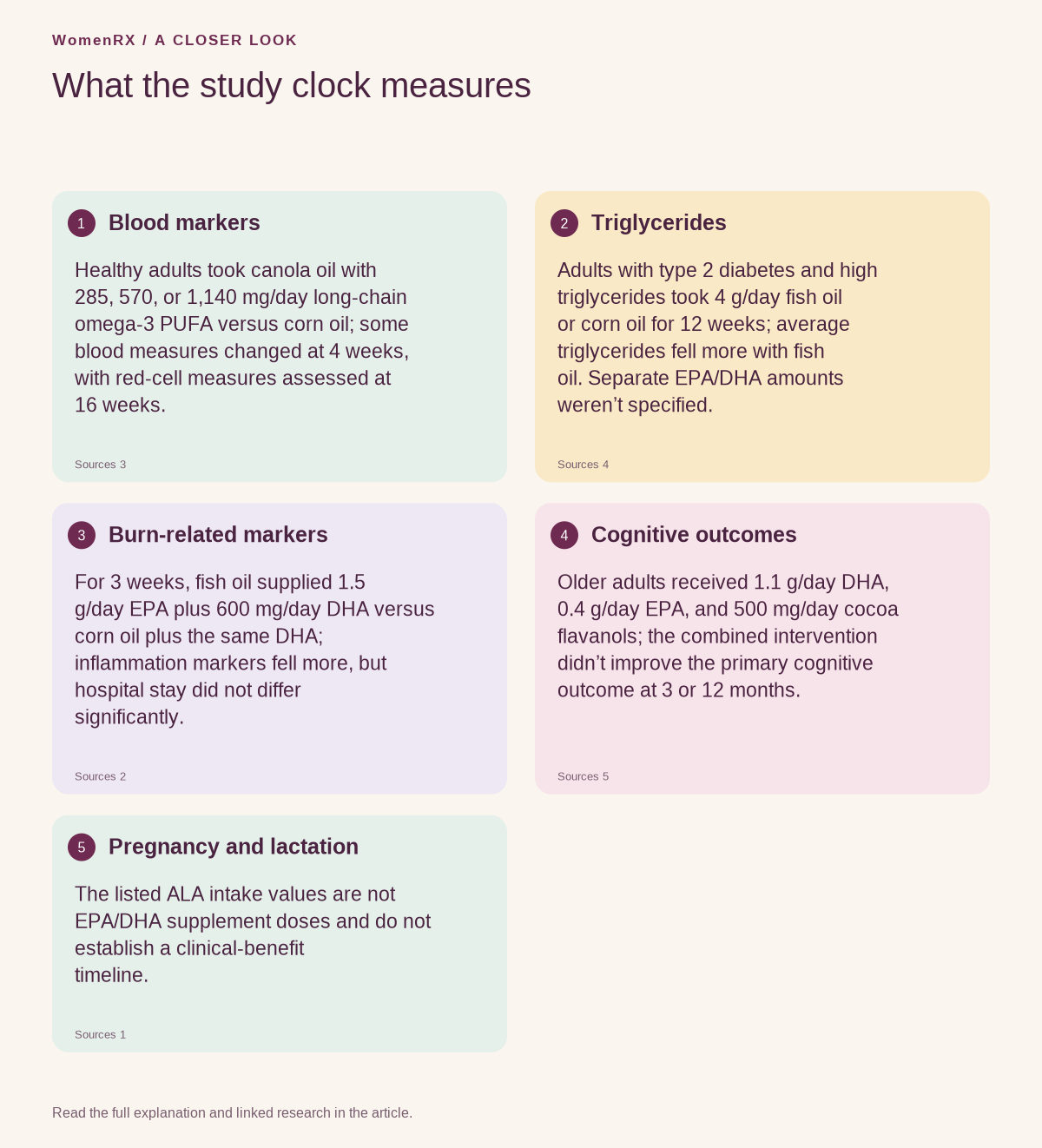
What the study clock measures
Blood markers: Healthy adults took canola oil with 285, 570, or 1,140 mg/day long-chain omega-3 PUFA versus corn oil; some blood measures changed at 4 weeks, with red-cell measures assessed at 16 weeks.3
Triglycerides: Adults with type 2 diabetes and high triglycerides took 4 g/day fish oil or corn oil for 12 weeks; average triglycerides fell more with fish oil. Separate EPA/DHA amounts weren’t specified.4
Burn-related markers: For 3 weeks, fish oil supplied 1.5 g/day EPA plus 600 mg/day DHA versus corn oil plus the same DHA; inflammation markers fell more, but hospital stay did not differ significantly.2
Cognitive outcomes: Older adults received 1.1 g/day DHA, 0.4 g/day EPA, and 500 mg/day cocoa flavanols; the combined intervention didn’t improve the primary cognitive outcome at 3 or 12 months.5
Pregnancy and lactation: The listed ALA intake values are not EPA/DHA supplement doses and do not establish a clinical-benefit timeline.1
Read the figure as text
These examples compare the omega-3 formulation, dose, comparator, outcome, and measurement period. Each is a study-specific observation, not a general onset promise.- Blood markers: Healthy adults took canola oil with 285, 570, or 1,140 mg/day long-chain omega-3 PUFA versus corn oil; some blood measures changed at 4 weeks, with red-cell measures assessed at 16 weeks.3
- Triglycerides: Adults with type 2 diabetes and high triglycerides took 4 g/day fish oil or corn oil for 12 weeks; average triglycerides fell more with fish oil. Separate EPA/DHA amounts weren’t specified.4
- Burn-related markers: For 3 weeks, fish oil supplied 1.5 g/day EPA plus 600 mg/day DHA versus corn oil plus the same DHA; inflammation markers fell more, but hospital stay did not differ significantly.2
- Cognitive outcomes: Older adults received 1.1 g/day DHA, 0.4 g/day EPA, and 500 mg/day cocoa flavanols; the combined intervention didn’t improve the primary cognitive outcome at 3 or 12 months.5
- Pregnancy and lactation: The listed ALA intake values are not EPA/DHA supplement doses and do not establish a clinical-benefit timeline.1
More questions, answered
Can I tell from how I feel whether my omega-3 level changed?
No. The trials measured blood fatty-acid profiles or other defined outcomes; a blood-marker change doesn’t establish that you’ll notice a difference in symptoms. 3
Does “1,000 mg fish oil” mean 1,000 mg of EPA and DHA?
No. The amount of fish oil and the amounts of EPA and DHA are different label details. The NIH fact sheet gives a typical example of 1,000 milligrams of fish oil containing 180 milligrams EPA and 120 milligrams DHA, while noting that products vary. 1
Sources you can check
- Omega-3 Fatty Acids - Health Professional Fact SheetAccessed 2026-09-25Return to first citation
- Eicosapentaenoic acid decreases inflammation and improves glucose homeostasis in patients with burns: a randomized clinical trial.Mousavi MA, Mousavi SN, Shaghaghi A, Sabet SA. · Scientific reports · 2025Return to first citation
- Transgenic Canola Oil Improved Blood Omega-3 Profiles: A Randomized, Placebo-Controlled Trial in Healthy Adults.Lin XL, Baisley J, Bier A, Vora D, Holub B. · Frontiers in nutrition · 2022Return to first citation
- Impact of omega-3 fatty acids on hypertriglyceridemia, lipidomics, and gut microbiome in patients with type 2 diabetes.Lu J, Liu R, Ren H, Wang S, Hu C, Shi Z, Li M, Liu W, Wan Q, Su Q, Li Q, Zheng H, Qu S, Yang F, Ji H, Lin H, Qi H, Wu X, Wu K, Chen Y, Xu Y, Xu M, Wang T, Zheng J, Ning G, Zheng R,... · Med (New York, N.Y.) · 2025Return to first citation
- A combined DHA-rich fish oil and cocoa flavanols intervention does not improve cognition or brain structure in older adults with memory complaints: results from the CANN randomized, controlled parallel-design study.Vauzour D, Scholey A, White DJ, Cohen NJ, Cassidy A, Gillings R, Irvine MA, Kay CD, Kim M, King R, Legido-Quigley C, Potter JF, Schwarb H, Minihane AM. · The American journal of clinical nutrition · 2023Return to first citation