How to Compare Omega-3 Supplements Before You Choose
The EPA and DHA amounts on the label tell you more than the large fish-oil number on the front.
Look for EPA and DHA on the supplement facts panel, then check how many capsules make one serving. Those amounts vary widely and aren’t the same as the total fish oil listed on the bottle. Whether you need a supplement depends on what you eat and why you’re considering one. An over-the-counter product isn’t interchangeable with prescription cardiovascular treatment. 1 4
Read past the fish-oil number
A bottle might advertise 1,000 mg of fish oil, but that’s the total oil, not the amount of EPA and DHA. Find each fatty acid on the supplement facts panel and check whether the amounts are listed per capsule or per serving. If a serving is several capsules, use the full serving size when comparing products.
For context, the NIH Office of Dietary Supplements gives an example of a typical 1,000 mg fish-oil supplement containing 180 mg EPA and 120 mg DHA. Products vary widely, so those amounts aren’t a target. Adding EPA and DHA per labeled serving helps you compare what’s inside, not decide how much to take. 1
You may also see a form listed, such as triglycerides or ethyl esters. Some forms appear to have somewhat higher bioavailability than others, but different forms can raise EPA and DHA levels in the blood. Form alone isn’t a reliable shortcut for choosing a product with a proven health benefit. 1 2
Match the product to your reason
If you’re considering omega-3s for heart protection, don’t assume any fish-oil capsule prevents heart attacks or strokes. A Cochrane review of 79 randomized trials involving 112,059 adults found that increasing long-chain omega-3s, mainly EPA and DHA, made little or no difference to several major outcomes, including cardiovascular events and mortality. The cited overall results cover adults with varying cardiovascular risk; they don’t provide a women-specific effect estimate. 3
Prescription icosapent ethyl has a narrower evidence story. A review describes cardiovascular benefit with this purified EPA product in a selected group with elevated triglycerides who were taking statins and had either existing cardiovascular disease or diabetes plus multiple risk factors. In a similar higher-risk population, the high-dose EPA-and-DHA formulation tested in the STRENGTH trial did not show a cardiovascular benefit. Neither result means an over-the-counter supplement can stand in for the product studied. 4
If a triglyceride result or cardiovascular risk is driving your search, the useful question is what that result means for your treatment options, not how many supplement capsules might equal a prescription product. Omega-3 products can also have adverse effects, including gastrointestinal problems or bleeding, and the review notes a possible increased risk of atrial fibrillation. Bring up products you already use when discussing your medicines, bleeding concerns, or heart rhythm history. 4
Count food sources, but know which omega-3 they provide
Fatty fish such as salmon, sardines, herring, and mackerel provide EPA and DHA. Flax, chia, and walnuts provide ALA, a different essential omega-3. The body converts ALA to EPA and DHA inefficiently, so an amount of ALA shouldn’t be counted as the same amount of preformed EPA and DHA. Algal oil usually provides DHA, and some products contain EPA too. Check the label rather than assuming all plant-based products are alike. 1 2
What you eat is worth considering before you shop. In a small randomized trial of 40 healthy young adults with low fish intake, both fish meals and an omega-3 supplement increased the omega-3 index, a blood marker of EPA and DHA, over eight weeks. Neither approach significantly changed blood lipids or a marker of inflammation during that trial. Raising a blood marker isn’t the same as showing that a product prevents cardiovascular disease. 5
Pregnancy and breastfeeding call for a DHA-specific question
If you’re pregnant or breastfeeding, ask about DHA specifically rather than relying on a general “omega-3” claim. The US intake reference described by NIH sets adequate intakes for ALA during pregnancy and lactation, but it doesn’t establish separate EPA or DHA intake recommendations. An ALA figure on its own isn’t a DHA target. 1
Check the type of oil, too. Cod liver oil supplies vitamins A and D as well as omega-3s, making its full contents relevant when comparing it with fish or algal oil. 1
Make the comparison in one pass
For each product, write down its EPA and DHA amounts, the number of capsules or other units in a serving, and whether it contains anything else you’re trying to account for. Then return to the reason you started looking. If it’s a food gap, pregnancy question, or cardiovascular test result, those are different decisions. A useful question to raise with a clinician or pharmacist is: “Given what I eat and why I’m considering omega-3s, is there a reason to choose EPA, DHA, both, or neither?” 1 4
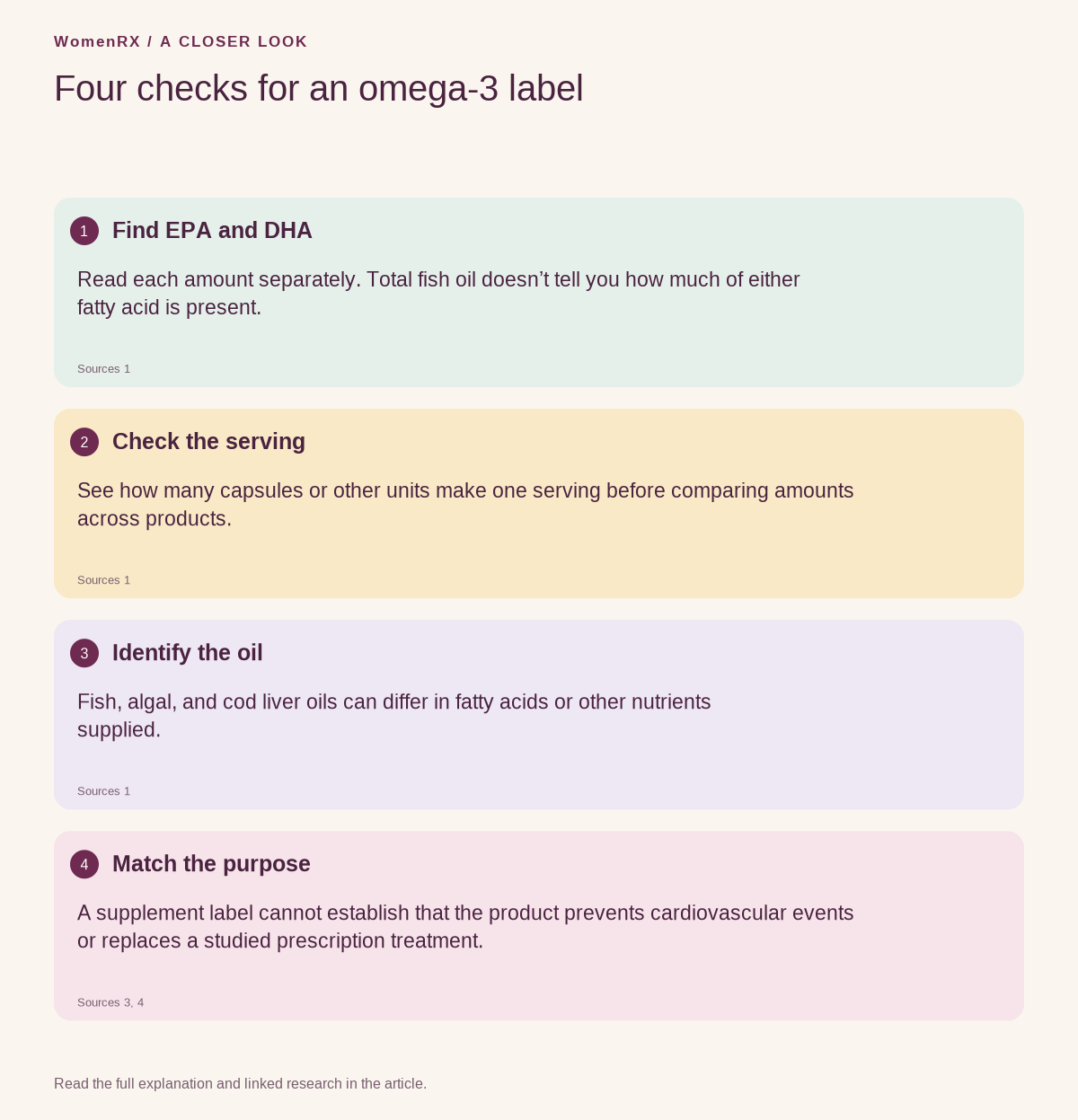
Four checks for an omega-3 label
Find EPA and DHA: Read each amount separately. Total fish oil doesn’t tell you how much of either fatty acid is present.1
Check the serving: See how many capsules or other units make one serving before comparing amounts across products.1
Identify the oil: Fish, algal, and cod liver oils can differ in fatty acids or other nutrients supplied.1
Match the purpose: A supplement label cannot establish that the product prevents cardiovascular events or replaces a studied prescription treatment.34
Read the figure as text
Compare what a product actually contains before deciding whether it fits your purpose.- Find EPA and DHA: Read each amount separately. Total fish oil doesn’t tell you how much of either fatty acid is present.1
- Check the serving: See how many capsules or other units make one serving before comparing amounts across products.1
- Identify the oil: Fish, algal, and cod liver oils can differ in fatty acids or other nutrients supplied.1
- Match the purpose: A supplement label cannot establish that the product prevents cardiovascular events or replaces a studied prescription treatment.34
More questions, answered
Does more EPA and DHA make a supplement better?
Not on its own. A larger amount tells you what the product contains, not whether it suits your goal or prevents cardiovascular disease. Evidence for a specific prescription EPA product doesn’t establish the same benefit for other formulations or over-the-counter supplements. 3 4
Is plant-based omega-3 the same as fish oil?
It depends on the source. Flax, chia, and walnuts provide ALA; fish provides EPA and DHA. Algal oil usually provides DHA and may also contain EPA. Check the specific fatty acids listed on the product. 1 2
Sources you can check
- Omega-3 Fatty Acids - Health Professional Fact SheetAccessed 2026-09-25Return to first citation
- Variability in the Clinical Effects of the Omega-3 Polyunsaturated Fatty Acids DHA and EPA in Cardiovascular Disease-Possible Causes and Future Considerations.Michaeloudes C, Christodoulides S, Christodoulou P, Kyriakou TC, Patrikios I, Stephanou A. · Nutrients · 2023Return to first citation
- Omega-3 fatty acids for the primary and secondary prevention of cardiovascular disease.Abdelhamid AS, Brown TJ, Brainard JS, Biswas P, Thorpe GC, Moore HJ, Deane KH, AlAbdulghafoor FK, Summerbell CD, Worthington HV, Song F, Hooper L. · The Cochrane database of systematic reviews · 2018Return to first citation
- Omega-3 fatty acids for the prevention of atherosclerotic cardiovascular disease.Barry AR, Dixon DL. · Pharmacotherapy · 2021Return to first citation
- Influence of Fish Consumption and ω-3 Supplementation on the ω-3 Index of Young Adults: A 2 × 2 Factorial Randomized Controlled Trial (YouFish Study).McMullan JE, Kumar RA, Yeates AJ, Allsopp PJ, Mulhern MS, van Wijngaarden E, Strain JJ, McSorley EM. · The Journal of nutrition · 2025Return to first citation