Omega-3 for Menopause: Food or Supplements?
Omega-3 supplements haven’t reliably eased hot flashes, so choose foods or capsules based on the goal you actually have.
For hot flashes, omega-3 supplements aren’t a dependable treatment: a pooled analysis found no benefit for symptom frequency or bother. 4 A separate review of three trials found fewer night sweats but no improvement in hot flashes, sleep, or quality of life. 3 Foods such as oily fish and ALA-rich seeds provide omega-3s, but that doesn’t establish them as menopause-symptom treatments. 1
Start with the goal, not the supplement
Omega-3 is a family of fats, not one menopause remedy. ALA is found in plant foods; EPA and DHA are long-chain omega-3s found mainly in seafood and in some supplements. The distinction matters: eating an ALA-rich food and taking an EPA/DHA capsule are not the same intervention, and neither should be assumed to relieve menopause symptoms. 1
Hot flashes and night sweats: mixed findings, no reliable hot-flash benefit
The most direct evidence concerns women having vasomotor symptoms, meaning hot flashes and night sweats. A 2015 pooled analysis of three randomized trials included 899 perimenopausal and postmenopausal women across six interventions. Omega-3 supplements did not reduce symptom frequency or bother compared with control. 4
A 2018 review of three trials, involving 483 women ages 51 to 54.7, found no difference in hot-flash frequency or severity, sleep, or quality of life. It did find fewer and less severe night sweats in the omega-3 groups, but the reviewers said the evidence was too limited to conclude that supplements help vasomotor symptoms overall. 3
Taken together, these studies don’t support choosing an omega-3 supplement as a reliable way to stop hot flashes. The night-sweat finding is a possible signal, not a settled benefit. For bothersome symptoms, the North American Menopause Society identifies hormone therapy as the most effective treatment; treatment choices depend on an individual’s circumstances and preferences. 2
Mood and brain health: promising discussion, not a proven menopause treatment
Mood changes and cognitive concerns can arise during the menopause transition, but that doesn’t establish that omega-3 supplements will improve them. A 2025 narrative review describes the menopause-specific evidence on EPA, DHA, and brain health as relatively sparse but indicative of possible benefit. It calls for further trials to clarify how benefits may vary with intake and timing. That tentative finding doesn’t establish a capsule as a treatment for menopause-related mood or memory concerns. 5
Joint aches: don’t equate them with studied conditions
Joint discomfort may be part of what you’re trying to address, but this research doesn’t establish that omega-3 supplements relieve menopause-related joint aches. Research on rheumatoid arthritis is a different question from ordinary joint pain during perimenopause or after menopause; evidence about rheumatoid arthritis alone would not establish relief of menopause-related aches. 1
Heart health: seafood is a food choice, not a menopause-specific prescription
Studies have linked eating more fish and seafood with better health outcomes, but observational findings can’t show that omega-3 itself caused the difference. Seafood also contains other nutrients, and people who eat it may differ in other ways. The NIH Office of Dietary Supplements says randomized trials are needed to clarify these relationships. This evidence doesn’t establish a special heart-protective effect of omega-3 supplements during menopause. 1
Food and supplements provide different things
If you want omega-3 in your meals, walnuts, chia seeds, and flaxseed provide ALA. Salmon, sardines, herring, and mackerel provide EPA and DHA. Food amounts vary, especially among fish. For example, the NIH fact sheet lists about 1.24 grams of EPA and 0.59 grams of DHA in a 3-ounce serving of farmed Atlantic salmon, while a 3-ounce serving of sardines canned in tomato sauce, drained, has about 0.74 grams of EPA and 0.45 grams of DHA. 1
Those are nutrient amounts, not menopause-treatment doses. A food can be a useful way to include omega-3s without implying that it will relieve hot flashes or joint aches. The adult Adequate Intake for women is 1.1 grams per day of ALA; this is not an EPA/DHA target. The Institute of Medicine did not set specific intake recommendations for EPA or DHA. 1
Supplements may contain fish oil, krill oil, cod liver oil, or algal oil. Formulas vary, so check the label for the actual amounts of EPA and DHA rather than relying only on the total amount of “fish oil.” Algal products usually provide DHA, and some also contain EPA. Cod liver oil also provides vitamins A and D, so it isn’t interchangeable with a plain fish-oil product. If you’re comparing capsules, check for those added vitamins as well as the omega-3 amounts. 1
Seafood can contain varying amounts of methylmercury. Omega-3 supplements have not been found to contain it because processing removes it, though that finding isn’t a guarantee about every product or every aspect of supplement safety. 1
A practical way to choose
If your main goal is fewer hot flashes, omega-3 supplements aren’t supported as a dependable option. If you want to add omega-3-containing foods to your diet, choose foods that suit your preferences and eating pattern; that’s a nutrition choice, not a proven menopause-symptom treatment. If you’re considering a supplement for mood, brain health, or joint pain, the menopause-specific evidence doesn’t establish that it will help. 1 3 4 5
Short-term trial results also shouldn’t be mistaken for proof of long-term safety: the 2018 review found no difference in reported adverse effects between supplement and control groups, but included only three trials. 3
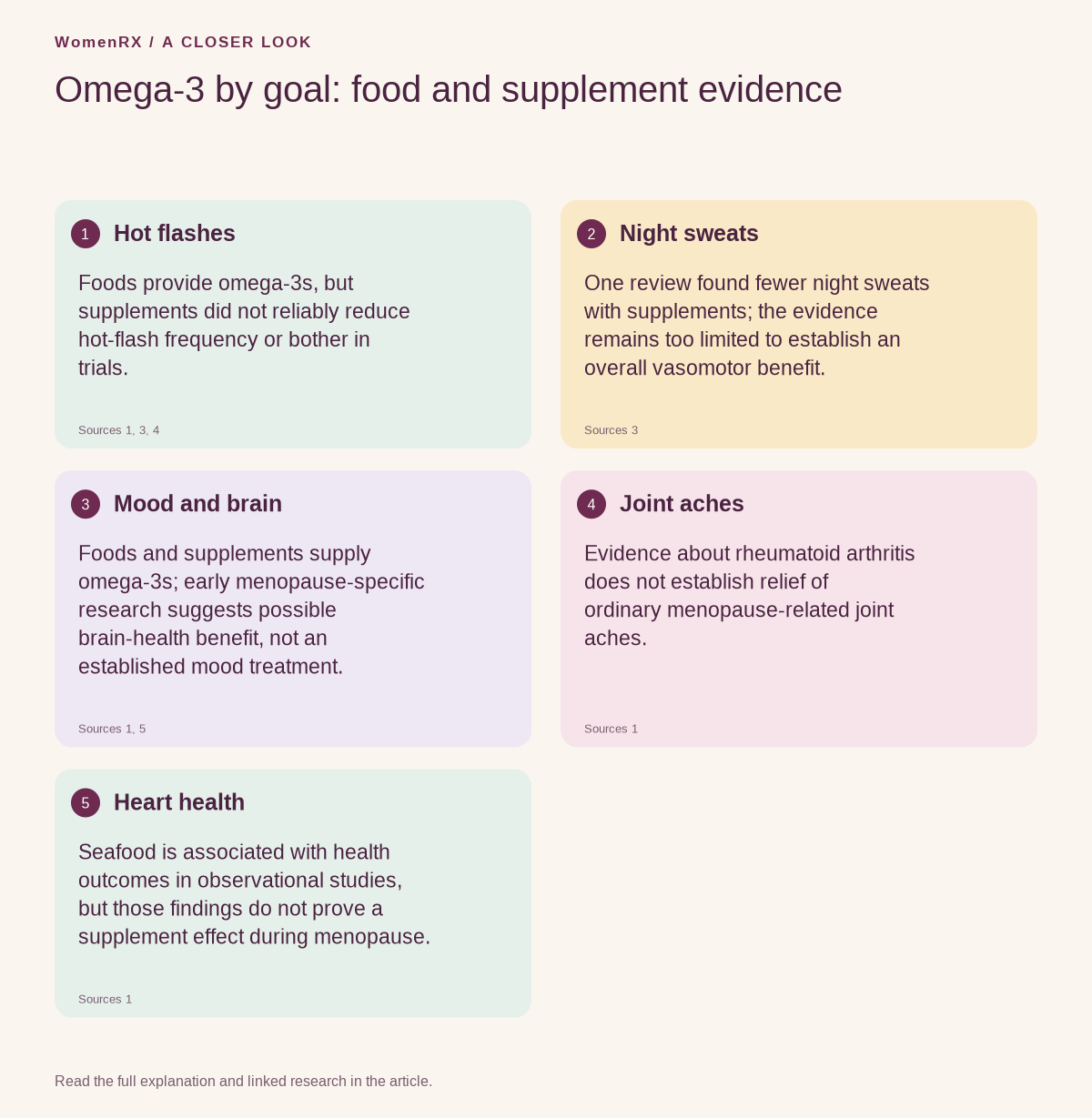
Omega-3 by goal: food and supplement evidence
Hot flashes: Foods provide omega-3s, but supplements did not reliably reduce hot-flash frequency or bother in trials.134
Night sweats: One review found fewer night sweats with supplements; the evidence remains too limited to establish an overall vasomotor benefit.3
Mood and brain: Foods and supplements supply omega-3s; early menopause-specific research suggests possible brain-health benefit, not an established mood treatment.15
Joint aches: Evidence about rheumatoid arthritis does not establish relief of ordinary menopause-related joint aches.1
Heart health: Seafood is associated with health outcomes in observational studies, but those findings do not prove a supplement effect during menopause.1
Read the figure as text
Different omega-3 sources provide different fats, and the evidence varies by menopause-related outcome.- Hot flashes: Foods provide omega-3s, but supplements did not reliably reduce hot-flash frequency or bother in trials.134
- Night sweats: One review found fewer night sweats with supplements; the evidence remains too limited to establish an overall vasomotor benefit.3
- Mood and brain: Foods and supplements supply omega-3s; early menopause-specific research suggests possible brain-health benefit, not an established mood treatment.15
- Joint aches: Evidence about rheumatoid arthritis does not establish relief of ordinary menopause-related joint aches.1
- Heart health: Seafood is associated with health outcomes in observational studies, but those findings do not prove a supplement effect during menopause.1
More questions, answered
Can plant-based omega-3 foods replace fish oil?
They provide a different omega-3. Walnuts, chia seeds, and flaxseed provide ALA, while fish oil provides EPA and DHA. Algal oil is another supplement option and usually provides DHA, sometimes with EPA. That difference is nutritional, not proof that either source relieves menopause symptoms. 1 3 4
Does an omega-3 supplement help with menopause-related mood changes?
It hasn’t been established as a treatment. A 2025 review calls the menopause-transition evidence relatively sparse but indicative of possible brain-health benefit, and calls for trials to clarify intake and timing. That doesn’t show that a supplement treats mood changes. 5
Sources you can check
- Omega-3 Fatty Acids - Health Professional Fact SheetAccessed 2026-09-25Return to first citation
- The 2022 hormone therapy position statement of The North American Menopause Society.“The 2022 Hormone Therapy Position Statement of The North American Menopause Society” Advisory Panel. · Menopause (New York, N.Y.) · 2022Return to first citation
- Effect of omega-3 supplements on vasomotor symptoms in menopausal women: A systematic review and meta-analysis.Mohammady M, Janani L, Jahanfar S, Mousavi MS. · European journal of obstetrics, gynecology, and reproductive biology · 2018Return to first citation
- Pooled Analysis of Six Pharmacologic and Nonpharmacologic Interventions for Vasomotor Symptoms.Guthrie KA, LaCroix AZ, Ensrud KE, Joffe H, Newton KM, Reed SD, Caan B, Carpenter JS, Cohen LS, Freeman EW, Larson JC, Manson JE, Rexrode K, Skaar TC, Sternfeld B, Anderson GL. · Obstetrics and gynecology · 2015Return to first citation
- Omega-3 fatty acids, brain health and the menopause.Minihane AM. · Post reproductive health · 2025Return to first citation