Omega-3 and Brain Health: What the Evidence Shows
The cognition trials discussed here don’t establish dementia prevention, and their findings vary by population and measure.
The trials discussed here don’t establish a reliable cognitive benefit across populations or show that omega-3 supplements prevent dementia. Results differ by population and outcome: a small depression trial found a benefit on one memory measure, while other trials have been mixed. Evidence about eating fish is a separate question, and it doesn’t establish that fish-oil capsules have the same effects. The results presented here don’t provide a women-specific estimate. 12345
Start with the brain outcome you mean
“Brain health” can mean remembering a list, managing a diagnosed condition, lowering future dementia risk, or supporting a developing brain during pregnancy. These aren’t interchangeable outcomes. A supplement trial that measures a memory test over several weeks cannot show that the supplement prevents dementia years later.
Omega-3s include DHA and EPA, found in fatty fish and some supplements, and ALA, found in foods such as walnuts and flaxseed. The NIH notes that fish studies can’t isolate omega-3s from other parts of the diet or from the habits of people who eat fish. That makes dietary associations different from evidence that a capsule causes a benefit. 1
What the supplement trials actually tested
A randomized trial in 72 outpatients with newly diagnosed depression compared fish oil plus venlafaxine with placebo plus venlafaxine for 12 weeks. Both groups improved on several cognitive scores. The omega-3 group had a statistically significant advantage on immediate memory, but not on the overall cognitive score or most other measures. The small trial suggests a possible, limited effect in a specific clinical setting, not a reliable boost for people generally. 3
A second example shows why a result in one group may not apply to everyone. In an analysis of a trial involving 171 people with Alzheimer’s disease, omega-3 supplementation appeared to affect some cognitive measures differently according to participants’ baseline homocysteine levels. The pattern wasn’t consistent across all measures, and the analysis was post hoc. It doesn’t establish omega-3 as a treatment for Alzheimer’s disease. 2
A larger trial in older adults with memory complaints tested fish oil together with cocoa flavanols, so it could not isolate fish oil’s effect. The combined intervention did not improve most cognitive outcomes compared with control. The combined group also had a reported decline in executive-function score relative to control and an associated decrease in cortical volume. Neither the lack of broad benefit nor these declines can be attributed to omega-3 alone, because the intervention combined fish oil with cocoa flavanols. 5
Taken together, these studies do not establish a reliable cognitive benefit in the clinical populations studied. They leave open questions about otherwise healthy adults and particular circumstances, rather than showing a dependable benefit for women as a group.
Dementia prevention is a different claim
Observational studies have linked eating more fish or seafood with better health outcomes, but people who eat fish may differ in other ways, and seafood contains more than omega-3s. The NIH notes that this makes it difficult to attribute an association to omega-3 itself. A fish-oil trial measuring memory or another short-term cognitive score also can’t establish that supplements prevent dementia. 1
So if your goal is lowering dementia risk, fish-eating patterns and supplement trials shouldn’t be treated as equivalent proof. These findings do not establish omega-3 supplements as dementia prevention.
Fish on the plate isn’t the same as a capsule
One small randomized trial helps show the distinction. It enrolled 57 cognitively intact older adults in South Africa, 74% of whom were women. Both groups received foods intended to improve their usual diets; one group also received fish, while the comparison group received meatballs and soy. The study reported a higher post-intervention cognitive score in the fish group in a model that used imputation and adjusted for baseline scores. This was a food-based intervention within a broader dietary change, not a fish-oil supplement trial. The overall result presented here can’t tell us whether the effect differed for women. 4
If you enjoy fish, this finding may be relevant to eating patterns, but it shouldn’t be translated into a promise that a supplement will improve memory. Fish and supplements also differ in what else they provide, and the NIH notes that omega-3 content varies among fish and supplement formulations. 1
What about pregnancy and brain development?
The adult cognition trials above don’t answer whether taking omega-3 during pregnancy improves a baby’s brain development. That is a distinct question, involving a different population and outcome. The NIH identifies infant health and neurodevelopment as an area of omega-3 research, but that does not establish a specific brain-development benefit from supplements during pregnancy. 1
For adults, a practical way to judge a supplement claim is to ask: Which outcome was measured, in whom, and was the intervention a supplement or a food? For cognition, that distinction keeps a narrow finding from being mistaken for a promise about everyday memory, dementia prevention, or pregnancy.
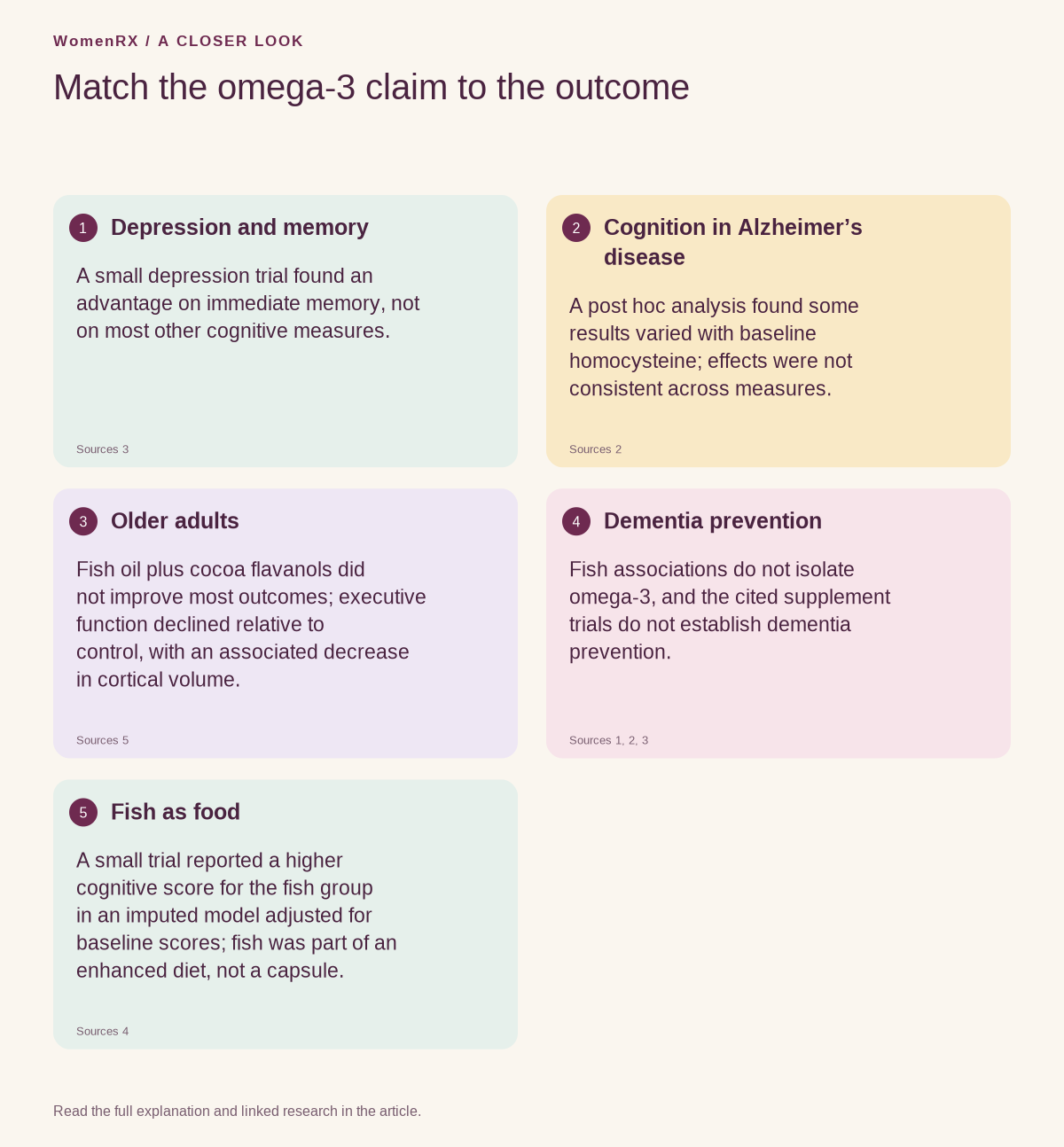
Match the omega-3 claim to the outcome
Depression and memory: A small depression trial found an advantage on immediate memory, not on most other cognitive measures.3
Cognition in Alzheimer’s disease: A post hoc analysis found some results varied with baseline homocysteine; effects were not consistent across measures.2
Older adults: Fish oil plus cocoa flavanols did not improve most outcomes; executive function declined relative to control, with an associated decrease in cortical volume.5
Dementia prevention: Fish associations do not isolate omega-3, and the cited supplement trials do not establish dementia prevention.123
Fish as food: A small trial reported a higher cognitive score for the fish group in an imputed model adjusted for baseline scores; fish was part of an enhanced diet, not a capsule.4
Read the figure as text
These findings answer different questions; a result in one group or outcome shouldn’t be stretched into a general brain-health promise.- Depression and memory: A small depression trial found an advantage on immediate memory, not on most other cognitive measures.3
- Cognition in Alzheimer’s disease: A post hoc analysis found some results varied with baseline homocysteine; effects were not consistent across measures.2
- Older adults: Fish oil plus cocoa flavanols did not improve most outcomes; executive function declined relative to control, with an associated decrease in cortical volume.5
- Dementia prevention: Fish associations do not isolate omega-3, and the cited supplement trials do not establish dementia prevention.123
- Fish as food: A small trial reported a higher cognitive score for the fish group in an imputed model adjusted for baseline scores; fish was part of an enhanced diet, not a capsule.4
Sources you can check
- Omega-3 Fatty Acids - Health Professional Fact SheetAccessed 2026-09-25Return to first citation
- Homocysteine Status Modifies the Treatment Effect of Omega-3 Fatty Acids on Cognition in a Randomized Clinical Trial in Mild to Moderate Alzheimer's Disease: The OmegAD Study.Jernerén F, Cederholm T, Refsum H, Smith AD, Turner C, Palmblad J, Eriksdotter M, Hjorth E, Faxen-Irving G, Wahlund LO, Schultzberg M, Basun H, Freund-Levi Y. · Journal of Alzheimer's disease : JAD · 2019Return to first citation
- Omega-3 polyunsaturated fatty acids supplementation improves memory in first-diagnosed, drug-naïve patients with depression: Secondary analysis of data from a randomized controlled trial.Xue Y, Wang L, Liu T, Zhao T, Xie K, Guo J, Chen J, Tang H, Tang M. · Journal of affective disorders · 2024Return to first citation
- Twelve Weeks of Additional Fish Intake Improves the Cognition of Cognitively Intact, Resource-Limited Elderly People: A Randomized Control Trial.Kühn L, MacIntyre UE, Kotzé C, Becker PJ, Wenhold FAM. · The journal of nutrition, health & aging · 2022Return to first citation
- A combined DHA-rich fish oil and cocoa flavanols intervention does not improve cognition or brain structure in older adults with memory complaints: results from the CANN randomized, controlled parallel-design study.Vauzour D, Scholey A, White DJ, Cohen NJ, Cassidy A, Gillings R, Irvine MA, Kay CD, Kim M, King R, Legido-Quigley C, Potter JF, Schwarb H, Minihane AM. · The American journal of clinical nutrition · 2023Return to first citation