Can Omega-3 Help Joint Pain? Match the Evidence to the Cause
Omega-3 research is more relevant to inflammatory arthritis than to everyday aches, and the results don’t show that it repairs joints.
Omega-3 may be worth discussing as an add-on for diagnosed inflammatory arthritis, but the evidence comes from studies of different polyunsaturated fats, not omega-3 alone in every trial. For osteoarthritis, the available review studied whole-diet changes, so it can’t tell you whether a supplement helps. Menopause can also bring joint aches, but these findings don’t establish how omega-3 affects them. 1 3 4
Joint pain is a symptom, not a diagnosis
A sore joint can follow an injury or repetitive activity, or be related to a longer-term condition such as arthritis. The pattern can offer clues: osteoarthritis pain may worsen with walking, while rheumatoid arthritis can involve stiffness on both sides that feels worse after rest. These clues don’t diagnose the cause, but they show why a supplement study for one condition may not apply to another. 1
Perimenopause and menopause can also contribute to aching, painful joints. That possibility doesn’t mean every new ache at this stage has the same cause, or that the arthritis research applies to menopause-related symptoms. 1
Inflammatory arthritis: a possible add-on, not a replacement
A systematic review and meta-analysis combined 30 randomized trials in people with inflammatory rheumatic diseases, most of whom had rheumatoid arthritis. The trials tested polyunsaturated fatty acid supplements, including omega-3 and omega-6 interventions. Across this mixed group of interventions, the review found improvements in pain, tender and swollen joint counts, disease-activity scores, and physical-function scores. It also found a decrease in erythrocyte sedimentation rate, but not in C-reactive protein. 4
The review’s more specific conclusion was that polyunsaturated fats, especially animal-source omega-3, may improve inflammatory disease activity and could be an add-on for rheumatoid arthritis. That is a possibility, not a substitute for arthritis treatment. The findings also don’t establish whether the benefits differ by sex, or prove that omega-3 prevents or reverses joint damage. 4
The review reported that most studies examined high-dose supplementation, often above 2 grams a day. That describes the research; it isn’t a recommended amount for you. Omega-3s include ALA, EPA, and DHA. EPA and DHA are the long-chain types, but a product’s omega-3 label alone doesn’t mean it matches the interventions studied. 2 4
Osteoarthritis: food-pattern findings aren’t capsule findings
For osteoarthritis, a 2024 systematic review assessed dietary-change trials. Seven randomized trials and one nonrandomized trial were included. Participants encouraged to eat diets higher in plant phenols and omega-3 fats reported improvements in pain and physical function. The studies varied too much for the researchers to combine their results into one estimate, and the review judged the evidence limited because of high risk of bias. 3
These were changes to overall diets, not a clear test of omega-3 capsules on their own. The findings therefore can’t show that a supplement caused the reported improvements. And pain or function changes don’t establish that cartilage was repaired or osteoarthritis progression slowed. 3
What to take from the evidence
If you have diagnosed inflammatory arthritis, the research supports asking whether omega-3 fits alongside your current treatment, rather than replacing it. The outcomes studied included symptoms and disease-activity measures; they don’t show that a supplement repairs joints. If you’re considering it for osteoarthritis, keep in mind that the reviewed evidence was about combined dietary changes, not a standalone supplement. 3 4
If the cause of your pain isn’t clear, choosing a supplement by symptom alone may miss the more useful next step: finding out what is causing it. Seek prompt medical attention for a hot, swollen joint, especially if you also have a fever or feel unwell, because joint infection is one possible cause. 1
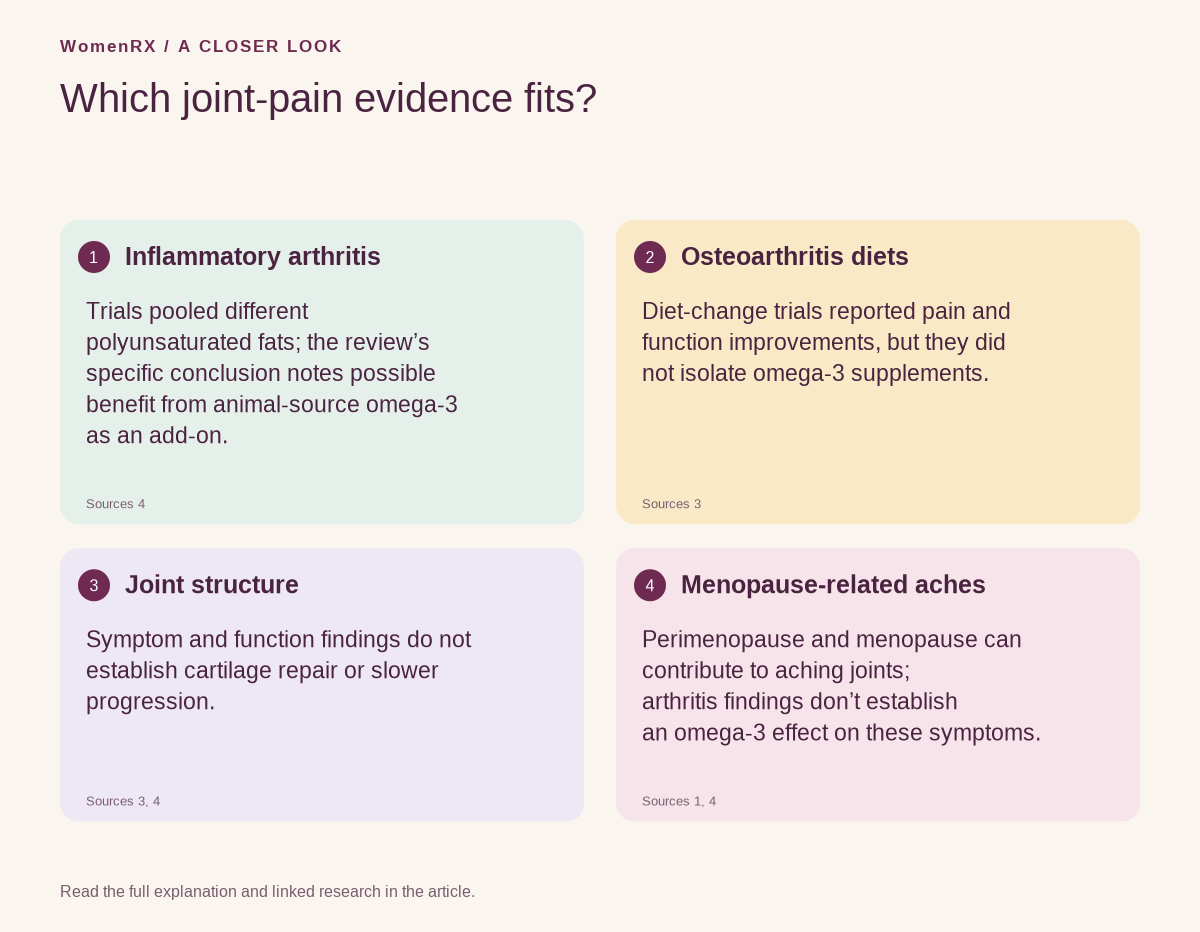
Which joint-pain evidence fits?
Inflammatory arthritis: Trials pooled different polyunsaturated fats; the review’s specific conclusion notes possible benefit from animal-source omega-3 as an add-on.4
Osteoarthritis diets: Diet-change trials reported pain and function improvements, but they did not isolate omega-3 supplements.3
Joint structure: Symptom and function findings do not establish cartilage repair or slower progression.34
Menopause-related aches: Perimenopause and menopause can contribute to aching joints; arthritis findings don’t establish an omega-3 effect on these symptoms.14
Read the figure as text
The condition studied and the outcome measured determine what omega-3 research can reasonably tell you.- Inflammatory arthritis: Trials pooled different polyunsaturated fats; the review’s specific conclusion notes possible benefit from animal-source omega-3 as an add-on.4
- Osteoarthritis diets: Diet-change trials reported pain and function improvements, but they did not isolate omega-3 supplements.3
- Joint structure: Symptom and function findings do not establish cartilage repair or slower progression.34
- Menopause-related aches: Perimenopause and menopause can contribute to aching joints; arthritis findings don’t establish an omega-3 effect on these symptoms.14
More questions, answered
Does omega-3 rebuild cartilage?
The findings described here don’t show cartilage repair. The inflammatory-arthritis review assessed symptoms and disease-activity measures, and the osteoarthritis review assessed pain and function after dietary changes. Neither establishes that omega-3 rebuilds cartilage or slows joint damage. 3 4
Sources you can check
- Joint pain - NHSAccessed 2026-09-25Return to first citation
- Omega-3 Fatty Acids - Health Professional Fact SheetAccessed 2026-09-25Return to first citation
- Diet modification reduces pain and improves function in adults with osteoarthritis: a systematic review.Stanfar K, Hawes C, Ghajar M, Byham-Gray L, Radler DR. · Journal of human nutrition and dietetics : the official journal of the British Dietetic Association · 2024Return to first citation
- Impact of type and dose of oral polyunsaturated fatty acid supplementation on disease activity in inflammatory rheumatic diseases: a systematic literature review and meta-analysis.Sigaux J, Mathieu S, Nguyen Y, Sanchez P, Letarouilly JG, Soubrier M, Czernichow S, Flipo RM, Sellam J, Daïen C. · Arthritis research & therapy · 2022Return to first citation