Joint Pain in Your 40s: Could Perimenopause Be One Factor?
Perimenopause can come with aching joints, but age and aches alone can’t tell you why a joint hurts.
Yes, perimenopause may be one factor: aching or painful joints are recognized menopause symptoms. But joint pain in your 40s isn’t proof of a hormonal cause. Changes in your periods or other menopause symptoms can make the transition relevant context, while the pain’s pattern, activity triggers, swelling, and any injury help point toward other explanations. No single symptom confirms perimenopause. 1 3
Start with two questions, not one
A new ache in your 40s can prompt a reasonable question: could this be perimenopause? It could. Perimenopause and menopause can include aching or painful joints, which NHS guidance links to lower estrogen levels. But that possibility doesn’t explain every ache, and age alone can’t identify the cause. 1
It helps to separate two questions: Could I be in the menopause transition? And what might be causing this particular joint pain? Period changes and symptoms such as hot flashes, night sweats, or vaginal dryness can help put the first question in context. They don’t prove that hormones are causing a sore knee, hand, or hip. No single symptom or test reliably confirms or rules out perimenopause. 3
What the pain pattern can tell you
Notice where the pain is, when it started, and what changes it. These patterns can offer clues, not a diagnosis:
- After a strain or a jump in activity: Pain, swelling, or bruising after intense or repetitive exercise can fit a sprain or strain. 1
- With walking or after activity: Pain that worsens while walking and stiffness after activity may fit osteoarthritis, particularly in people over 45. 1
- On both sides, with stiffness after resting: Pain and stiffness on both sides of the body that are worse after not moving can occur with rheumatoid arthritis. 1
- A suddenly hot, swollen joint: A joint infection is one possible cause, especially if you also feel feverish or unwell. 1
These patterns overlap, so don’t use them to diagnose yourself. Perimenopause can be part of the picture even when another joint issue also deserves attention. 1
Use cycle changes as context, not a verdict
If your periods have become irregular or changed from their usual pattern, mention that alongside your joint symptoms. Period patterns often shift as menopause approaches, but irregular periods can also have other causes. 2 A review of studies in women aged 40 and older found that age, menstrual history, and symptoms can inform a clinician’s assessment of perimenopause, but no one symptom or test is accurate enough on its own. That research does not establish that cycle changes identify the cause of joint pain. 3
A useful way to organize what you notice is to jot down when the pain began, which joints hurt, whether it followed an injury or activity change, and whether movement or rest affects it. Keep period timing and other menopause symptoms in a separate note. This is not a diagnostic score; it gives you a clearer account of both the joint problem and the broader context.
When a joint needs prompt attention
Seek urgent medical assessment if a joint is hot and swollen, or if joint pain comes with fever, chills, or feeling generally unwell. Joint infection is one possible explanation. If you have very bad joint pain after a fall or injury, or you can’t walk or put weight on the joint, go to an emergency department immediately. 1
If pain is worsening, keeps returning, affects sleep, or gets in the way of normal activities, arrange an assessment rather than assuming it is hormonal. 1 The practical takeaway: cycle changes may make perimenopause worth discussing, but the joint’s symptoms and circumstances still matter.
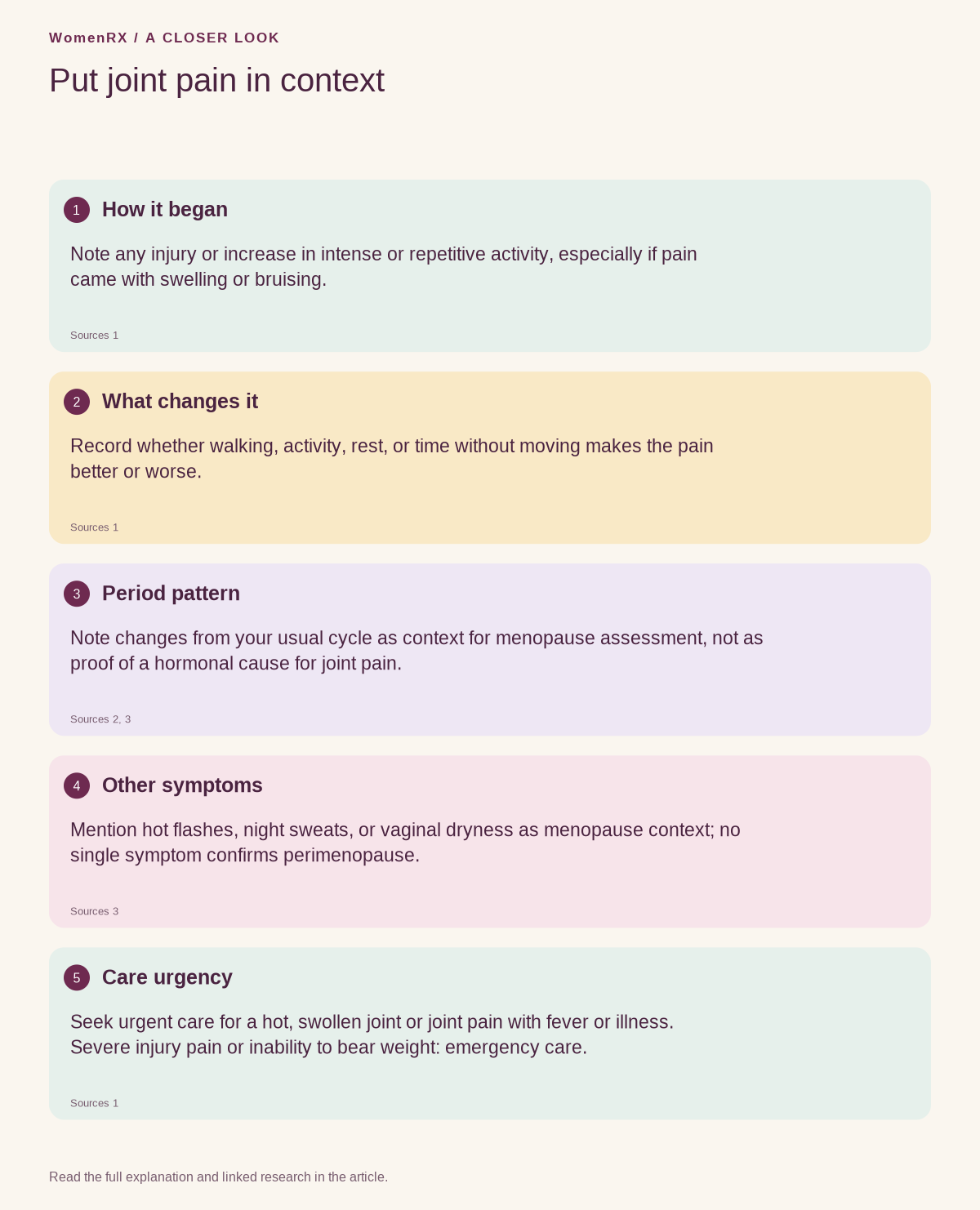
Put joint pain in context
How it began: Note any injury or increase in intense or repetitive activity, especially if pain came with swelling or bruising.1
What changes it: Record whether walking, activity, rest, or time without moving makes the pain better or worse.1
Period pattern: Note changes from your usual cycle as context for menopause assessment, not as proof of a hormonal cause for joint pain.23
Other symptoms: Mention hot flashes, night sweats, or vaginal dryness as menopause context; no single symptom confirms perimenopause.3
Care urgency: Seek urgent care for a hot, swollen joint or joint pain with fever or illness. Severe injury pain or inability to bear weight: emergency care.1
Read the figure as text
Separate clues about the joint itself from menstrual and menopause context. These prompts can organize what you notice; they do not diagnose the cause.- How it began: Note any injury or increase in intense or repetitive activity, especially if pain came with swelling or bruising.1
- What changes it: Record whether walking, activity, rest, or time without moving makes the pain better or worse.1
- Period pattern: Note changes from your usual cycle as context for menopause assessment, not as proof of a hormonal cause for joint pain.23
- Other symptoms: Mention hot flashes, night sweats, or vaginal dryness as menopause context; no single symptom confirms perimenopause.3
- Care urgency: Seek urgent care for a hot, swollen joint or joint pain with fever or illness. Severe injury pain or inability to bear weight: emergency care.1
Sources you can check
- Joint pain - NHSAccessed 2026-09-25Return to first citation
- Irregular periods - NHSAccessed 2026-09-25Return to first citation
- Is this woman perimenopausal?Bastian LA, Smith CM, Nanda K. · JAMA · 2003Return to first citation