Insomnia in Your 40s: Could Perimenopause Be One Factor?
Night sweats that wake you and changes in your periods may be useful context, but age alone can’t explain a sleep problem.
Perimenopause could be one factor, especially if waking episodes coincide with hot flashes or night sweats. But sleep problems can also occur without those symptoms, and night sweats have causes beyond menopause. Note when you wake, what you experience, any cycle changes, and possible contributors such as stress, pain, medicines, alcohol, or caffeine. That pattern can help guide a fuller assessment. 1 2 5
Look for a pattern, not an age-based answer
Being in your 40s doesn’t, by itself, establish that you’re in perimenopause or explain why you’re sleeping poorly. Instead, look at what happens around the awakenings. Do you wake feeling suddenly hot or sweaty? Are you regularly waking with soaking-wet clothes or bedding, even when the room is cool? Does that happen alongside changes in your menstrual cycle? Those details can help describe what’s going on, but none alone confirms the cause.
Sleep disruption and vasomotor symptoms, such as hot flashes and night sweats, can overlap during the menopausal transition. But the connection isn’t one-to-one: a study protocol’s background review describes women with sleep problems but no vasomotor symptoms, as well as women with substantial vasomotor symptoms whose sleep isn’t disturbed. Addressing hot flashes may help some sleep problems without resolving every reason for waking. 5
Make a short, useful sleep record
For a couple of weeks, jot down a few details when sleep is disrupted. This isn’t a diagnostic test; it’s a way to see whether a pattern is emerging and explain it clearly.
- Cycle context: Note the first day of bleeding and any changes in timing or flow you’ve noticed. Avoid treating a single cycle change as proof that hormones caused insomnia.
- What woke you: Record whether you felt hot, sweaty, anxious, uncomfortable, or simply awake. If you were sweating, note whether your clothes or bedding were soaked and whether the room felt cool.
- Sleep pattern: Note trouble falling asleep, repeated waking, early waking, and how rested or sleepy you feel the next day. These are common ways insomnia shows up. 2
- Other possible contributors: Include stress, pain, medicines or supplements, caffeine, tobacco, and alcohol. These can be relevant to sleep problems; some medicines and substances can contribute to insomnia. 2 3
- Signs of another sleep problem: Mention loud snoring or restless legs if they’re part of the picture. Sleep apnea and restless legs are among the sleep disorders considered in menopause-related sleep assessment. 6
The point isn’t to track every detail indefinitely. It’s to see whether awakenings repeatedly line up with sweating, cycle changes, a stressful stretch, a medicine change, or something else.
Night sweats aren’t always hormonal
Ordinary sweating can happen when bedding or a room is too warm. Night sweats usually means sweating enough to soak sleepwear or bedding despite a cool sleeping environment. Menopause symptoms are one possible cause, but anxiety, alcohol or drug use, and other conditions can also be involved; sometimes the cause isn’t clear. 1
If you’re regularly waking with soaking-wet sheets, or the episodes worry you, arrange an evaluation rather than assuming they’re perimenopause. Make sure to mention other symptoms, including an unexplained fever or chills, cough, diarrhea, or unintentional weight loss. 1
Consider the whole sleep picture
Insomnia can mean trouble falling asleep, staying asleep, or both. Stress is a common short-term trigger. Ongoing problems can also relate to medical conditions, medicines, pain, caffeine, tobacco, alcohol, or another sleep disorder. 2 3
A useful distinction is whether something is repeatedly waking you, or whether you’re awake without an obvious trigger. Repeated hot, sweaty awakenings may make vasomotor symptoms worth discussing. Waking with pain, worries, or no clear trigger points to other parts of the picture worth exploring too. This isn’t a way to diagnose yourself; it helps avoid settling on a hormonal explanation before considering alternatives.
If poor sleep has lasted for months, affects your ability to manage daily life, or hasn’t improved with changes to your sleep habits, seek care. An evaluation may include your medical and sleep history and a physical exam; a sleep study may be considered when appropriate. 2 3
Treat the cause you actually have
If hot flashes or night sweats are part of the problem, treatments for menopausal vasomotor symptoms may be relevant. The North American Menopause Society describes hormone therapy as the most effective treatment for vasomotor symptoms, while also emphasizing that benefits and risks vary by person and treatment factors. That doesn’t mean hormone therapy is the answer to every case of insomnia. 4
Sleep problems may need their own attention, especially if you keep waking after hot flashes improve or never had them in the first place. The evidence base for treating insomnia specifically in perimenopause is still developing: a 2025 study record is a protocol for a planned comparison, not results showing which approach worked. 5
Your notes can help you explain what’s changed and ask what causes fit the pattern. The goal is not to label every restless night hormonal, but to find the most plausible reasons for yours.
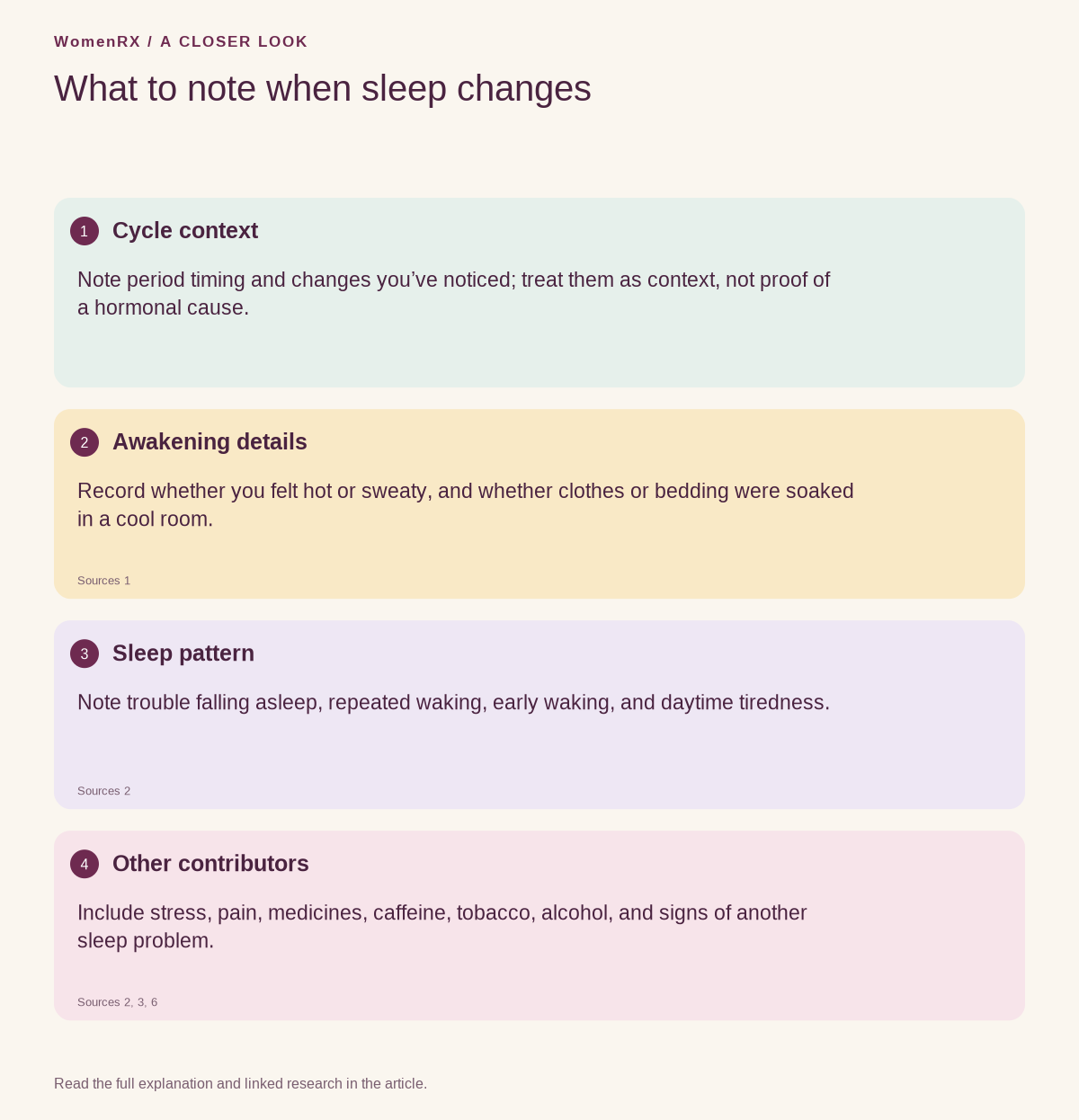
What to note when sleep changes
Cycle context: Note period timing and changes you’ve noticed; treat them as context, not proof of a hormonal cause.
Awakening details: Record whether you felt hot or sweaty, and whether clothes or bedding were soaked in a cool room.1
Sleep pattern: Note trouble falling asleep, repeated waking, early waking, and daytime tiredness.2
Other contributors: Include stress, pain, medicines, caffeine, tobacco, alcohol, and signs of another sleep problem.236
Read the figure as text
Use these prompts to describe the pattern and possible contributors without assuming that a symptom or your age identifies the cause.- Cycle context: Note period timing and changes you’ve noticed; treat them as context, not proof of a hormonal cause.
- Awakening details: Record whether you felt hot or sweaty, and whether clothes or bedding were soaked in a cool room.1
- Sleep pattern: Note trouble falling asleep, repeated waking, early waking, and daytime tiredness.2
- Other contributors: Include stress, pain, medicines, caffeine, tobacco, alcohol, and signs of another sleep problem.236
More questions, answered
Can you have perimenopause-related sleep problems without night sweats?
Yes. Sleep problems can occur without vasomotor symptoms, and some people with vasomotor symptoms don’t report disturbed sleep. Night sweats are a clue to discuss, not a requirement for considering other causes of sleep disruption. 5
When should I get repeated night sweats checked?
Arrange an evaluation if you regularly wake with soaking-wet clothes or bedding, or if the sweating worries you. Mention accompanying symptoms such as fever or chills, cough, diarrhea, or unexplained weight loss. 1
Sources you can check
- Night sweats - NHSAccessed 2026-09-25Return to first citation
- Insomnia | MedlinePlusAccessed 2026-09-25Return to first citation
- Insomnia - NHSAccessed 2026-09-25Return to first citation
- The 2022 hormone therapy position statement of The North American Menopause Society.“The 2022 Hormone Therapy Position Statement of The North American Menopause Society” Advisory Panel. · Menopause (New York, N.Y.) · 2022Return to first citation
- No more sleepless nights in perimenopause-an open-label, randomized, parallel-group, active controlled intervention study in perimenopausal women with vasomotor symptoms and insomnia to investigate the efficacy of hormone replacement therapy and cognitive behavioral therapy for the treatment of insomnia: study protocol.Pavicic E, Stute P, Rudzik F, Urech A, Lozza-Fiacco S. · Trials · 2025Return to first citation
- Sleep Disruption in the Menopausal Transition and Postmenopause: A Narrative Review.Lyu AC, Kravitz HM. · Obstetrics and gynecology · 2026Return to first citation