Low Sex Drive in Your 40s: Could Perimenopause Be One Factor?
Perimenopause can contribute to changes in desire, but comfort, health, mood, medicines, and relationship context can matter too.
Yes, perimenopause can be one factor: a U.S. study following women through midlife found that desire decreased by late perimenopause. But the transition wasn’t independently linked to every part of sexual function, and desire can have more than one contributor. Pain or dryness, health conditions, medicines, mood, and relationship changes may be relevant; sleep changes are also worth mentioning, without assuming they caused the change. 6 4 1 3
A change in sexual desire in your 40s can be connected to perimenopause, but it doesn’t automatically mean your hormones are “low” or that you need hormone treatment. Desire is one part of sexual function, and it can shift for several reasons at once.
What research says about perimenopause and desire
In a U.S. study that followed 3,302 women ages 42 to 52, desire decreased by late perimenopause. Vaginal or pelvic pain also became more likely. But after accounting for other factors, the transition wasn’t independently associated with every outcome researchers measured, including sexual frequency, arousal, or satisfaction with a partner. How often you have sex and how much you want it aren’t the same thing. 6
This study shows a pattern across a group, not what’s causing a change for any one person. Being in your 40s doesn’t by itself confirm perimenopause, and a change in desire alone can’t identify its cause.
Consider comfort, health, and context
If sex has become uncomfortable, dryness or pain may be part of the picture. Menopause-related genitourinary symptoms can be discussed and treated separately from desire itself. A menopause position statement lists vaginal estrogen and other options for bothersome genitourinary symptoms in some situations; that doesn’t mean these treatments are right for everyone or that they directly address every kind of low desire. 2
Desire can also be affected by physical health, psychological well-being, and relationship dynamics. Medicines and chronic conditions are other possible contributors. For example, consider whether a health or medicine change happened around the same time as your interest in sex changed. These are possibilities to explore, not proof of a cause. 6 4 1
Sleep and mood are worth mentioning as part of the wider picture. Reviewed menopause guidelines include disturbed sleep and mood changes among symptoms associated with the transition. A study of partnered midlife women in China found sleep problems were associated with lower sexual frequency, but it didn’t establish that sleep problems caused that change or that the finding applies to desire. 3 5
Prompts to help sort out what changed
You don’t need to arrive with a diagnosis. It may help to describe what changed and what else was happening around that time. You could jot down:
- Desire: Is interest lower in general, or does it vary by situation?
- Comfort: Is there dryness, pain, or another change during sex?
- Health and medicines: Did a health condition, treatment, or medicine change around the same time?
- Sleep and mood: Have sleep or mood changed too? These details add context, but don’t prove a cause.
- Relationship and circumstances: Has closeness, privacy, conflict, or another part of your situation shifted?
- What you want help with: Is the main concern desire, discomfort, distress, or a mix?
These prompts help organize the conversation; they aren’t a test or a way to diagnose yourself. If the change bothers you or affects your well-being or relationship, or comes with pain or dryness, it’s reasonable to bring it up with a clinician. You can ask what might be contributing and whether there are options that fit the specific concern. Hormone therapy decisions depend on the symptoms being treated and an individual assessment, not simply on age or a change in sex drive. 2
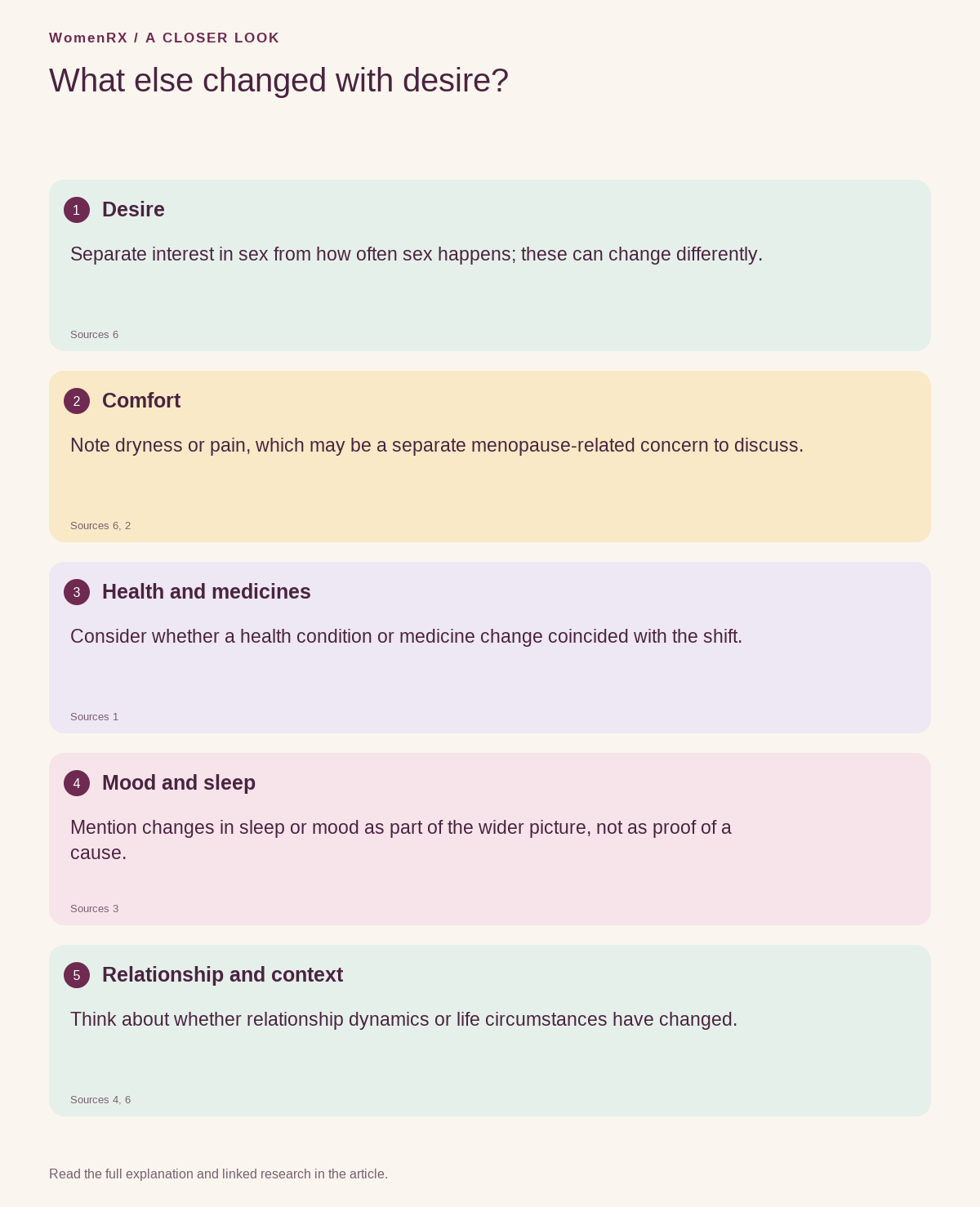
What else changed with desire?
Desire: Separate interest in sex from how often sex happens; these can change differently.6
Comfort: Note dryness or pain, which may be a separate menopause-related concern to discuss.62
Health and medicines: Consider whether a health condition or medicine change coincided with the shift.1
Mood and sleep: Mention changes in sleep or mood as part of the wider picture, not as proof of a cause.3
Relationship and context: Think about whether relationship dynamics or life circumstances have changed.46
Read the figure as text
Use these prompts to organize what you’ve noticed. They are conversation starters, not a diagnostic checklist.- Desire: Separate interest in sex from how often sex happens; these can change differently.6
- Comfort: Note dryness or pain, which may be a separate menopause-related concern to discuss.62
- Health and medicines: Consider whether a health condition or medicine change coincided with the shift.1
- Mood and sleep: Mention changes in sleep or mood as part of the wider picture, not as proof of a cause.3
- Relationship and context: Think about whether relationship dynamics or life circumstances have changed.46
More questions, answered
Does having sex less often mean my desire is low?
Not necessarily. Frequency and desire are different measures. In a U.S. study following women through the menopause transition, desire decreased by late perimenopause, while the transition wasn’t independently associated with sexual frequency. 6
Does low desire mean I need hormone treatment?
No. A change in desire alone doesn’t establish that hormones are the cause or that hormone treatment is appropriate. The symptoms you’re trying to address, such as bothersome genitourinary symptoms, and your individual circumstances matter to treatment decisions. 2
Sources you can check
- Sexual Health | MedlinePlusAccessed 2026-09-25Return to first citation
- The 2022 hormone therapy position statement of The North American Menopause Society.“The 2022 Hormone Therapy Position Statement of The North American Menopause Society” Advisory Panel. · Menopause (New York, N.Y.) · 2022Return to first citation
- A systematic review and critical appraisal of menopause guidelines.Hemachandra C, Taylor S, Islam RM, Fooladi E, Davis SR. · BMJ sexual & reproductive health · 2024Return to first citation
- Sexual Function Through Menopause: A Review of Basic Evaluation and Treatment.Pope R. · BJOG : an international journal of obstetrics and gynaecology · 2025Return to first citation
- Prevalence and predictors of sexual function in midlife partnered Chinese women assessed by two simple indicators: Sexual frequency and sexual desire.Zhou Y, Li C, Jin F, Shao H, Teng Y, Tao M. · The journal of obstetrics and gynaecology research · 2019Return to first citation
- Longitudinal changes in sexual functioning as women transition through menopause: results from the Study of Women's Health Across the Nation.Avis NE, Brockwell S, Randolph JF, Shen S, Cain VS, Ory M, Greendale GA. · Menopause (New York, N.Y.) · 2009Return to first citation