Higher Sex Drive After Menopause: Possible Reasons
Desire can change after menopause, and a higher sex drive doesn’t by itself reveal a hormone level or mean something is wrong.
Sexual desire varies, including after menopause. A U.S. study found lower desire on average by late perimenopause, but it can’t predict what any one woman will experience after menopause or explain an increase. Health, psychological well-being, relationships, and medicines can provide useful context. If a change is sudden and unwanted, or comes with a notable mood or health change, consider discussing it. 31
A change in desire isn’t a hormone test
A stronger sex drive after menopause may feel welcome, surprising, or uncomfortable. It doesn’t, on its own, show that your testosterone or another hormone is high or low. The relationship between hormone changes and sexual function is not simple, and the exact connection remains under study. 4
Desire is only one part of sexual experience. Arousal, physical comfort, pleasure, and satisfaction can change independently. In a U.S. longitudinal study of 3,302 women, researchers tracked different aspects of sexual function as participants moved through the menopause transition. On average, desire decreased by late perimenopause and vaginal or pelvic pain became more likely. After accounting for other factors, the transition was not independently associated with several other outcomes, including arousal and emotional satisfaction with a partner. 3
Those are group patterns during the transition, not a rule for every woman or a forecast for life after menopause. The study doesn’t tell us how common increased desire is in postmenopause. Averages can’t explain an individual change.
Look at the surrounding context
Desire can sit alongside changes in health, mood, relationships, or medicines. In the study, health and psychological functioning were related to sexual-function outcomes; relationship changes, marital status, and vaginal dryness were associated with some outcomes. These findings describe associations, not proof of what caused a particular change. 3
Medicines can affect sexual desire or performance. Chronic health conditions can affect sexual health more broadly. 1 For example, a shift in interest might happen around a new medication, a change in well-being, or a change in a relationship. That timing may be worth mentioning, but it doesn’t establish the cause.
Desire and comfort can also move in different directions. Wanting sex more doesn’t necessarily mean sex feels comfortable. If vaginal dryness or discomfort is an issue, it’s separate from libido; treatments are available for bothersome genitourinary symptoms of menopause, with options depending on a person’s situation. 2
When a check-in may help
If increased desire feels welcome and isn’t causing difficulty, it doesn’t need to be treated as a problem simply because it changed after menopause. If it is sudden and unwanted, feels difficult to manage, or arrives alongside a noticeable mood or health change, it’s reasonable to discuss it with a healthcare provider. Health and psychological functioning are relevant context for sexual function, and medicines can affect desire or performance. 31
You can start with what matters most to you: whether the change feels good or unwanted, when you noticed it, and whether your mood, health, relationships, or medicines changed around the same time. That gives the conversation useful context without assuming that menopause or one hormone explains everything.
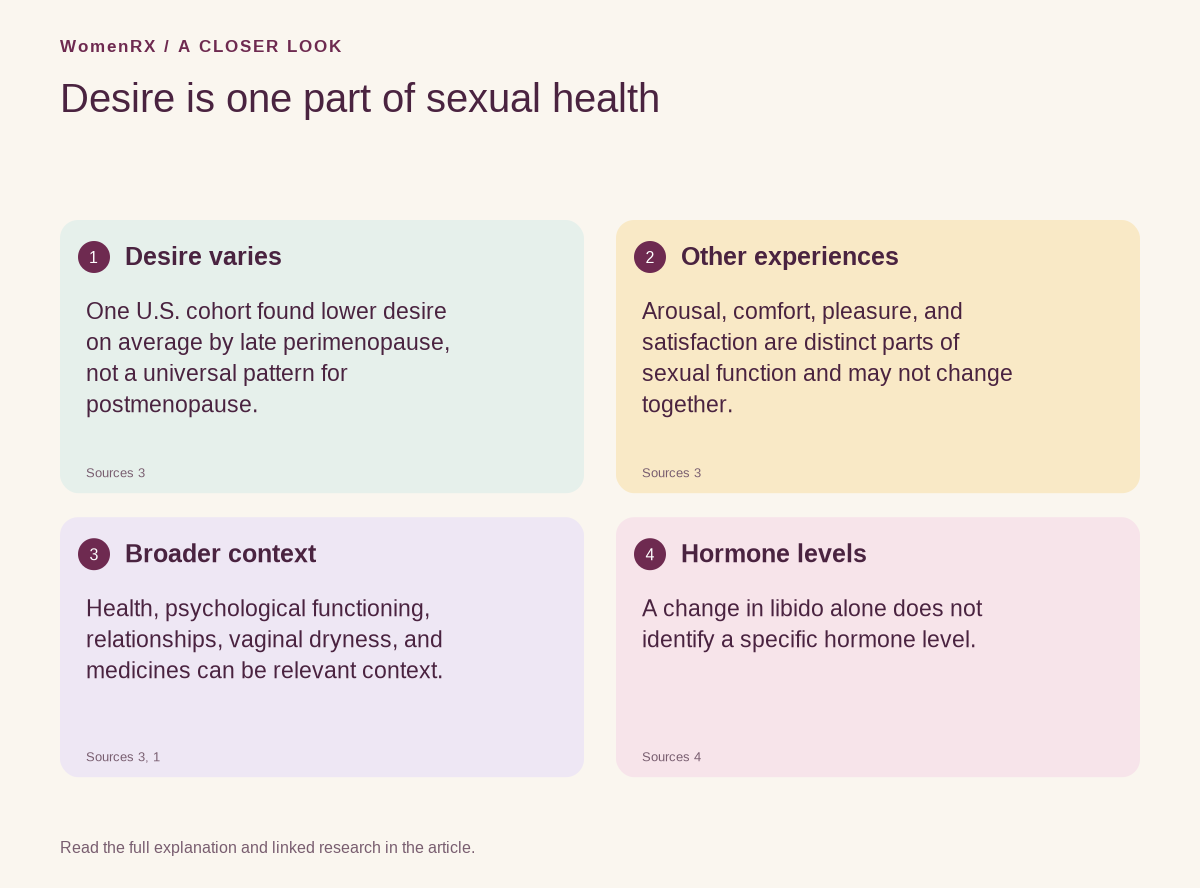
Desire is one part of sexual health
Desire varies: One U.S. cohort found lower desire on average by late perimenopause, not a universal pattern for postmenopause.3
Other experiences: Arousal, comfort, pleasure, and satisfaction are distinct parts of sexual function and may not change together.3
Broader context: Health, psychological functioning, relationships, vaginal dryness, and medicines can be relevant context.31
Hormone levels: A change in libido alone does not identify a specific hormone level.4
Read the figure as text
These distinctions help put a change in desire in context without treating one pattern as the rule after menopause.- Desire varies: One U.S. cohort found lower desire on average by late perimenopause, not a universal pattern for postmenopause.3
- Other experiences: Arousal, comfort, pleasure, and satisfaction are distinct parts of sexual function and may not change together.3
- Broader context: Health, psychological functioning, relationships, vaginal dryness, and medicines can be relevant context.31
- Hormone levels: A change in libido alone does not identify a specific hormone level.4
More questions, answered
Does higher desire mean my testosterone is high?
Not by itself. Hormone status and sexual function don’t have a simple, settled one-to-one relationship, so a change in desire can’t identify a particular hormone level. 4
Sources you can check
- Sexual Health | MedlinePlusAccessed 2026-09-25Return to first citation
- The 2022 hormone therapy position statement of The North American Menopause Society.“The 2022 Hormone Therapy Position Statement of The North American Menopause Society” Advisory Panel. · Menopause (New York, N.Y.) · 2022Return to first citation
- Longitudinal changes in sexual functioning as women transition through menopause: results from the Study of Women's Health Across the Nation.Avis NE, Brockwell S, Randolph JF, Shen S, Cain VS, Ory M, Greendale GA. · Menopause (New York, N.Y.) · 2009Return to first citation
- Effects of hormone replacement therapy on sexual psychophysiology and behavior in postmenopause.Sarrel PM. · Journal of women's health & gender-based medicine · 2000Return to first citation