How Desire Can Shift Before and After Menopause
Research finds changes in desire across both stages, but it doesn’t point to one predictable timeline for every woman.
A U.S. study that followed women over time found that reported desire decreased by late perimenopause. A smaller clinic study found lower desire scores in early postmenopause than in early transition. Together, they suggest change can occur across both stages, but they don’t show when or how much desire will change for an individual. 2 3
There isn’t one menopause-stage switch
Research suggests sexual desire may change during perimenopause and after menopause, but it doesn’t establish a universal pattern or a precise point when desire changes. A group average can describe what happened in a study without predicting what you’ll experience.
It also matters what a study means by “desire.” One may ask how often someone feels desire; another may use a questionnaire score. Those measures aren’t the same as how often someone has sex, how satisfying sex feels, or whether a change is troubling.
What the studies found at each stage
A large U.S. study followed 3,302 women, ages 42 to 52 at the start, for six annual follow-ups. Participants rated how often they felt desire, along with other aspects of sexual function. After adjusting for age and relevant social, health, and psychological factors, reported desire decreased by late perimenopause. The study also found increased reports of vaginal or pelvic pain. The transition wasn’t independently associated with every outcome: for example, sexual frequency and emotional satisfaction with a partner were not independently related to the transition in the adjusted analysis. 2
A smaller study assessed 138 women who had sought clinic care for hot flashes. It compared women in early transition, late perimenopause, and early postmenopause using the Female Sexual Function Index, which includes a desire score. In that sample, desire scores were lower in early postmenopause than in early transition. Because this was a one-time comparison in a clinic sample, it can’t show how any one woman’s desire changed as she moved between stages. 3
A separate study of partnered women in Shanghai found postmenopause was associated with lower desire scores. It adds evidence from a different population, but its group-level finding still isn’t a forecast for an individual woman. 1
Taken together, these findings suggest changes may be evident by late perimenopause and may also be seen in early postmenopause. They don’t establish a sharp dividing line between the stages or a single trajectory that applies to everyone.
What a stage label can, and can’t, tell you
In the clinic study, researchers categorized stage using menstrual patterns: early transition meant cycles had become at least seven days different from usual; late perimenopause meant at least 60 days without a period; and early postmenopause meant 12 months or more without a period, but less than four years. These were the study’s categories, not thresholds that show when desire must change. 3
The studies also measured desire differently. The U.S. study asked about frequency of desire over time. The clinic study compared questionnaire scores at one point in time. A lower score in one group and a decline over time in another aren’t identical findings, so it’s best not to treat them as a precise stage-by-stage comparison. 2 3
Desire is only one part of sexual experience. In the U.S. study, pain reports increased over the transition, while the transition wasn’t independently associated with outcomes such as intercourse frequency, arousal, emotional satisfaction, or physical pleasure. Health, psychological functioning, relationship status or changes, and vaginal dryness were also associated with sexual-function outcomes. These findings show why a change in desire can’t automatically be explained by menopausal stage alone; they don’t identify the cause of a change for one person. 2
For example, if sex has become uncomfortable, desire and comfort may not feel like separate issues in everyday life. But studies that measure them as separate outcomes shouldn’t be read as though one automatically explains the other. The useful takeaway is that stage is context, not a prediction: desire, sexual activity, comfort, and satisfaction can each tell a different part of the story.
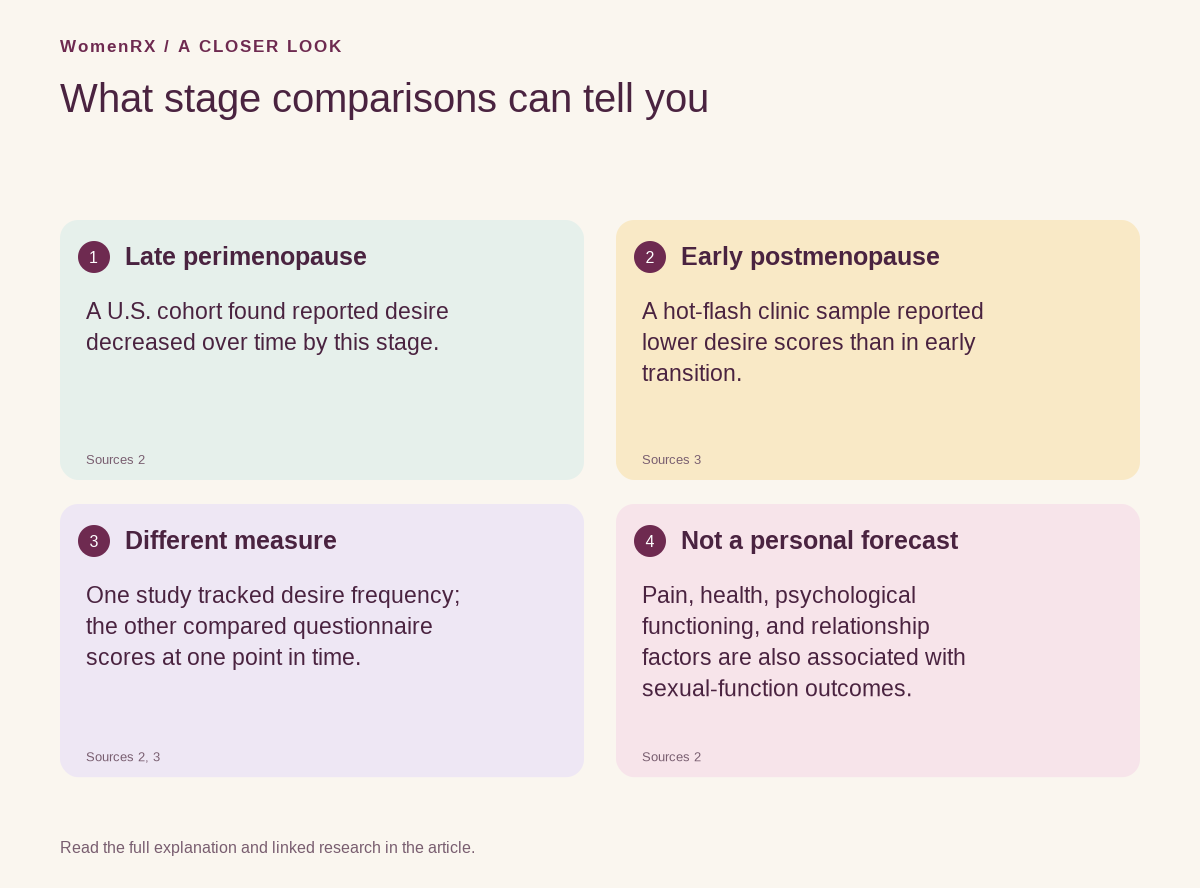
What stage comparisons can tell you
Late perimenopause: A U.S. cohort found reported desire decreased over time by this stage.2
Early postmenopause: A hot-flash clinic sample reported lower desire scores than in early transition.3
Different measure: One study tracked desire frequency; the other compared questionnaire scores at one point in time.23
Not a personal forecast: Pain, health, psychological functioning, and relationship factors are also associated with sexual-function outcomes.2
Read the figure as text
These studies suggest possible changes across both stages, but differ in their samples, designs, and measures.- Late perimenopause: A U.S. cohort found reported desire decreased over time by this stage.2
- Early postmenopause: A hot-flash clinic sample reported lower desire scores than in early transition.3
- Different measure: One study tracked desire frequency; the other compared questionnaire scores at one point in time.23
- Not a personal forecast: Pain, health, psychological functioning, and relationship factors are also associated with sexual-function outcomes.2
Sources you can check
- Prevalence and predictors of sexual function in midlife partnered Chinese women assessed by two simple indicators: Sexual frequency and sexual desire.Zhou Y, Li C, Jin F, Shao H, Teng Y, Tao M. · The journal of obstetrics and gynaecology research · 2019Return to first citation
- Longitudinal changes in sexual functioning as women transition through menopause: results from the Study of Women's Health Across the Nation.Avis NE, Brockwell S, Randolph JF, Shen S, Cain VS, Ory M, Greendale GA. · Menopause (New York, N.Y.) · 2009Return to first citation
- Hormonal and psycho-relational aspects of sexual function during menopausal transition and at early menopause.Nappi RE, Albani F, Santamaria V, Tonani S, Magri F, Martini E, Chiovato L, Polatti F. · Maturitas · 2010Return to first citation